 |
| Glistening, gleaming, mysterious yet charming, the eye of the Arab horse illustrates the entire. Behind the beauty, there is something more beneath those jewels, which twinkle brilliantly upon the delicate face. It is that, which combines with their unique exquisiteness, that separates this breed from others. It is their spirit and intellect, their capacity of understanding that can be seen, shining brightly through those radiant eyes.
A bright mind of energy, compassion, curiosity and strength works with their refined, elegant body and golden hearts, creating a creature of true spirit that glows with beauty. A unique breed with a earned and well carried reputation of hot energy and bright intelligence. The equine einsteins of the world. The greatness of the Arabian Horse, however, is no secret. These horses are cherished and admired in their native deserts, as well as in the rest of the world. In Islam, the Arab horse is frequently referred to as �the supreme blessing� or �the happiness in this world, rich booty and eternal reward.� They truley are the "Treasure of the Desert." In the United States, the Arabian horse is the 3rd most popular breed, closely behind the Quarter Horse, and Paint, in second. It is probably due to their great versatility and will to please that has landed them in such a high position on the popularity list. These horses do it all, from western pleasure to racing, dressage to gymkhana. And they excell. Built for the desert's harsh landscape, these sturdy horses have proven to be supreme athletes, and therefore it is with no suprise that they dominate the endurance racing curcuit. |
 |
| Fast Facts |
|
| Links |
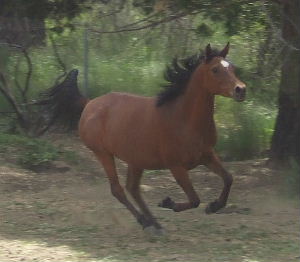
| The Arabian Horse is the oldest of the horse breeds. Its exquisit physical features, strength of mind and versatility has encouraged people, from any time, to use this breed to influence and create other breeds. Thus, the Arab is widely called the "fountainhead" of horse breeds. The Arab has even played a strong role in the creation of the Thoroughbred. Did you know that the skeletal frame of the Arabian horse is made up of fewer bones than the average horse? While most horses have 18 ribs, Arabs have 17, and the normal count of tail bones is 18. Arabs have 16. Arabians also have only 5 lumbar vertebrae, other horses have 6. The height of the Arab varies greatly, from around 14 HH to around 16.3 HH. However, the average height for an adult Arab is 14.3 HH. Just for reference, 1 HH ("hand") equals 4 inches. |
 |
 |
 |
| Educational: The Arabian Horse Association www.ArabianHorses.org A White Horse www.awhitehorse.com The Canadian Arabian Horse Registry www.cahr.ca Online Arab Breeder Directory ArabHorse.com www.arabhorse.com Interactive Horse Education www.allabouthorses.com |
|
|

The Arabian spirit has survived for thousands of years. Despite changes to their appearance (though not many), their spirit burns hot within, exactly how it did in the beginning, and will continue to thrive as they do. "When God wanted to create the horse, he said to the South Wind, 'I want to make a creature of you. Condense.' And the Wind condensed.The Archangel Gabriel immediately appeared and took a handful of the stuff and presented it to God, who make a brown bay, or burnt chestnut upon saying 'I call you Horse; I make you Arabian and I give you the chestnut colorof the ant; I have hung happiness from the forelock which hangs between your eyes; you shall be the Lord of the otheranimals. Men shall follow you wherever you go; you shall be as good pursuit as for flight; riches shall be on your back and fortune shall come from your mediation.' Then He put on the horse the mark of glory and happiness, a white mark in the middle of the forehead." |
| -- Emir Abd-el-Kader (1808-1883) on his theory of the creation of the Arabian Horse |
 |
 |
| All photos, writing and layout by Veronica Scavo May, 2006 Please do not use text or photos from this website without permission. Thank You. Contact |
 |