 Who was the
Buddha?
Who was the
Buddha?
In this article I hope to raise awareness of the Buddha, the teachings of the Buddha on suffering and to also question his teachings.
What is suffering?
I believe there are many ways in which you can suffer, both physically and mentally. Physical sufferings are caused by illness, injury and dying. Examples of physical sufferings could be having appendicitis, having cancer or being murdered. Mental sufferings are things such as bereavement, mental illnesses and persecution. Good examples of suffering would be the mental suffering suffered by the Jews in the war, when some had to pretend they were Christians and couldn’t practise Judaism; such things happen all to often and examples are easy to find. The concise Oxford dictionary defines suffering as " undergo, experience, be subjected to, pain, loss, grief, defeat, change, punishment, wrong."
Feelings evoked by suffering!
There are many feelings evoked by suffering. Bereavement is upsetting especially in incidents of murder. James Bulger’s parents as well as being bereaved as a result of the murder of their son, they also feel betrayed and annoyed by the justice system. There is a feeling that someone must be to blame and must suffer too. Victims of rape often become traumatised, scared and angry. Illnesses and injuries are mainly upsetting and distressing. Other types of suffering make people feel annoyed, threatened, miserable and depressed. In general, suffering evokes more than one negative feeling.
Suffering often splits or makes communities and/or families stronger. For example in WW2 when families were split up during evacuation, it made the whole community stronger because they all had to help each other.
Ultimate Questions
The difference between an ordinary question and an ultimate question is that ultimate questions have no obvious answers, whereas ordinary questions do. Ultimate questions often raise problems with religions. There are many ultimate questions raised about the question of suffering. One is, if there is a god, why do we suffer? All Christians believe that there is a God and a majority of them believe that we suffer because we reject his advice. Buddhists, however, do not believe that there is a god.
Another ultimate question raised by suffering is, is there any justice in the world? There are many debates over this question and I have mixed feelings.
Does god exist? Is the major question from suffering. Christians, Jews, Islams, Sikhs and Hindus would answer yes and Buddhists would answer no.
"How can we help?" is another question raised. I think Buddhists would reply that we should inform them of the Buddha’s teachings.
Several other questions raised over suffering are;
• Why do some, but not others suffer?
• Why are we born, if we are going to suffer?
• What the person suffering did to deserve suffering?
These questions are all open to debate and almost everybody will believe or answer these questions differently, as it is their right and they should not be judged by it.
Who was the
Buddha?
The Buddha was born over 2,500 years ago. His father was the king of Nepal and so he was known as Prince Siddhartha. When he was first born a wise man said that he would either become a king or holy man. His father did not want him to be a holy man and so he kept him locked in the palace. Prince Siddhartha married and had a son, but he still longed to know what was outside the palace. One day he asked his friend Chanda (the palace chariot driver) to take him out of the palace into the town. This very first time he went out of the palace he saw an old man; this was his first ever experience of old age. The following day he again went out with Chanda and this time he saw an ill man, this was his first experience of sickness and illheath. The next day Siddhartha again went into the town, this time he saw a funeral procession. This was his first experience of death. All these sights of suffering shocked Siddhartha. Then he saw a holy man who looked very peaceful. Siddhartha decided he wanted to be like the holy man (at peace with the world) and he also wanted to discover the answer to suffering. He lived for years in the desert starving himself by eating only one grain of rice a day. One day when he was sitting under a Bodhi tree meditating (thinking peacefully) he was enlightened. He gained the answer to suffering and this is what he said:
Why do we suffer? (The four noble truths)
The Buddha believed that suffering was almost inevitable – but to get rid of suffering you must follow the four noble truths.
Eightfold Path
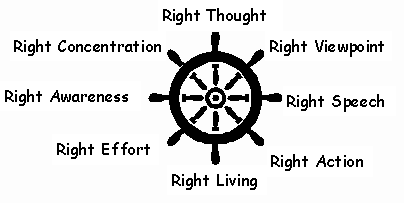 The
Buddha said to end all suffering you must also follow the eightfold path. These
eight commands are usually depicted around a wheel, the Buddhist symbol.
The
Buddha said to end all suffering you must also follow the eightfold path. These
eight commands are usually depicted around a wheel, the Buddhist symbol.
Notice how all the actions start with ‘right’. The Buddha did not just mean ‘correct’ he meant the ‘best possible.’
In order to show "right speech" a Buddhist would not be unkind, selfish, lie or gossip.
Buddhists would not kill, steal, not commit adultery, drink alcohol or take drugs to follow the "right action" command. To apply this to their life, Buddhists would not be allowed to work in a butchers or be in any of the armed forces.
The "Right living" action includes not working in a job that hurts or kills others, for example the army. This command also says you should work to the best of your ability.
"Right effort" means that you should avoid all evil things and work hard at everything in life. This means that a Buddhist would put 100% effort into everything they do.
Buddhists believe you should be aware of what is happening around you and in your mind. They call this "right awareness."
You should train your mind to ‘let go’ and concentrate without your mind wandering; Buddhists meditate to achieve this and call it "right concentration." Being a Buddhist would mean meditating regularly.
Studying Buddhism and accepting the four noble truths is a must for all Buddhists, this comes under "right viewpoint" in the eightfold path.
To follow the "right thought" Buddhist should try to be unselfish and care about other people.
Annica
Buddhists say that everything changes. This is referred to as annica, meaning ‘impermanence’. Buddhist believe that it is because we want things to remain the same that we suffer (this is also mentioned in the dictionary.)
My opinion on Buddhism
I think that the principles of Buddhism are excellent because I do believe that some suffering is caused by craving, for example drug addicts. A Buddhists would explain a drug addict by saying they suffer all the time (1st noble truth;) The cause of the suffering is the craving of the drug (2nd noble truth;) If they stop the craving then they stop suffering (3rd noble truth;) and finally to end their suffering they must follow the middle way otherwise known as going into rehabilitation (4th noble truth.)
However the idea that all suffering is caused by craving I think is ridiculous because some people are born with diseases and they have never had the chance to crave anything. Another good example is when people have suffered due to natural disasters such as the earthquake in India and the flood in Mozambique – those millions of people can’t all have craved something, can they? Famines in Africa are also the same, the people involved in famines crave foods now because they are starving, but before they couldn’t have all have craved something, again you tell this by the number of people involved. In famines the reason for suffering is a shortage of food, not because everyone craved something.
The statement that all life is suffering I disagree with because during your pre-toddler years you are hardly ever suffering. Also most people don’t suffer when they sleep. I do however agree that you do suffer for majority of your life.
I believe that the eightfold path is an excellent idea, because many incidents such as the Anna Clumbie case could have been avoided if everyone had followed it.
I don’t believe that the Buddha had enough knowledge about the world and people to make the assumption that all suffering is caused by craving, especially since he spent most of his life protected by his father.
Can good come from suffering?
Bad can come from suffering, but many people believe good can also come from suffering. I also believe good can come from suffering; a good example of this would be drug addicts talking and telling people what being a drug addict is like and discourages them from being an addict. Another example that I mentioned near the beginning is that suffering often unites communities, for example during the Blitz in WW2.
Laws are often changed because of disasters that bring about suffering.
So in conclusion I feel that the Buddhist way of thinking is good and I like the idea of meditating, to relax and calm people down. However I can still see many flaws in some of their main principles.