Introduction
Italy is country in Europe that borders with France, Switzerland, Austria and Slovenia. It extends in the north from the Alps to the Mediterranean Sea in the south. It has a population of about 57,461,000 and is a good example of a developed country.
In my project I will look at what gives Italy its identity and the different regions of Italy. I also hope to find out the differences between the north and south of Italy.
What gives Italy its identity?
Italy is famous for its food. It is famous for pasta, pizza, risotto, minestrone, salami, ice cream, olive oil, oranges, tomatoes, olives, grapes, lemons, cheese (including parmesan and gorgonzola), Wine (including lambrusco, marsala, valpolicella and chaniti), and coffee.
Italy is famous for its two volcanoes Etna and Vesuvuis and the Alps that lie between the Swiss and Italian border (the tallest mountain in Europe called Mont Blanc actually lies in the Alps). Italy is also famous for the shape the country it is like a boot kicking a ball (Sicily)
Italy is famous for Opera and many famous composers such as Antonio Vivaldi Gaetano Donizetti, Giacomo Puccini, Gioacchino Rossini, and Giuseppe Verdi.
Italy has been the birthplace for many sculptors and artists like Leonardo De Vinci.
Religion is a very important part of almost every Italian. Most Italians are strong Catholics. The Pope lives in the Vatican City a village (which is in fact its own country) inside of Rome, Italy.
Italy is well known for its Milan football team and motor racing is also popular in Italy.
Italian Regions
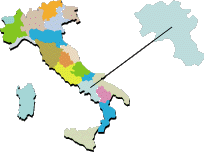
Italy can be divided into different region. The economic regions are: north and south. Italy can also be divided into political states:
|
Region |
Capital of Region |
|
Abruzzi |
L'Aquila |
|
Basilicata |
Potenza |
|
Calabria |
Catanzaro |
|
Campania |
Naples |
|
Emilia-Romagna |
Bologna |
|
Friuli-Venezia Giulia |
Trieste |
|
Lazio |
Rome |
|
Liguria |
Genoa |
|
Lombardy |
Milan |
|
Marche |
Ancona |
|
Molise |
Campobasso |
|
Piedmont |
Turin |
|
Puglia |
Bari |
|
Sardinia |
Cagliargi |
|
Sicily |
Palermo |
|
Trentino-Alto Adige |
Trento and Bolzano |
|
Tuscany |
Florence |
|
Umbria |
Perugia |
|
Valle d'Aosta |
Aosta |
|
Veneto |
Venice |
Italy can also be divided into 9 tourist regions. These are: Tuscany and Rome, The Adriatic coast, the south, the mountain and lakes, Neapolitan Riviera, Sicily, Sardinia, North Italy and Venice, and the Italian Riviera.
Italy can also be divided into three physical regions: the Alps, the Apennines and the north Italian plain.
The tourist regions
The mountain and lakes of Italy are snow covered for most of the year and are very popular with skiers.
The north of Italy and Venice is mainly lowland it consists of long sandy beaches.
The Italian Riviera is well known for its good food. It has a lively nightlife and is popular with anybody who likes water sports. It has sandy bays and large headlands of cliff.
Tuscany and Rome is famous for its art and architecture. It has many museums and vineyards.
The Neapolitan Riviera has clear blue skies and many warm and clear seas. It is a relaxing place to visit.
The South’s mountains are quiet and unspoilt inland. The coast is also quiet. It has white sandy beaches that are very relaxing.
Sicily is the largest island in the Mediterranean Sea and is famous for its Volcano Mount Etna. Sicily has many ruins of Roman Architecture.
Sardinia has white sandy beaches and clear turquoise waters and a wild rugged interior.
The Adriatic coast has long golden sandy beaches and tourist towns such as Rimini.
The Naples area
Naples is the third biggest city in Italy and lies on the West Coast of southern Italy. Naples is a manufacturing centre and is an important seaport. Many tourists visit to see the towns Pompeii and Herculaneum destroyed by the Volcano Mount Vesuvius in AD79, Vesuvius being the only active volcano in Europe.
Naples was built because it is by the sea so it was in a good position for trading. It was also built because of the very fertile land by the volcano. Naples was the birthplace of pizza, (which a baker at royal court invented in the 1700’s) and is famous for it’s food. Music and Opera plays a great part of Italians in the Naples area.
The north part of the Naples area is well developed. However to the south of the Naples region (Sorrento) is very unfertile because of the thin soil on the limestone hills. All the vegetation is scrub and holiday resorts cling to cliffs linked by twisting narrow roads.
Differences between the North and South of Italy
The physical differences between the north and south are that the north has good fertile land because of the deltas that formed from the silt from the Alps that has been deposited a the ends of rivers. These rivers often flood if the snow in the Alps melt. The main river is the river Po and this has a delta that is pushing out. Little natural vegetation actually survives on the flat land in the North.
In the south earthquakes or volcanic eruptions often occur. Rocks were formed on the seabed and later formed the Apennines. The Apennines were once covered with woodland vegetation. But this vegetation was cleared, and this exposed the soil to winter rains that washed away much of the fertile land. Now most of the Apennines is covered in scrub vegetation and the land is not fertile.
 The
climate is very similar between the north and south, but the south is slightly
hotter. The rainfall is lower in the south and is mostly in the winter. In the
North rain is evenly spread throughout the year.
The
climate is very similar between the north and south, but the south is slightly
hotter. The rainfall is lower in the south and is mostly in the winter. In the
North rain is evenly spread throughout the year.
The North is more developed than the South. This gap has widened since the last war.
Life in North Italy

 The
North is the richest area in Italy. Most people live in towns and cities in the
north of Italy. Land is not wasted everywhere has something on it. Farmers make
great profits from selling their products. The industries in the north have
attracted many people from the south since the 1950’s. The west and centre of
the North region of Italy is the most industrial. Fiat has a large assembly
(factories etc.) in Turin that is owned by the owner of the Turin local paper
and the Juventus. Milan is the largest city in Italy and is the centre for
fashion and banking. Most of the exports of this region leave through the port
of Genoa and the Alps. The jobs in this area are highly paid and require skills,
but there is now less farming land and roads and houses are being built close
together. Industrial work is causing increasing pollution and environmental
problems such as acid rain.
The
North is the richest area in Italy. Most people live in towns and cities in the
north of Italy. Land is not wasted everywhere has something on it. Farmers make
great profits from selling their products. The industries in the north have
attracted many people from the south since the 1950’s. The west and centre of
the North region of Italy is the most industrial. Fiat has a large assembly
(factories etc.) in Turin that is owned by the owner of the Turin local paper
and the Juventus. Milan is the largest city in Italy and is the centre for
fashion and banking. Most of the exports of this region leave through the port
of Genoa and the Alps. The jobs in this area are highly paid and require skills,
but there is now less farming land and roads and houses are being built close
together. Industrial work is causing increasing pollution and environmental
problems such as acid rain.
Life in South Italy
 The
South is the poorest area in Italy. Most people live in villages on mountain
tops in the south of Italy. These villages do not create industry and so not
many people are attracted there. Many people are migrating to find jobs and
better paid jobs. A quarter of all people’s work in the south is farming and
these farms are very small in size. The farmer’s fields are often far away
from the village they live in. A farmer farms for just enough food for himself
and his family and there is often not much left to sell. The south is isolated
from the rest of Europe and so has never had much part in trade. The area has a
high birth rate, making more competition for jobs. Attempts have been made to
improve the area but many have been unsuccessful, successful ones include steel
making, chemicals and car making. But even these industries do not employ many
people. The south is slowly becoming better off. Marshy areas have been drained
and trees planted. New dams and motorways have been built. The hot dry summers
now attract more tourists to the sandy beaches. Now some earlier migrants have
now returned with wealth.
The
South is the poorest area in Italy. Most people live in villages on mountain
tops in the south of Italy. These villages do not create industry and so not
many people are attracted there. Many people are migrating to find jobs and
better paid jobs. A quarter of all people’s work in the south is farming and
these farms are very small in size. The farmer’s fields are often far away
from the village they live in. A farmer farms for just enough food for himself
and his family and there is often not much left to sell. The south is isolated
from the rest of Europe and so has never had much part in trade. The area has a
high birth rate, making more competition for jobs. Attempts have been made to
improve the area but many have been unsuccessful, successful ones include steel
making, chemicals and car making. But even these industries do not employ many
people. The south is slowly becoming better off. Marshy areas have been drained
and trees planted. New dams and motorways have been built. The hot dry summers
now attract more tourists to the sandy beaches. Now some earlier migrants have
now returned with wealth.
Information sources
Interactions pages 56 - 66
CD ROM’s -: Hutchinsons Encyclopaedia
World map encyclopaedia
Travel Brochure -: Citalia’s Italy
Passport to Italy (by Cinzia Mariella)
Internet -:
http://www.embitaly.org.uk/
Conclusion
In this project I have achieved increasing use of the Internet and personal computer and my ability to bring information from different sources together.
I have learnt that the North is more economically developed than the south and that there are different way you can divide countries e.g. Physical and Political.
I could have improved by using more information sources.