Australia
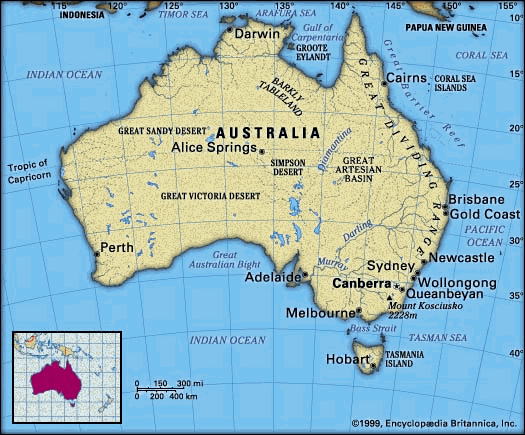
This year the Olympics are being held at Sydney in Australia. The map below shows where Sydney is in Australia
Tourism is Australia largest source of income from abroad. accounting for 10% of the total. Faster, cheaper air travel and highly successful government marketing campaigns draw tourists in increasing numbers, especially from Asia.
The country's attractions include wildlife, swimming and surfing off Pacific and Indian Ocean beaches, skin-diving along the Great Barrier Reef and skiing in the Australian Alps. Aboriginal culture and the town of Alice Springs are among the outback's attractions. The far north has tropical resorts; the northwest, pearl-fishing. The vineyards of the south and southeast attract many visitors, as do the cultural life of Melbourne and Sydney and the arts festivals held in the state capitals. Sydney hosting the Olympics will give the city a massive economic boost.
A Brief History of the Olympic Games
It is not certain when the Olympic games started, but the first ever Olympic champion recorded was Coroebus of Elis, a cook who won the sprint race in 776BC. Although the games are thought to be at least 500 years older that that, according to one legend they were founded by Hercules. Women were not allowed to enter as competitors or, except for the priestess of Demeter, as spectators. All competitors competed in the nude. The games where held every four years until in AD393 when they were abolished by the Roman Emperor Theodosuis I, probably because of their pagan associations.
In 1887 the 24 year old Pierre baron de Coubertin, conceived the idea of reviving the Olympic games and spent seven years preparing public opinion in France, England, and the United States to support his plan. On November 25, 1892, at a meeting of the Union des Sports Athlétiques in Paris, he said:
"Let us export our oarsmen, our runners, our fencers into other lands. That is the true Free Trade of the future; and the day it is introduced into Europe the cause of Peace will have received a new and strong ally. It inspires me to touch upon another step I now propose and in it I shall ask that the help you have given me hitherto you will extend again, so that together we may attempt to realise, upon a basis suitable to the conditions of our modern life, the splendid and beneficent task of reviving the Olympic Games."
At an international congress in 1894, his plan was accepted and the International Olympic Committee was founded. The first modern Olympic Games were held in Athens in April 1896, with 13 nations sending nearly 300 representatives to take part in 42 events and 10 different sports.
Women did not compete in the first Olympics as it had been regarded as "no place for women." But nineteen females competed in the 1900 Olympics in Paris, in table tennis and golf. A century later for the first time, sports are now required to include women's events to enter into the Olympic Games. Women will now be competing in all Olympic-sporting events besides boxing, wrestling and baseball, and will compete exclusively in softball, synchronised swimming and rhythmic gymnastics. Out of 300 events on the program, 168 are for men, 120 for women and there are 12 mixed events. Women make up a record 42 per cent of all participants.
Before the 1970s the Games were officially limited to amateurs, but since that time many events have been opened to professional athletes. The Olympic Games have come to be regarded as the world's foremost sports competition.
The Olympic Games take place every four years. No Games took in 1916, 1940, and 1944 because of war.
Benefits of the Olympics
The Benefits of the Olympic games to the athletes are that they get to compete at the highest standards in the world. The Athletes also get to use the best amenities in the world and visit new countries. Sponsors are received from big companies such as Nike, Adidas ect. For example an athlete from Equatorial Guinea called Eric (now known as Eric the Eel) swam the slowest time ever but every one loved him. And he has now been kited out in the top of the range Speedo swimming suit, rather than his trunks.
The benefits to the people of Sydney are that after the Olympics have finished the amenities will still be left (e.g. stadium) and other better services that were not previously available will be available (eg restaurants, roads and public transport).
There will also be the chance for businesses to make big money, e.g. hotels can charge extortion prices and people will pay them. Also restaurants will make great trade, from tourist. This is even better for Sydney, considering this is there of peak season.
The knock on effects will be that the whole of Australia will benefit from the Olympics because people will hear about Australia on TV and go on holiday there next year or maybe the year after that. Also people might visit other countries that have entered the Olympics, because they showed a clips of those countries on TV. Bringing tourism to the countries would bring employment and money to the country.
Problems of the Olympics
Problems that athletes face are testing positive for drugs that they didn’t take. Other problems related to drugs are that athletes test positive for drugs can pay a fine and then carry on competing (like the Chinese weight lifter) and go on to win having cheated, this is unfair to the other athletes that haven’t cheated.
Another problem of the Olympics is that it is expensive to hold. Problems of litter, pollution and noise are a great concern. Drugs, rowdiness, injuries of athletes and traffic accidents increases, pressurises the police and other emergency services.
The local people suffer because of congestion, lots of restaurants will be booked up and every where is generally busier.
Aborigines have a stage to protest about the way they have been treated by the whites, although this is a problem for the Olympic hosts it is a benefit for the aborigines.
Conclusion
The most important benefit of the Olympics is the tourism side of it; as businesses in Sydney make a lot of money and then the country becomes rich. The worst problem of the Olympics is the litter, rowdiness, crowded streets and the pollution. I don’t think the Olympic games are any longer viable as fair competition because you can pay a fine for using drugs and then still go on to win. I also do not think that the phrase "and the day it is introduced into Europe the cause of Peace will have received a new and strong ally" is any longer true because it was not run during the war and nowadays it is a competition for rich countries only. But it should still continue, but with equal rights for each country no matter how rich or poor e.g. all the countries should be fitted out with the same costumes/uniforms (except with different names of the countries on them.) Countries should be forced to compete as there is a lot of hidden talents in these LEDC’s that can not afford to send their competitors.
Information Sources
1995 Dorling Kindersley Multimedia
Official Site of the Sydney 2000 Olympic Games http://www.olympics.com/eng/
Britannica.com http://www.britannica.com/