 |
|
|
|
|
|
|
|
|
|
|
|
|
|
|
|
|
|
Journal Project
~Manfred von Richthofen~ |
|
|
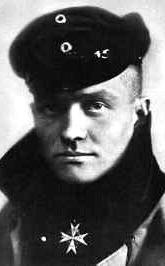
~ Manfred von Richthofen was a German fighter pilot
who was known to the English as "The Red Baron." He
joined the army in 1911 and was a lieutenant in the German
cavalry when the war started out in 1914. Richthofen
transferred to the air service in 1915 and joined Jagdstaffel 2,
a new squad of fighter pilots, in 1916. In two months he had
already achieved a dozen victories in the air, including a win
over Britain's leading ace, Major Lanoe Hawker. At the
beginning of 1917 Richthofen was made commander of
Jagdstaffel 11, later known as the "Flying Circus" for their
brightly colored aircraft. Manfred was known for his red
plane, and was given the nickname in Germany called "Der
Rote Kampfflieger" ("the red fighter pilot") and became a
national hero for his tricks in the skies.
http://www.answers.com/topic/manfred-von-richthofen |
|
|
 |
|
|
|
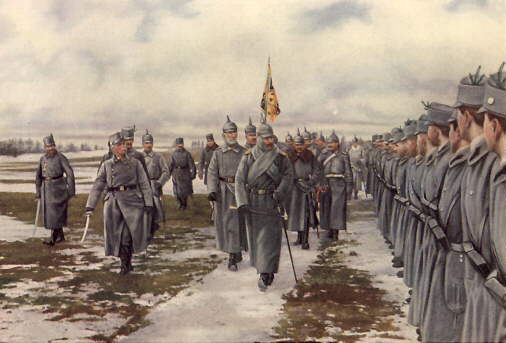
~ The eighteenth of August, Ninteen-Fourteen: Today is the day that I am joining the army. I have been positioned in the German calvalry as a lieutenant. Two days after the Great War started, August 17th, 1914, General Alexander Samsonov's Second Army attacked around the right flank of the German Eighth Army commanded by General Friedrich von Prittwitz. Along with the staff at East Prussian Army Headquarters, they planned a counteroffensive against the Russians. This was named the "The Battle of Tannenberg" ended by August 30 when Samsonov's entire command disintegrated at a cost of 92,000 captured and tens of thousands of other casualties. Within a week, German forces under General August Mackensen defeated Rennenkampf at the Battle of Masurian Lakes, where the Russians lost another 100,000 casualties.
http://www.infoplease.com/ipa/A0001284.html |
|
|
|
|
 |
|
|
|
|
|
|
~ The Twelfth of September, Ninteen-Fourteen: There was a recent battle, a battle that included more weapons and machinery than I have ever seen or even imagined possible. We, the Germans, took over command of the entire Eastern Front. We used many of our units to support the more weakened Austrian troops. In September, General Max von Gallwitz' new Twelfth Army attacked into the Courland toward Riga. As the entire Russian front line fell apart, the Russian strongholds of Novo-Georgiesk and Brest-Litovsk both fell to us. Only at the end of September did the Russians resolve to allow a new line to form. This became known as the Battle of the Marne.
http://members.fortunecity.se/mikaelxii/ww1/eastern/Eastern.html
http://www.answers.com/topic/manfred-von-richthofen |
|
|
|
~ The Ninteenth of January, Ninteen-Fifteen: I have been transferred to the air service. It is much more exciting to take part in flying the aeroplanes than in the calvalry; however the calvary was a lot safer. I have witnessed a new weapon tactic that we, the Germans have created to defeat the enemy-poison gas. It has destroyed hundreds so far. The Lusitania has been sunk by a German submarine that killed 1,198, including 128 Americans. I believe the United States will now take part in the Great War.
http://members.fortunecity.se/mikaelxii/ww1/eastern/Eastern.html
http://www.infoplease.com/ipa/A0001284.html |
|
|
~ The Twenty-First of March, Ninteen-Sixteen: I have achieved numerous victories over Russian and British figher pilots. I have taken part in several battles such as the Battle of Verdun. The attack started on 21 February on the right bank of the Meuse with the heaviest bombing that had ever taken place in a war. It lasted over 9 hours and was the most horrible that man had ever seen.
The German army command decided to attack both banks of the Meuse at the same time. The most important aim of attack on the left bank was the Bois Bourrus. The French artillery was concentrated here. Before this Bois could be attacked a hill called Le Mort-Homme, also known as "Dead Man Hill", had to be taken. The attack started on 6 March 1916.
Two days later, 8 March 1916, the battle started on the right bank. The aim of attack was the fortress of Vaux that had by now been fortified and could be counted among the strongest forts of war. The German attack was immediately put to a stop by the heavy French gunfire. The intense fights over the fort lasted until 19 March but nothing was achieved. The German troops were exhausted and the battle was therefore deferred.
http://www.war1418.com/battleverdun/kortverdun/index.htm |
|
|
|
~ The Seventh of September, Ninteen-Sixteen: The battle of the Somme started on 1 July 1916 and as a result of this the activities at the Verdun front were temporarly halted. Our troops were instructed to be economical with munitions. More and more troops and artillery were transferred to the Somme and the eastern front where a large Russian offensive had started. The battle at Verdun continued unrelentingly although on a smaller scale. General Mangin started a large offensive at Fleury on 15 July, but this attack was stopped causing numerous French losses.
We were commanded to attack once more, and to consolidate the front between Fleury and the Thiaumont fortification. The attack begun on the first of August and lasted on and off until the sixth of September.
The fields and trenches were covered with casualties; there was no longer one front-line. The troops on both sides somehow survived under ghastly circumstances. There was an enormous shortage of drinking water, munitions and food. The losses on both sides were enormous. As of the sixth of September, rest had temporarily set in at the battlefield of Verdun.
http://www.war1418.com/battleverdun/kortverdun/index.htm |
|