Napoleon Bonaparte
Time Line
Napoleon Bonaparte is born in Corsica (1769-1821)
birth
and childhood- Hated France because he was born when
physical
stature (Napoleonic complex)- Napoleon was quite small in before his
prime (5’11’’). He had a rigid pose and would usually walk with one arm tucked
in his coat.
marriage
and political significance- He wrote a brief history of
Early military successes (1796)-
Napoleon's army defeats the Austrians in
Treaty of Campo Formio- On
1798-1799 French extend their control- Napoleon made many
advances with the French. He expanded their borders and invaded
Napoleon Fights his Egyptian campaign (1798-1799)
Napoleon's invasion of
Rosetta Stone Discovery- Soldiers of Napoleon's army
discovered the Rosetta Stone in
Lord Horatio Nelson's role (1758-1805)- Nelson was against
Napoleon Bonaparte and fought against him in the
War of the Second Coalition is fought (1798-1801)
Describe the war and its participants- The war came with
people from many countries. The odds were a lot to France and the Swiss. The
Swiss became under French rule so they were on his side, The Spanish allied
with
Napoleon's defeat of the Second Coalition- Napoleon came out victorious at the Second Coalition as he usually does. The war ended with two treaties that helped to bring about some peace.
Treaty of Luneville- In February of 1801, the Treaty of
Luneville was written and made to make peace and put an end to the battling
with the Austrians. On
Treaty of
Napoleon Bonaparte seizes power and becomes first consul (1799)-
How does he come to power?- A new type of government was formed and it was called the Consulate, Napoleon, of course, wanted more glory and he wanted to guarantee himself as first consul. He himself as well as some help worked to overrule the Consulate to insure power. Later the constitution was changed somewhat and Napoleon went from consul for life to emperor.
The Constitution of 1799- Napoleon and his helper, Sieyes, created a constitution that would allow them to manipulate it in such a way that they could gain more power. The constitution made it so that the nation would have an unselected Senate and legislatures who in turn would choose a few consuls.
Consulate- The consulate was the new way of government that was formed. It was not a well structured government and allowed leeway so that Napoleon could gain more power, the Consulate basically did not allow the people to choose their leaders but rather Sieyes stated “authority must come from above and confidence from below.”
The Concordat of 1801 establishes a reconciliation between France and the Papacy (1801)
What did it do?- The Concordat of 1801 was made the Pope at
the time and the Papacy, Pope Pius VII, and Napoleon Bonaparte with
Pope Pius VII (1800-1823)- Pope Pius the VII was part of the
papacy when the Concordat was brought up. It took three phases for Napoleon and
the Pope to come to an agreement on reestablishing the Roman Catholic Church as
the basis of religion in
Civil Constitution of Clergy- Because of the financial crisis that was going on, the national assembly seized some church lands and made the State in charge of church affairs. Many Clergymen were against this new form of government but were forced to sign it or be put under arrest.
Napoleon becomes first consul for life (1802)
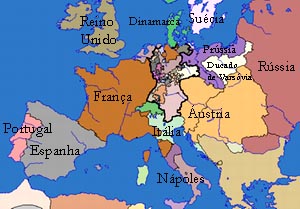
The Napoleonic Empire / Map (1804)
hereditary emperor-
Eugene de Beauharnais (1781-1824)-
Napoleon's divorce 1809)- Due to political opportunities and
social awareness in the fact that he needed a son to follow in his footsteps,
Napoleon divorced. Napoleon’s divorce of Josephine led to marriage between
himself and Mari Louise of
Archduchess Marie Louise (1791-1847)- Hoping for a son, and
as well as political and romantic reasons, Napoleon married another wife, the
Archduchess Marie Louise who was from
Napoleonic Administration- Napoleon created an Administration in benefit of the country and the administration was under the national government’s ruling power and authority. This Napoleonic Administration made equality be a major factor to the French government. One of these new laws was to tax citizens based on equality with no exceptions pertaining to wealth or social/economic status.
Financial Reforms- The financial arrangement shifted under Napoleon’s leadership and was improved through a series of reforms. He collected the taxes of the people and formed an unbendable economy, one way this was possible was through the Bank of France which was made available in 1800.
Centralized Government- Napoleon centralized the government
of
Napoleonic Code 1807 (into effect 1804)- The Napoleonic Code was one of the greatest things produced during Napoleon’s time. This code required to make French law completely uniform. It was based on two ideas: that all men are equal under the law, women were considered exceptions, and all people have a right to property. In the earlier code it eliminated all privileges from the laws, including tax laws. The following code expounded on various laws to ensure the posterity of private property.
Educational Reform/
War of the Third Coalition (1805-1807)- The Third War
Coalition was the emperor of
British Naval Victory at Trafalgar- The British Naval Victory at Trafalgar was one of the most decisive naval battles in history. This victory all began when Napoleon considered battling the British.
French Victories on Land- Napoleon was also victorious outside of naval battles. He also made victories and conquered many contributing to the French victories on land against Turkish and British troops.
Napoleon creates the Confederation of the Rhine and abolishes the Holy Roman Empire (1806)
Describe what it did.- The Confederation of the
Treaties of Tilsit- This treaty established
Tsar Alexander I (1801-1825)- Alexander I was the emperor of
King Frederick William III (1797-1840)- William the III was
also involved in the Third Coalition and he was actually against napoleon.
Although he was against him, he thought of him as “the only man in
Napoleon's brothers Kings – Jerome was declared King of
Joseph (1768-1844)- Joseph was in the Directery and the Council of Five Hundred, he was later declared King of Spain because he protested over being left out of the line of succession.
Louis (1778-1846)- Louis was King of Holland and was Napoleon Bonaparte’s second youngest brother and also wanted to be in on the goodness of being in the line of succession.
Jerome(1784-1860)- Jerome is Napoleon’s youngest brother and the last on in the line, he was the King of Westphalia.
Napoleon establishes the continental system (1806)
Describe what it did.- The Continental System was Napoleon's
attempt to stop
Berlin Decree of 1806- The Berlin Decree of 1806 was concerning the British blockade of merely commercial ports was opposing to global law, Napoleon retaliated by setting up the British Isles under blockade and forbidding any trade to or from them
Milan Decree 1807- The Milan Decree allowed the French warships to capture neutral vessels that would be sailing from any British port or from countries engaged by British armies.
The Peninsular War- Arthur Wellesley was one of the best soldier of his time, other than Napoleon. He was smart as far as militarian trade and he knew the art of war and the techniques of strategies.
Conflict on Other Fronts(1808-1810)
Austria- Austria was just one of the many nations that
Napoleon chose to battle against during the Napoleonic Wars. As a result of
these wars
Battle of Wagram (July 1809)- Napoleon learned from his last
battle and made it up to his nation at the battle of
Treaty of Schonbrunn (Oct. 1809)- The Treaty of Schonbrunn was a treaty of peace that was made between France and Austria, which forced Austria to give up a lot of land and it also made them unite under the Continental System.
Plans to restore the French Empire in
Describe the happenings of the War –
Napoleon fights his unsuccessful Russian campaign (1812)
Invasion of Russia- Napoleon gathered an army together and
entered
Prince Mikhail Barclay de Tollay (1761-1818)- Prince Mikhail Barclay de Tollay was a prime minister. This man was very powerful yet he was against Napoleon through all his dealings.
Marshal Mikhail Kutuzov- Kutuzov was a follower of Prince Mikhail Barvlay de Tollay and he later got to take his place after Tollay died. He also became powerful and was also against Napoleon.
Battle of Borodino- In this battle Bonaparte lost about 30,000 men because he was to ignorant to listen to the signs of war. He went into this battle with less weapons and provisions than the Russians which led to the loss of many men.
Grand Army entered
French Retreat (Oct 19, 1812)- Napoleon realized that they were at a disadvantage in this war. He finally decided that they should retreat because they would not be able to make it through the war.
Russia, Prussia, and Austria defeat Napoleon in the Battle of Nations (1813)
Napoleon abdicates and goes into exile on the island of Elba (1814)
Describe Napoleon's exile.- Due to his downfall and
destruction Alexander the I and others decided to exile Napoleon so he could
stir up no more trouble. They sent him to
Louis XVIII (1814-1824)- Louis XVIII was the next leader to
take the empire of
Napoleon
returns to power, beginning the Hundred Days (1815)
Describe the 100 Days- The Hundred days is also known as the Waterloo Campaign which started on Maarch 1st which was the day Napoleon arrived in Paris and June 28 which is when Louis XVIII returned as King.
Napoleon is defeated at Waterloo (1815)
Describe the Battle of Waterloo.- The battle of
Duke of Wellington- The Duke of Wellington was against Napoleon Bonaparte and he helped to bring Napoleon’s final glorified days to an end.
Gebhard Von Blucher (1742-1819)- Gebhard Von Blucher aided the Duke of Wellington to the destruction and capture of Napoleon Bonaparte and saw to it that Napoleon no longer fought them again.
Napoleon dies on Saint Helena (1821)