

THE INSPECTOR CALLS
T.Elia, Senior Inspector Batinah South Region
“There are two ways to slide easily through life. One is believing everything and the other is rejecting everything. Both save us from thinking.”
It is axiomatic that all pathologically normal children are pre-wired with a mechanism capable of acquiring the mother tongue and learning one or more other languages with the right amount of exposure to them at the right age. We see polyglots providing the point but that is outside the classroom and true mostly of oracy. But the TESL/TEFL situation with all its systematicity seems destined to fail in the classroom on both counts – exposure and age.
Now the problem:
Children are endowed with a mechanism, which seems to work remarkably effectively as well as automatically with the mother tongue but stubbornly refuses to with regard to other tongues unless certain conditions of exposure and age are met. The experts have therefore locked themselves in the problem of creating materials, methodologies and teachers as innovative means to replicate or better to re-trigger this obtuse mule of a mechanism. We have seen the best of minds in the field engaged in – for over several decades – spinning their own TESL/TEFL philosophies – each trusting his/her own spin. However, all these innovations are but variations on an attempt to make that mechanism work, without meeting the conditions. And no wonder the inadequacies we lamented over in Final year TESL learners half a century age are not any different from those we lament over now early 21 century. To realize the enormity of the issue we are dealing with, let’s look at three schemata as viewed by three experts, who among others have influenced the TESL/TEFL thinking – over ¾ of a century – on both sides of the Atlantic as well as the Indian Sub-continent.
Diagram 1
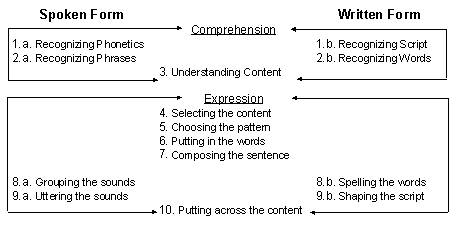
W F Mackay: Language Teaching Analysis
Diagram 2
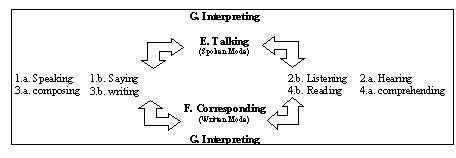
H G Widowson
1.a, 2.a, 3a and 4a are physical means (channel)
1.b, 2.b, 3b and 4b are acts of communication
E and F are social/interlocuting activities (Communicative Approach)
G the highest psychological activity
Diagram 3
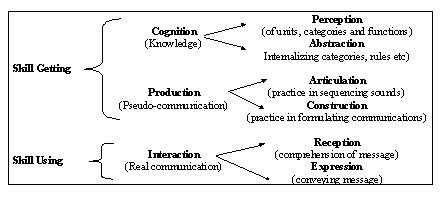
Wilga M Rivers: Second Language Teaching
As I perceive their individual thrust, Mackay looked at language skills as psychological assembling network, while Widdowson looked at them as sociological communicative network and Rivers as interactional tool-using network. Between them the three views reflect the complexity of the system we glibly call language skills – in the second/foreign language learning context.
As against these three theoretical constructs of experts in the field, let us now look at the following showing the practical implications from the view point of the learner and the teacher. This I must add is a feeble attempt at representing an extremely complex set of aspects in a graphic organizer. What is described in there is anything but exhaustive – either in scope or in variety of ELT activities.
Diagram 4
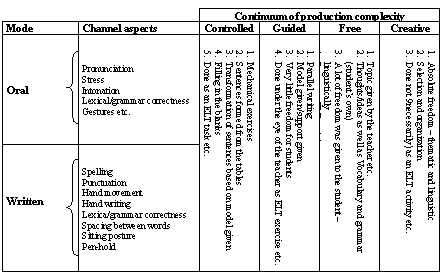
Through all this the teacher is seen as controller, assessor, organizer, prompter, participant and resource/guide.
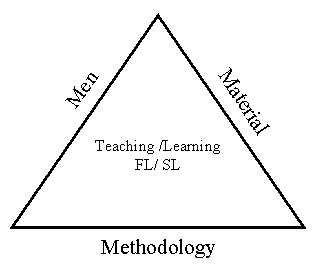
Experts in the ELT field have always thought a breakthrough into this complex situation could/should be had by modifying the following three dimensions ignoring the Fourth Dimension – the extent of exposure.
Diagram 5
Consequently most of the research over several decades has been on one or more of these. The following table should describe the scenario.
Diagram 6
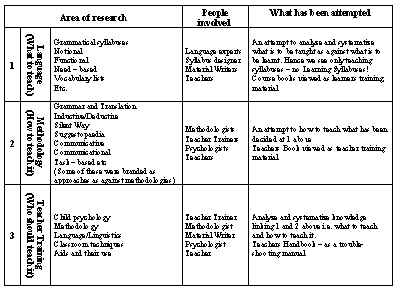
So, the syllabus designer shapes the syllabus, the material writer shapes the tasks, the teacher shapes the techniques – all geared to shape the learner’s strategies of learning. But none of them seem to hold the key to our problem.
Much to the chagrin of experts, neither the learner is able to learn the language nor the teacher is able to account for this phenomenon. Put differently out attempts at achieving something that would alter the character of TESL/TEFL situation in 45 minute – lesson – a - day don’t seem to work. This 45 – minute – a – day idea has not worked in India where we have had several decades – if not a century – of second language learning situation , or in Oman, where we have had about 30 years of foreign language situation. I mention these two countries because of my ELT connection with them.
The employment of different materials (designed and developed to suit the needs of the Sultanate), different methodologies, different (nationalities of) teachers tried over 30 years in Oman doesn’t seem to pay any substancial dividends.
Interestingly, as recently as Jan’02 the performance of III Sec learners echoed the observations made on the performance at the same level in 1983. Teachers say we hardly find more than 6 out of 30 in a class who can produce acceptable texts of 8 to 10 sentences – spoken or written with or witout prompts. And we have heard it said over and over again.
The questions we therefore need to ask ourselves are –
A. Are we interested in defending/promoting a methodological position? OR
B. Are we interested in our students learning the target language?
What we have got here is Hobson’s choice!
If our answer to question ‘B’ is yes, we need to look at two alternatives and perhaps choose the second willy-nilly.
- Improve the quality ( the nature) of exposure in the classroom with a 40 minute lesson a day i.e. teaching English as a subject OR
- Increase the quantity ( the extent) of exposure with 2-3 hours a day i.e. teaching two more subjects in English a day, besides English as a subject.
For decades we have attempted to improve our lot focusing on 1 above and I strongly feel it is time someone started experimenting with 2 right from Elementary Levels. If there have been any experimentations with 2 above I am not aware. I suggest Science and Math for technological reasons- the two subjects could very well be History and Geography taught in English.
And that is where the fourth dimension comes in – the time dimension. If the principle of synergy has worked elsewhere it should work here as well.
The following diagram descries the language-learning continuum I have in mind Point ‘C’ marked is the position I recommend – though ‘D’ would be the best – for Oman because it has got the will and the resources. Incidentally at ‘C’ one will be bringing in variety i.e. non-ELT focused variety – variety of subject matter, variety of authentic texts, variety of task types, variety of teachers which we have always tried – not successfully – to bring into a 45 minute lesson.
Diagram 7
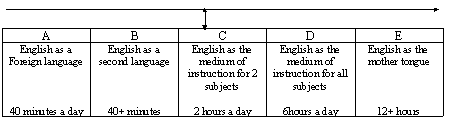
On this continuum of learning English, Oman, I am afraid, has failed operating at ‘A’, India has failed operating at ‘B’ but on the other hand has been very successful operating at ‘D’. When I say India being successful at ‘D’ I’ not talking about the learner’s degree of elegance in articulation but the level of sophistication in handing spoken or written language. At ‘D’ in India both the learner and the teacher are driven by the need to cope with the content of the subject matter and not by focusing on English which happens to be carrying the subject mater. If at al any focusing on English has to be done it is done incidentally and marginally.
If language is best learnt when the focus is not on language, I am asking Oman to put focus on science and Math taught through English.
Pleasure, it is said, is the byproduct of what we enjoy doing.
SO IS LANGUAGE!