
THE INSPECTOR CALLS
T.Elia, Senior Inspector Batinah South Region
During my visits to schools certain issues of common importance cropped up and I thought fit to discuss them in RR for the benefit of all concerned.
Table Filling /Written production tasks.
Kindly look at my article, in issue 19/ May 93 ( The mechanics of
Production Tasks) on the production model. Let’s take another look at the
issue:
- text is read/ heard
- table is completed
- new text is produced orally
- new text is produced in writing
These four steps complete a skill cycle, as we all know. But the point at issue is: we need to see that every learner goes through these four steps not only independently but roughly simultaneously, of course except step 3. By the very nature of the activity, oral production is limited to about 6 students in a class of 20, but the remaining three steps are meant to be done by every student in the class. Whatever is needed for steps 3 and 4 made available at step 2. By this I mea the table/ the diagram completed at step 2 supplies the learners with both the conceptual and linguistic help they may need at step 3 and 4.
The evidence of having understood the text is seen in what the pupils write completing the table. The evidence of having meaningfully completed the table can be seen when they speak and write based on the information o the table. This, it appears to me, the central truth we need to bear in mind.
But a good number of teachers have either failed to see the truth behind te strategy, or do not appreciate the importance of it. They put the table on the bb, complete the table themselves getting students t copy it down in their AB. And they do the same thing at written production – teacher writes the paragraph and students copy it down. What’s happening here? Whatever is happening, the purpose of the tasks is defeated. We can not expect the learners to use the information in a table that they haven’t completed.
I would therefore like the teachers to consider:
Not
putting the table on bb but mentioning the Para/ line number of the text
where the information is available. The table in the AB should be filled in
by the students looking at the text in the AB and not from the table
completed by the teacher. By so doing you make your students less dependent
on you.
By extension of this principle you shouldn’t write the paragraph on the bb
for them to copy down. But put on bb instead a skeletal outline and not
running sentences. The out line can highlight any major linguistic problems
they are likely to meet and which are not readily available in the table
they have already completed in their AB.
I can see the question marks on your faces. I agree with you. Not many will be able to do anything at al. But at least this will enable them to see the futility of copying down and the need to train themselves to be self dependent. Working on their own on an imperfect but genuinely productive task is better by far. It doesn’t matter if they make mistakes.
Fidelity to production model:
This brings us to the question of the need for uniformity. Yes,
one of the purposes of the production model is to ensure uniformity. How
ever I would like you to consider uniformity in terms of content as against
structural identity of sentences right through the model. Let me illustrate
my point by quoting an example from a lesson I have seen recently – Task 11
of Act 3 Unit8 of 3 Sec. The production model suggests for the opening
sentence – “ There are two solutions to the problems of acid rain.” W don’t
want all the 30 students in the class ( let alone all 3S students in the
Sultanate) to have that as their first sentence. We need to explore/ elicit
and accept appropriate alternatives fro the students. I strongly feel that
we need to take the students – at least the brighter ones - beyond the
structural pattern the model offers where possible/ appropriate. If we can
elicit here alternatives like –
There aren’t/ many solutions to the problem….but….
We haven’t got many solutions to the problem….but….
Solutions are rather difficult to find for ….we should be happy.
If 6 students out of 20 in the class can be made to see the freedom these alternatives offer, it is worth while attempting it. I reckon this flexibility in the production model can safely be tried starting from 1 Sec. if not earlier in view of what is said above. And we need to look at the model given in the TB as a production mode and not as the production model, which is what all concerned agree on.
Vocabulary Classification Tasks:
We are all aware of the usefulness to students of the tasks
deciding on the class category of new vocabulary items. We get our students
to read a text and identify difficult words and get them to guess whether
the word is a noun / adjective / verb. The idea behind this is the belief
that identification of grammatical category is a step on the way towards
establishing the meaning. If you think this helps please put this diagram on
the bb and get the students (Sec levels) to see the criteria available for
deciding the class category: At A we are moving from meaning to form, and at
B from form to meaning.
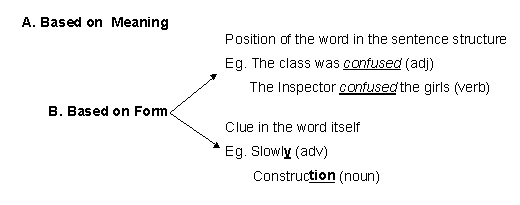
The learner’s awareness as they become effective users of the language need to move from B to A, I should think. After all, the ability to decide on the category of the word need not enable the learners to predict the meaning of a word.
But the truth remains that finding its class is easy when we know the meaning of the word.; whereas finding its meaning is not always easy even when we know to which class the word belongs. I would like you to tell me if you like my two – line limerick:
When the class category is established, the meaning need not be near; But when the meaning is established, the class category is almost clear.
Marking the written work:
As I often suggest, I would like every teacher to have a weekly
schedule so that he/she can cover marking the written work of all classes at
least once a week. The need for regular and careful marking is felt more
with written production task – unlike the slot-filing ones. And this would
enable you to think of / provide remedial help at least once a fort night
covering common basic language problems.
The visuals in AB – for elicitation or explanation?
The visuals provided in the AB – particularly those at the beginning of a unit are meant to be used to get students to (use the language) say what they think about the pictures. This is supposed to be a warming up exercise – where the teacher’s focus should be on elicitations from pupils rather than on explanation by the teacher.
For example – the picture of Act 1 Unit 7 of 3 prep / Act1 Unit 7 of 2Sec. should be used to see what the pupils can say about different fish or different jobs in the picture rather than as a task to be explained by the teacher.
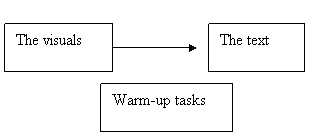
As we can see, the purpose of visuals is to tune the pupils into the text they are going to read/hear. This tuning is best done when the learners employ their skills ‘reading’ the visuals with minimal or no explanation by the teacher.