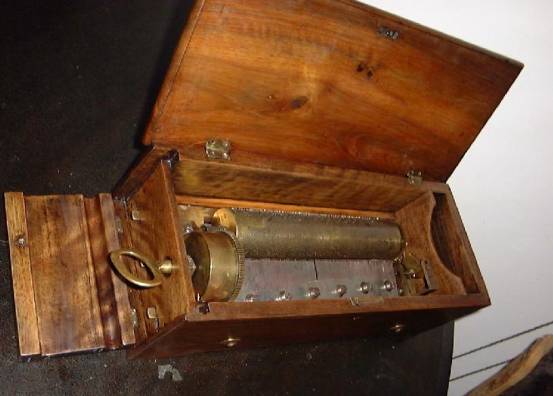
Musical boxes were and are a luxury item. An average musical box will cost
several hundred US dollars. Some
of the larger boxes can run thousands of dollars. There are several types of musical
boxes from a small toy to the enormous automatic orchestra or automatic
military band organ. The earliest
music playing machines recorded were around 1600, playing bells to make a
simple song. Around 1830, technology
was invented to tune a steel bar to make a comb for what we refer today as a
musical box. Making musical boxes
grew more refined and many items were added, an organ or bells, a drum,
castanets, or even a singing bird in the musical box. Still, some of the finest boxes are the simplest with more
gentle music.
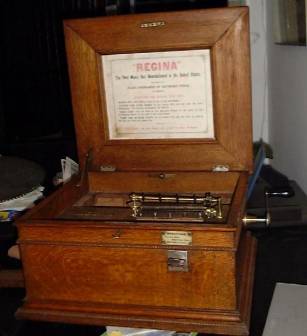
 1890
brought the next advance to musical boxes. Instead of playing a fixed song or program, the boxes now
had metal discs with a song programmed on to them (the predecessor to today’s
compact disc). This allowed you to
buy one music box and play thousands of songs. Soon afterwards, however, the player piano was introduced,
along with player organs, even automatic banjos and violins.
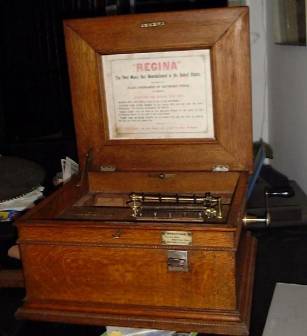
1890
brought the next advance to musical boxes. Instead of playing a fixed song or program, the boxes now
had metal discs with a song programmed on to them (the predecessor to today’s
compact disc). This allowed you to
buy one music box and play thousands of songs. Soon afterwards, however, the player piano was introduced,
along with player organs, even automatic banjos and violins.
The introduction and spread of the record player and radio
however brought to an end the desire for limited music and the expense of
making them made it un-profitable to continue. Today there are a few makers of musical boxes, but they have
lost the glory of the wonderful past.
I would like to explain the operation and mechanics of tuned
steel comb musical boxes.
To begin at the beginning, let’s identify the parts of a
musical box. The mechanism is
comprised of a Ratchet lever or key to wind, Spring, Cylinder, Comb,
Speed-Governor, Tune-Changing-Snail, Start/Stop-Lever, Change/Repeat Lever,
Base-Plate, Sounding Board, Case, Tuning Weights and Dampers.
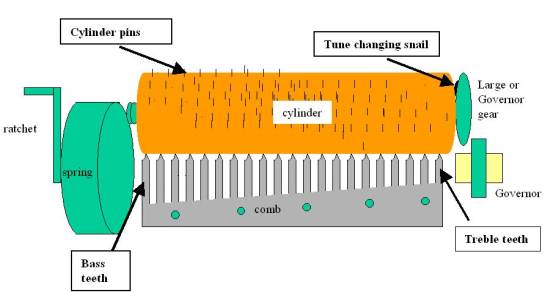
The Bass or lower teeth have a lead tuning weight attached
underneath the comb to make the sound deeper. This addition allows for very deep notes to be played by a
relatively uniform sized comb.
Between the cylinder and large gear is a small gear called the
tune-changing snail. This gear
pushes the cylinder slightly to the right to align the pins with the comb and
change to the next song (coded in the pins). Each song or “air” has a set of pins lined up with the tips
of the comb teeth. There may be as
many as 20 airs on one cylinder although the majority of boxes have only 4, 6
or 8.
How does it work?
In order to understand the workings of musical boxes, it is important to
understand the physical properties of steel. Musical boxes are usually powered by a spring. There are exceptions to this rule such
as a child’s music box that is powered by turning a crank, and some clocks that
have “musical boxes” which are powered by the weights of the clock, however in
general, the mechanics are spring powered. The most important springs in musical boxes however are not
the springs that power it, but rather the set of springs, which collectively
are called the comb. The comb is
made of tempered steel, made in exactly the same process as a standard spring,
and the qualities of the teeth of a comb are identical to the properties of a
spring. Steel when manufactured is
pliable. It has many interesting
properties, however, which make it suitable for its many uses. First of all, taking a piece of steel
and heating it to red hot and then allowing it to cool off slowly will return
the steel to its origional properties.
It is hardened by heating it to red hot and cooling it off suddenly by
thrusting the red-hot steel into cold water or oil. Hardened steel is strong but brittle. After hardening steel, it is possible
to maintain the strength but remove its brittleness by tempering it (slowly
heating it once again, but this time not to red-hot). Heating the steel gently until it starts to change color will
retain the strength yet it will no longer be brittle. Continuing to heat gently, the steel will first turn yellow,
then purple, and finally blue. At
this point, the steel has spring properties and is flexible. The same process for making a spring is
used for tempering the steel for a musical box’s comb.
It was in 1830 that it was discovered that controlling the
thickness and width of a spring can control the frequency of its oscillation,
and thus the sound which it makes when its plucked. The relationship between thickness, length and width not
only controls the sound, but also the overtones that it creates. Makers of musical boxes studied these
relationships and worked hard to bring the most pleasing combination of tone
and harmonics.
Making music is much more than playing notes. Making music involves timing, notes and
chords. The most amazing part of
exquisite musical boxes is not the beauty of the box, but the beauty of the
melodies that they play. Plucking
the comb tooth by a pin on a rotating cylinder plays each note. It is physically impossible to rapidly
repeat a note due to the properties of the rotation of the cylinder and the
vibrations of the tooth.
Additionally, sometimes it was desired to allow a note to continue
sounding and yet to repeat the same note again. This was made possible by repeating the same tone with
several sequential teeth. The time
it takes for the vibrations of these teeth to finish can be quite long, up to
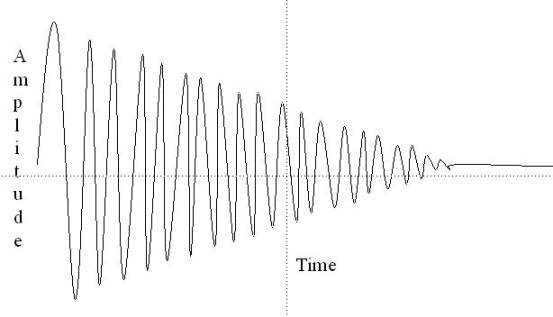
20-30 seconds for some of the larger teeth. While the physical vibrations of a tooth take the form of a
decaying sine wave, if the cylinder has a new pin for the same tooth, there is
a distinctive metal grating on metal sound from the remaining kinetic energy of
the spring.
Take this graph representing the vibrations of a tooth from
a single plucking.
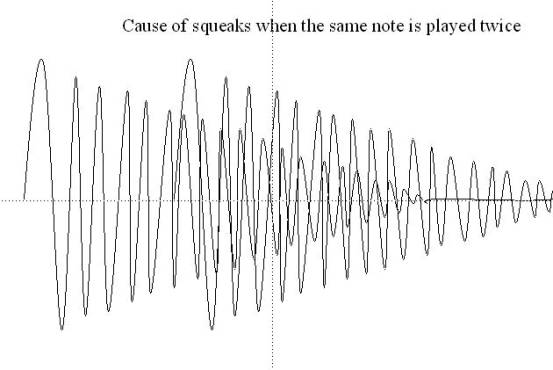
If the same tooth is plucked once again at the 50% level,
then all of the remaining kinetic energy of the spring is released quickly and
noisily as shown in the next diagram—all the remaining kinetic energy of the
first note sounds as dissonance as it is transferred to the cylinder pin
instead of decaying slowly.
The early Swiss inventors thought of this as well (or if
they didn’t think of it, it became obvious when they built their first musical
box) and came up with a solution.
The vibrations of the comb are silenced shortly before the note is
plucked by means of a small steel wire (yet another spring),
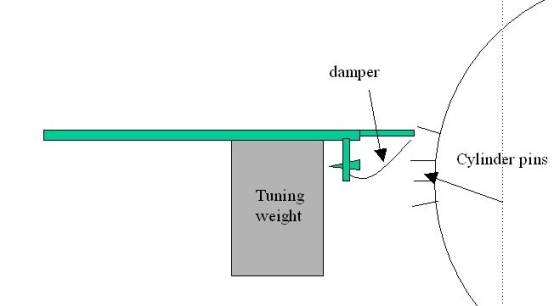
Underneath the tooth is a small thin wire called a damper
that the pin first pushes against the tooth to stop the vibrations before the
cylinder pin reaches the tooth.
The damper gently absorbs the remaining kinetic energy a stills the
tooth before the cylinder pin comes into contact the second time.
Finally the musical box as a luxury item is presented in a
luxurious way. The majority of
these boxes in richly veneered or solid hardwood cases, many with hand inlayed
patterns. The mechanisms are shiny
brass or nickel-plated. The result
is a delight to the eyes and ears.