Gandalf and the Istari
Of the many interesting ideas and characters JRR Tolkien has written about, the Istari have been interesting to many readers. The word ‘istar(i)’ is the high-elven (Quenya) translation for ‘wizard’. But JRR Tolkien’s wizards were quite distinct from wizards and magicians of later legend as the Istari belonged solely to the Third Age of the Sun and then departed. Only Elrond, Cirdan, and Galadriel, who were the leaders of the High Elves in Middle Earth, discovered that indeed the Istari were Maiar and that they had come from over the Sea.
At first they were thought to be Men with long white beards and clothed in robes, who often wore tall pointed hats. They had acquired lore and arts after secret study. They appeared in simple guises as old Men, approximately 50-60 years of age, but vigorous, and as travelers, and wanderers gaining knowledge, but revealing to none their purpose or power. They were not heeded at first, but when Sauron began to take shape again and grow, they were active and sought to contest with him and move Elves and Men to beware their peril.
 Before the coming of the Istari to Middle Earth, the forest known as Greenwood the Great was invaded by Sauron when he built a stronghold known as Dol Guldur in the south of the forest. The forest was renamed Mirkwood because Sauron spread his evil influence throughout the forest and evil creatures came to hunt. It was at this time when the Istari first came from the West across the Sea. Even though Elrond, Cirdan, and Galadriel kept the secret of the Istari’s true identity among themselves, rumor spread
among the Elves that the Istari were sent by the Lords of the West, the Valar, to challenge Sauron.
Before the coming of the Istari to Middle Earth, the forest known as Greenwood the Great was invaded by Sauron when he built a stronghold known as Dol Guldur in the south of the forest. The forest was renamed Mirkwood because Sauron spread his evil influence throughout the forest and evil creatures came to hunt. It was at this time when the Istari first came from the West across the Sea. Even though Elrond, Cirdan, and Galadriel kept the secret of the Istari’s true identity among themselves, rumor spread
among the Elves that the Istari were sent by the Lords of the West, the Valar, to challenge Sauron.
When it was perceived that the Istari did not die, but remained the same, only slightly aged, they were thought to be of Elven kind, but this was not so. The wizards were, in actuality, supernatural beings, Maiar, who had chosen or been chosen to take on human (incarnate) form. The Maiar in Tolkien’s pantheon equates roughly to an angel or archangel. They were sent by the Valar (highest order of spiritual beings) as emissaries from the Uttermost West across the Sea from the immortal land known as Aman. As emissaries, they had the task of aiding the struggles of the free peoples against the growing might of Sauron, the Dark Lord who was an evil Maia.
However, the Istari were given some orders to follow. They were not to face or confront Sauron directly, power to power, but inspire the free peoples to great deeds. They were not to dominate the free wills of the free peoples -- a principle reason for their mission was to prevent Sauron from dominating others. They were forbidden from revealing themselves in power or majesty. These rules were set down by the Authority, the omnipresence of Tolkien’s world. It was He who ordained the Rules. By being incarnate, it limited or "cloaked" the powers of the Maia, and intentionally so because they were to organize the resistance and inspire the peoples of Middle Earth to help themselves.
The Istari took interest in all things and affairs of the peoples of Middle Earth, which was another common aspect of the ‘wizard’ image. Some might argue that they stuck their noses where it did not belong.
The Istari were far older than they appear. They first appeared in Middle Earth around the 1000th year of the Third Age. Gandalf, one of the Istari, finally left Middle Earth after the War of the Ring, in the year 3021 of the Third Age. Only Cirdan the Shipwright, saw them arrive in Middle Earth. When Gandalf arrived, Cirdan perceived that he was the mightiest of heart and gave him the Red Ring of Fire, Narya.
"For great labors and perils lie before you, and lest your task prove too great and wearisome, take this Ring for aid and comfort. It was entrusted to me only to keep secret, and here upon the West-shores it is idle; but I deem that in days ere long to come it should be in nobler hands than mine, that may wield it for the kindling of all hearts to courage." (Tolkien: Unfinished Tales, P.504)
In a council of the Valar (and some might say headed by The Authority) it was resolved to send three emissaries to Middle Earth.
"Who would go? For they must be mighty, peers of Sauron, but must forgo might, and clothe themselves in flesh so as to treat on equality and win the trust of Elves and Men. But this would imperil them, dimming their wisdom and knowledge, and confusing them with fears, cares, and weariness coming from the flesh." (Tolkien: Unfinished Tales, P 508)
Only two came forward. They were Curumo [Saruman] and Alatar. The leader of all the Valar and Maiar, Manwe wanted Olorin to go but when asked, Olorin responded that he was too weak and that he feared Sauron. Manwe told him that was all the more reason to go and then Manwe commanded Olorin to go. Aiwendil [Radagast] went along with Curumo at the begging of another one of the Valar. And Alatar took Pallando as a friend.
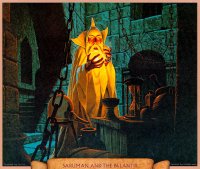 Saruman (the White), which means ‘Man of Skill’ [Sindarin: Curunir; Quenya: Curumo] was the oldest of the wizards and the leader of what is known as the Council of the Wise or simply, the White Council. He looked and acted like Gandalf, but soon his evil thoughts revealed him. After he heard about the Ruling Ring of Power, that was made by Sauron, Saruman wanted to possess it for himself. He did not keep any of the Rings, but he did have one of the Palantiri, which was an Elven-crafted stone in which one with a strong will could look at things far away. He lived in Orthanc, a great tower of another age, and controlled his armies from within Isengard, the city which ringed Orthanc. When Saruman first came to Middle Earth, he was not evil in heart, but, as he began studying the lore of the Rings of Power, he soon became jealous of Sauron as a rival, instead of hating him as the Enemy. With the Palantir stone, Saruman gazed abroad and soon turned his attentions to Mordor where Sauron dwelled, and Saruman was caught by a will stronger than his own. One weapon Saruman could use against his enemies was his persuasive voice to "convince" other people to follow his evil will. This is against one of the Rules set by the Authority.
Radagast (the Brown) [Quenya: Aiwendil] was a master of shapes and hues. He was mostly noted as a friend to birds and beasts and he could understand their speech. Unwittingly, Radagast was involved in Saruman’s treachery by lending his aid to have the birds spy on what he thought were the Enemy’s doings, but instead, Saruman used the birds to spy on the river Anduin where it was thought the Ruling Ring would be found. The Enemy indeed was scouring the riverbeds of Anduin so Radagast did not give it a second thought. In what almost ruined chance for victory, Saruman asked Radagast to locate Gandalf and have Gandalf come to Orthanc, where Gandalf was then imprisoned. Even so, Gandalf did not consider Radagast a traitor. Gandalf might have noted, although that cannot be proven, that Radagast was partly responsible for the timely rescues provided by the Eagles. Some have said that Radagast failed in his mission to Middle Earth, and it was tempting to think that his ‘failure’ was not as big as that of Saruman’s. What remains is that Radagast never became evil. Saruman himself admits this in The Fellowship of the Ring.
"’Radagast the Brown!’ laughed Saruman, and he no longer concealed his scorn. ‘Radagast the Bird-tamer! Radagast the Simple! Radagast the Fool! Yet he had just the wit to play the part that I set him.’"(Tolkien: The Fellowship of the Ring, P.339)
The birds gathered important information, but this was not really helpful as it was taken to Saruman, who was a traitor at heart. Fortunately, Gandalf found out Saruman’s plan when Saruman tried to convince him to join him. Gandalf refused, and was imprisoned until his miraculous rescue by an Eagle.
Of Alatar and Pallando, very little indeed is known. They had no recorded names in Middle Earth except for the title ‘Ithryn Luin’, or ‘The Blue Wizards’. When the Istari first arrived in Middle Earth, Saruman and the Blue Wizards had traveled far east. But after a time, only Saruman returned. In the Letters of JRR Tolkien, Tolkien himself says that even he is not sure what may have happened to the Blue Wizards. (Letter #156)
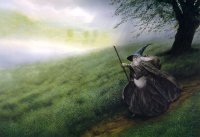
The last to land in Middle Earth was Gandalf (the Grey). He is the most important wizard in The Lord of the Rings. The very first glimpse of Gandalf we see is near the very beginning of The Lord of the Rings. He is described as:
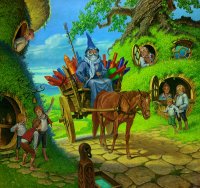 ".....an old man driving [a cart] all alone. He wore a tall pointed blue hat, a long grey cloak, and a silver scarf. He had a long white beard and bushy eyebrows that stuck out beyond the brim of his hat."(Tolkien: Fellowship of the Ring, P45)
This description was what Gandalf displayed for people. To Hobbits, the hole-dwelling race of people half the height of a human, he was just an old man famous for his fireworks, but Gandalf’s business was far more difficult and dangerous. One is struck by this unassuming way the character is introduced, how it is hinted that this character may just be more than a "wizard" whose talents may not be limited to fireworks. Gandalf’s outward appearance is the actual representation of his humble character, entirely unassuming at first, but suddenly hinting at an unknown font of power and wisdom.
The exact year of the arrival of Gandalf is uncertain. He came at about the same time as the first signs were noted of the re-arising of the Shadow, and the reappearance and spread of evil things. He was said to have wandered long in varied guises, engaged not in the events around him, but explored the hearts of Elves and Men who had opposed and might still oppose Sauron. From his wandering, he had many names to his credit. He was named Gandalf in the North, Mithrandir [the Grey wanderer] by the Elves, Tharkun [Staff-man] by the dwarves, Incanus in the South, and an interesting note, he was the reluctant Olorin commanded to Middle Earth by Manwe, in Valinor.
The North is where most of all the events of the War of the Ring took place. The North was the main province of Gandalf’s labors and within it above all, the North-west which consisted of Lindon, Eriador, and the Vales of Anduin. Gandalf’s primary alliances were with Elrond, the Elf Lord and the Northern Dunedain (Rangers). Gandalf had a peculiar love of the halflings, or hobbits, because of his wisdom and premonition of their ultimate importance. At the same time, he perceived their inherent worth.
"Many are the strange chances of the world, and help oft shall come form the hands of the weak when the Wise falter."(Tolkien: The Silmarillion, P362)
The Realm of Gondor did not really attract his interest and for the very same reason it attracted Saruman’s; Gondor was a center of knowledge and power of many millennia. Gondor’s rulers certainly opposed Sauron as it happened that the Realm arose as a threat to Sauron and his realm of Mordor. Gondor only continued to exist in so far and so long as Sauron’s threat to them could be resisted by armed force. Therefore, Gandalf could do very little to guide their proud rulers or to instruct them. Only in the decay of their power, when they showed courage and steadfastness in what seemed a lost cause, did Gandalf begin to be deeply concerned for them.
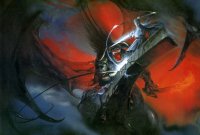 Tolkien’s philosophy on working physical effects in the "real world" of Middle Earth required that a spirit or will actually be a physical entity. Gandalf was a Maia, as all the Istari were, an angelic being "clothed" in mortal flesh and therefore subject to physical harm; such as hunger, weariness, and even injury and death. This is why Gandalf fighting a balrog is intriguing. A balrog was an evil demon of fire that was in the service of The Dark Lord. Thus, with Gandalf subject to the flesh, his facing the balrog is a real and deadly danger. At this point in the story, Gandalf realizes that the Quest of the Ring was in danger an he sacrificed himself to ensure the escape of his friends. He fell off the bridge, locked in combat with the balrog and both eventually perish.
But to the amazement of the reader and also the characters in the book, Gandalf returns from death. And being returned, he is enhanced in power and clothed in white robes.
In order to understand why Gandalf did not just blast the balrog, we must remember the Rule prohibiting the Istari from exercising power. By sacrificing his life, Gandalf was conforming to the Rules. He was handing over to the Authority who ordained the Rules, giving up personal gain for the insured safety of his friends. The Authority accepted the sacrifice and Gandalf was returned.
Gandalf was returned with enhanced power. Because of this greater power, when he spoke, people listened. The old Gandalf could not have dealt with Saruman. Gandalf still had the obligation to hide his power but if the physical powers of the Enemy were too great, he could act as an emergency "angel".
The Valar's plan for the Istari failed. Radagast had become enamoured with the beasts of Middle-earth, Saruman had succumbed to designs of power and a lust for the Ruling Ring, the Blue Wizards were rumored to have founded magic cults, and even Gandalf was killed. Yet Sauron remained and complete domination of Middle-earth was nearly his. This is the point where Gandalf's sacrifice is changed. Tolkien said it was not the Valar who returned Gandalf; it was Authority, He who ordained the Rules, or more plainly, the omnipresence.
Gandalf was returned in white clothes and finally confronted Saruman, the traitor, casting him down and taking the title as head of the White Council away.
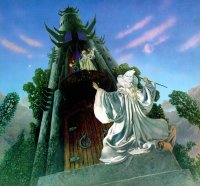 "Behold, I am not Gandalf the Grey whom you betrayed. I am Gandalf the White returned from death. You have no color now, and I cast you from the order and from the Council. Saruman, Your staff is broken."(Tolkien: The Two Towers, P229)
And when, at the end of The Lord of the Rings Sauron was finally vanquished through the courageous effort of the hobbit, Frodo, the Istari were done their mission. It was only Gandalf who remained faithful to the mission, and it is he, who was allowed back to Valinor.
"Well, here at last, dear friends, on the shores of the Sea comes the end of our fellowship in Middle Earth. Go in peace! I will not say: Do not weep; for not all tears are an evil."(Tolkien: The Return of the King, P377)