|
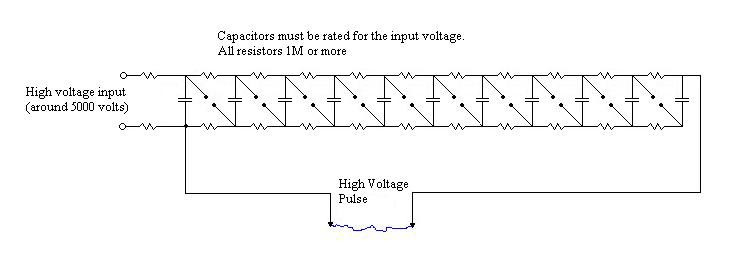
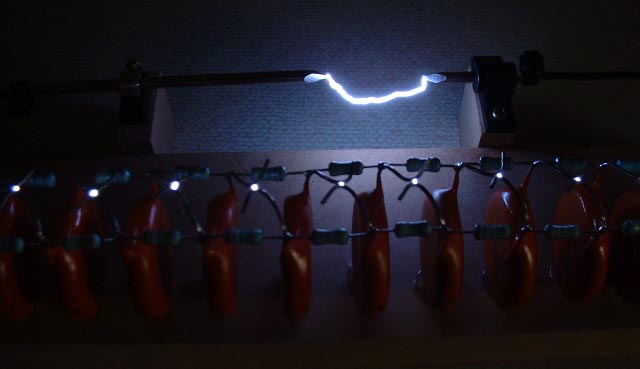
A marx generator is a clever way of charging up a number of capacitors in parallel and discharging them in series. The output voltage is the voltage in each of the capacitors multiplied by the number of stages. The Cascade multiplier uses diodes and capacitors to multiply the voltage whereas the marx generator uses resistors to charge the capacitors and spark gaps to discharge them. When the voltages in the capacitors are high enough to trigger the spark gaps, the capacitors are instantly connected in series resulting in the voltages in the capacitors adding up to produce very large outputs. The resistors connect the charging supply to the resistors but limit the capacitors discharge rate during spark gap conduction. In order for the marx generator to function, the spark gaps must all fire in less time than it would take for any single capacitor to discharge through it's resistors. Fortunately, spark gaps reach maximum conductance in about 10 nanoseconds. |
|