 |
|
|
|
|
|
|
|
|
|
|
|
|
|
|
|
|
|
|
|
|
|
|
|
|
|
|
|
|
|
|
|
|
|
|
|
|
|
|
|
|
|
|
|
|
|
|
|
|
|
|
|
|
|
|
|
|
|
|
|
|
|
|
|
|
|
|
|
|
|
|
|
|
|
|
|
|
|
|
|
|
|
|
|
|
|
|
|
|
|
|
|
|
|
|
 |
|
|
|
|
|
|
|
|
|
|
|
|
|
|
|
|
|
|
|
|
|
|
|
|
|
|
|
|
|
|
|
|
|
|
|
|
|
|
|
|
|
|
|
|
|
|
|
|
|
|
|
|
|
|
|
|
|
 |
|
|
|
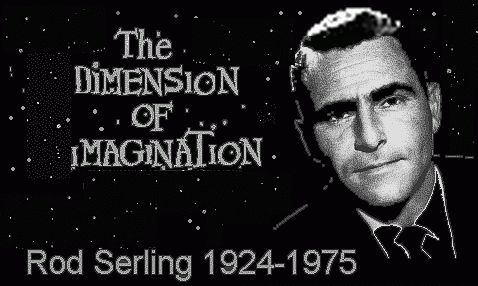
There is a fifth dimension beyond that which is known to man. It is a dimension as vast as space and timeless as infinity. It is the middle ground between light and shadow, between science and superstition, and it lies between the pit of man's fears and the summit of his knowledge. This is the dimension of imagination. It is an area which we call The Twilight Zone. |
|
|
|
 |
|
|
|
|
|
Submitted for your approval, one Rodman Edward Serling of Syracuse New York, maybe you've seen him standing off to the side, in a dark suit holding a cigarette. His works of note are too many to mention. He gave birth to an entire genre of television. His face is widely known and almost everyone has a favorite episode of the show he created. Yet when he died, he considered his life to be, at best a failure. Rodman Edward Serling. Screen writer, husband, visionary, philosopher, author, enigma. |
|
|
|
One Summer Per Customer |
|
|
|
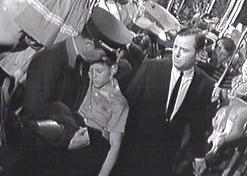
His childhood was not much different from anyone else who grew up after the great depression. His hometown of Syracuse would be a place he would visit regularly later in his career. He could be seen riding his bike along main street, or listening to shows like "Weird Tales" with his brother Robert. The nice, quiet town of Syracuse would later become a backdrop for many of his screen plays. The most touching of these was "Walking Distance, perhaps the closest thing to an autobiography he ever penned. In it, a weary ad executive returns home, only to find that he has not only gone back home, but back in time to a summer long ago.
It was said of Rod that he always wanted to go back to that special summer of Cotton Candy, music concerts. But this was the Twilight Zone, and we learned we couldn't go home again. As the character's father tells him "Maybe there's only one summer per customer." |
|
|
 |
|
|
|
|
|
"Maybe there's only one summer per customer" Rod Serling longed for the innocence of his childhood and it shows in "Walking Distance." Serling always wanted to go back to his youth and often did for the most memorable and touching teleplays ever written. |
|
|
|
|
|
|
War and The Birth of a Legend |
|
|
|
As soon as he graduated from high school, he enlisted in the U.S. Army 11th Airborne Division paratroopers. It was here he would find inspiration for what was, undoubtably, his greatest teleplay. "Requiem for a Heavyweight", originally aired as a "Playhouse 90" production. It was during his stint with the military that he took up boxing, winning 17 out of 18 bouts. While in combat in the Philippines, he was wounded by shrapnel and discharged in 1946. This would prove to be a turning point in his life. He would revisit the horrors of war many times in his career.
Serling enrolled in Antioch College in Yellow Springs Ohio where he took a major in, of all thing, phys ed. But there was another path for Serling. While still a student, he sold his first tteleplay, "Grady Everett for the people" for one hundred dollars.
Serling followed that up with what some claim to be his most triumphant, and surely most acclaimed work. In 1955, "Patterns" was produced, earning him the first of what would be six Emmy awards.
But it was also a disappointing time for Serling. "Patterns" was a critical success, but Serling was dissatisfied. "You just can't produce anything meaningful for television when they're breaking in every five minutes to sell detergent." He was disappointed and outraged at how much power the sponsors had on what could be produced. In an interview with Mike Wallace, Serling remarked on an episode of "Lassie" in which the dog had a litter of puppies. There was a backlash of letters to the network and the sponsors along the tune of "If I wanted my children to see a sex show, I would have taken them to a burlesque." It was then that he decided that serious, dramatic television was not for him. In 1957 he pitched the idea of a new show, a show dealing in science fiction and the imagination.
That show was "The Twilight Zone". CBS television bought the show on the pilot "Where is everybody?" An agreement was reached that Serling would have control over the scripts and the production, and the sponsors would sell their coffee. This relationship proved to be an effective one with few exceptions.
156 episodes would be produced over the next five years. Serling himself wrote ninety-two of them. As promised, he delivered worlds of wonder, imagination, and fear. However, the writer in him could never deliver on his promise to steer clear of socially relevant issues. |
|
|
|
Monsters and Men: Serling and the Social Consciousness. |
|
|
|
 |
|
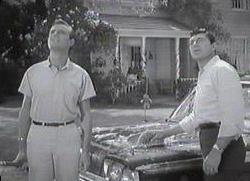
""The Monsters are due on Maple Street" is just one of the many examples of Serling's ability to sneak a little social relevance in with our fantasy and science fiction. On the surface, it's a story about an impending alien invasion where the residents of a small, peaceful street are looking over their shoulders for some unseen enemy. Who is the monster? Perhaps, as Serling revealed to us, the greatest monster is our own fear and paranoia. In the end, we are the monsters. It was a bold move during a time when McCarthyistic fear and paranoia had swept the country. But it was safe. This was, after all, fantasy. Just replace communists with aliens, and people could handle it a lot better |
|
|
|
|
who are the Monsters? In "The Monsters are Due on Maple Street," Serling reveals that our own fear and paranoia is the greatest monster of all. |
|
|
|
|
|
|
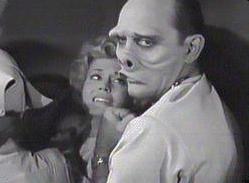
Serling learned he could address not just socially relevant issues in this brave new genre, but also philosophical ones as well. On occasion, he even mingled the two. "Eye of the Beholder" was the story of a young woman believed to be a freak, undergoing what would be the last of a series of procedures to try to make her look more "normal" With careful editing and lighting effects, the audience never sees any of the character's faces until the end. Even the unfortunate young woman's face is bandaged. This clever trick led to a big payoff. Slowly, the bandages are removed and we are seeing through the eyes of the young woman. Then, when at last the bandages are removed, and the doctor backs away in revulsion saying "No change!" as the nurse screams in terror. The deformed woman is revealed to be, by our standards at least, an attractive woman. Then we see the twisted, horrific face of the doctor. In no time, it is revealed that in this world anyway, ugliness is beautiful. From the television monitor, we see their leader speaking of "Glorious conformity." We see that this is a backwards world, where ugliness is normal, and beauty is truly in the eye of the beholder. We had to look inside ourselves for a time, and occasionally, we didn't like what was staring back at us. |
|
|
 |
|
|
|
"Glorious conformity!" Serling showed us what the ultimate price for our own prejudice is in "Eye of the Beholderquote;In traditional Serling style, we're made to believe until the very end that this poor woman was horribly disfigured . . . Or was she? Nothing is certain in "The Twilight Zone." |
|
|
|
|
|
|
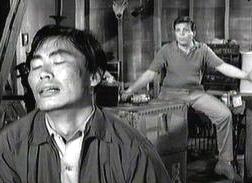
America definitely didn't like what was staring back at it when "The Encounter" aired. "The Encounter" was the story of an American war hero, a young Japanese man, and a samurai sword. Beneath the surface, it was the story of ghosts and changing attitudes. When a World War II vet hires a young Japanese man (Played by a pre Star Trek's George Takei), the vet muses "We were told you people were animals, and now you're highly cultured." Contrary to the highly patriotic sentiment at the time, the war hero in "The Encounter," wasn't really a hero at all. He is in possession of a sword he took off Japanese officer who had surrendered, yet he was killed anyway. "We were told to take no prisoners." The vet says in an eerily similar fashion to the Nazi excuse We were just following orders. The young Japanese man had his own demons as well; His father betrayed the United States by assisting in the bombing of Pearl Harbor. In the end, it is each man's inability to let go of the past that leads them to destroy themselves. This brand of irony was a staple of "The Twilight Zone." Only this time the sponsors and the viewing public thought he hit a little too close to home. The backlash of angry letters led to "The Encounter" being pulled and never aired again. Despite this setback, Serling would continue to produce the type of material he wanted, even if it meant that people would be forced to face the truth about their own secret prejudices. |
|
|
 |
|
|
|
|
|
A striking indictment on war, "The Encounter" was Serling's boldest work for "The Twilight Zone". The ignorance of the masses mistook the message for being "Anti-American" rather than antiwar. Showing the darker corners of the human experience was not something Serling shied away from. He was relentless in showing us what was both good and bad in humanity and unflinching in his honesty, even at the cost of offense. |
|
|
|
|
|
|
 |
|
|
|
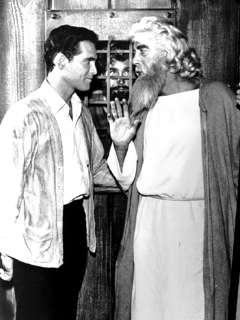
"You can catch the devil, but you can't keep him." Many of Rod Serling's works would address the topic of war. "The Howling Man" was another example of this. When a young man on holiday encounters a bizarre religious sect and a caged man who claims they're all "mad, we are once again led down the murky path of perception and the folly of man. The brothers at the strange ancient monastery warn him that this man is not to be believed, that he is, in fact, the Devil himself.
"I only kissed her," The caged man says pitifully. "Is there anything? wrong with that?" Regardless of the monks warnings, the young man allowed himself to be deceived. It is humanity's lot to let the devil out of the cage.
The man releases the prisoner, only to find that the Devil is never what he appears to be. He devotes his life to tracking down the Devil, through war after war, and catches him yet again. But this is The Twilight Zone, and you can catch the Devil, but you can't keep him for very long. The deeper meaning here is that we all keep our own devils locked up, but eventually they get released, and that leads to war, carnage, chaos. We may blame the Devil for all the evils of the world, but ultimately it is man that lets the devil out of his prison. As startling and covert an indictment against war as was ever done at the time, "The Devil" in this case is man's barbarism and capacity for being warlike. Serling warns that we will always war because we always let our own devils loose. |
|
|
|
|
"The Howling Man", much like many of Serling's other works places the blame for all of society's ill square on the shoulders of man himself. We let the evil out because we refuse to listen to more level headed people. We pay the price for letting the evil out. War left more than physical scars in the life of Rod Serling. |
|
|
|
|
|
|
Irony and Meaning |
|
|
|
 |
|
|
|
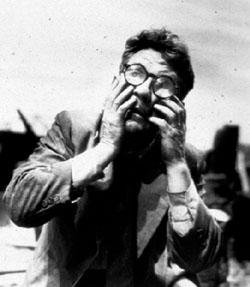
Serling was the master at devising endings that were fitting, but never foreseen. In "Time enough at Last", a bookish bank teller becomes an unlikely victim of one of Serling's most memorable twist endings. Painfully shy and constantly hiding from the rest of the world in the pages of a book nearly costs him his job. Even his own wife does not allow him to bury his nose in books. After being warned that he would lose his job if he was caught reading t work one more time, the teller decides to hide in the bank vault during lunch to read the paper. In typical "Twilight Zone" fashion, and the newspaper foretells of the events to come "H bomb could destroy the world". That headline becomes prophetic. There was a nuclear war, but the vault shelters him from the blast. The last man left on the Earth finds he has no pushy boss to tell him to put his book away, no nagging wife to throw his books out, he finally has "Time enough at last." to do nothing but read. But this is the Twilight Zone, and seldom is there a happy ending. For this bookish man learns all too quickly that no man is an island unto himself, and the people in the pages of those books can't repair a pair of broken glasses. |
|
|
|
|
"Time Enough at Last" reminds us that we need each other. The twist endings that became a staple of "The Twilight Zone" also served to illuminate a greater truth about human nature. Our inability to foresee the outcome of our selfishness always leads to agony in the end. |
|
|
|
|
|
|
Requiem for The Heavyweight: After "The Twilight Zone" |
|
|
|
The Twilight Zone ended in 1964. Serling continued to write for film and television, penning the scripts for such notable films as "Planet of the Apes" and "Seven Days in May" He returned to what gave his notoriety in a show called "Rod Serling's Night Gallery", but he had little to do with the show. He had become what he hated the most, a salesman. Before he died in 1975 of complications arising from a heart attack, he wrote "I have done nothing of consequence, nothing that will stand the test of time . . . " There are hundreds of "Twilight Zone" conventions every year in the United States drawing in an estimated 67 million people. "The Twilight Zone" is even taught as University Curriculum in several major colleges. To this day, "The Twilight Zone" is aired, somewhere in the world, every 22 minutes, 24 hours a day. Serling's works have not only stood the test of time, it has surpassed time and now resides in "the middle ground between light and shadow, between science and superstition, between the pit of man's fears and the summit of his knowledge,in the dimension of imagination." Rod Serling will always live on, even if only in that area which we call the Twilight Zone. |
|
|
|
 |
 |