Featuring Philip Peter...
"No one ever told me comics were supposed to be sequential art,"
relates Philip Peter, creator of the decidedly disjointed piece of art
that is the comic book Century 1. Peter didn't start out the way
most artists and writers of comic books do. "I didn't read comic books.
I still don't," says Peter.  "It's a good thing I didn't.
I might have picked up some bad habits, like not developing my own
personal style."  So how did Peter come upon creating a semigothic,
allegorical, religiously-themed... comic book?  "I started out trying
to express myself with drawings.  The problem with visual art is that the
drawings can be misinterpreted if their meaning isn't clear.  I needed
to find a way to combine the art with words.  And the idea of drawing a
picture and putting a caption beneath it didn't seem natural to me somehow.
So I thought about it and decided that the most seamless and accepted way
to integrate words into visual art was a comic book."

"I think there's a power in still images.  People of course know that
there's a power in moving images, but I think there's a power in still
images as well.  A lot of comic books today act as if they have an
inferiority complex with respect to movies, as if they feel a need to
act like moving pictures, or apologize for not being a motion picture.
For example, a character will be drawn three times in the same panel, to
convey the sense that he's moving, as if you're looking in a kinetoscope.
I think that's silly.  I think you should play your strengths.  There are
things you can do in a motion picture which can't be done as well in a
comic book, but there are things you can do with still images that can't
be done as well with moving images.  There's a strength in moving images,
and there's a strength in still images.  There's no need for one to act
like the other," says Peter, referring back to the disjointed series
of images which makes up the story of his original comic book.
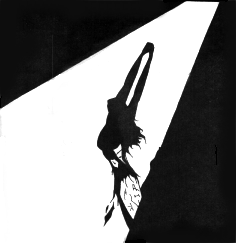
Ironically, Peter did write a screen adaptation for Century 1, which
was being considered by a production company at one time.
"They told me that they only considered two out of every 200 projects
as seriously as they were considering mine."  The project was ultimately
abandoned due to a lack of investors.  "I'm not of the opinion that every
comic book can or should be made into a movie.  The reason I decided
to write a screen adaptation based on Century 1 is because I thought
that it could work well as an independent short film....  It wasn't
so much a translation of my work as it was an interpretation.
I basically took the story and wrote it again from scratch.
There wasn't anything that contradicted the comic book, really."

But with four actors (not counting extras), small sets, and no special
effects, the script isn't what comes to mind when most people think of
a comic book movie.  Another controversial aspect of the darkly quiet
script is its highly visual nature.  With some scenes related through subtly
executed visuals more than dialogue, Peter took great care to describe
the images in detail.  "And, of course, a lot of directors are offended at
the very idea that a writer would try to have any say about the visual look
of a project, even if it's based on his own comic book.  But it would have
been irresponsible of me as an artist to have left it in someone else's
hands without at least trying to express my vision to them."

So, what's the main difference between writing a screen project and
writing a comic book?  "For me, when writing a screen project,
the story comes first and the visuals follow.  Whereas, when doing
the comic book, the art comes first, then the story."  Which goes a
long way to explain the non-sequential style of his comic book.
"The idea of comics as sequential art stems from the assumption
that first you come up with the story, then you draw a bunch of
pictures to illustrate it.  Whereas, when I was doing the comic book,
my approach was just the opposite.  First came the art, then I tried to
contrive a storyline to link the drawings together, using as few words
as possible to give it some semblance of a story.  To this day, I object
when I hear people say that, in comics, storytelling is everything and art
isn't really that important.  To me, Century 1 was more about the art, and
I still think of it as an art piece more than anything else."
To Contact
copyright 1997 Philip Peter
