
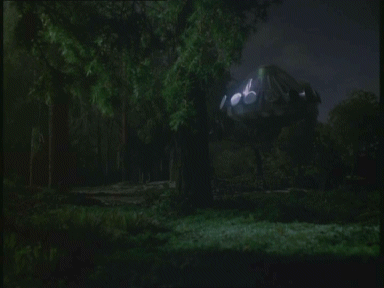
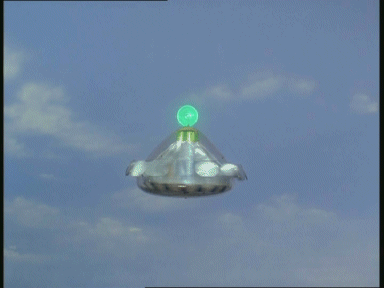
I suppose it was a tribute to the model makers that I thought it was made of metal and glass and was then industrially chrome plated using a skilled and expensive chemical process they had devised.At first I pretty much resigned myself to the fact that the model could,nt be duplicated outside of the hallowed halls of Century 21 Studios in Slough.
At this point I contented myself with making simple drawings that attempted to characterise its varying appearances.
This of course proved totally inadequate .I wanted a model and I just could,nt see how that was going to happen.And so the matter rested until my obsession was re-kindled again with repeat showings in 1973.
This time I attempted to make a simple 3D version by gluing together three impressions of the UFO from the weekly comic COUNTDOWN using carbon paper.This gave me a basic fin
structure and I painted the whole thing with silver paint.
I attached this very rough spinner to a piece of cotton thread.For a short time it seemed to work,and at least made a change from trying to reproduce a 3D image on a 2D drawing pad.
Of course my imagination had to go into overdrive to make up for my little cardboard creation's massive failings.
During the next few years I did manage to accquire some better reference information.
The Barratt's sweet cigarette cards helped a good deal as did super 8mm film shot directly from the TV,although resolution was quite poor.At least I had a little more insight into how the model was put together.I still believed at this point however that it was built from
metal and glass and had been chrome plated.Its amazing to think that it was only in May 2002 that I found out that Derek Meddings had in fact used a highly reflective chrome tape to cover the model.I say amazed because as long ago as 1974 I had built a cardboard model covered with chrome tape.What let the model down was that its structure and the edges to which the chrome tape were applied were totally wrong (I could never apply it smoothly enough) consequently the effect was awful.As a result of this I abandoned chrome tape as a means of realising my long held ambition.
After chrome tape I attacked the biscuit tins,you know those special presentation boxes only sold at Christmas.These tins were made of highly reflective metal and could just about be cut with a pair of scissors,however as most of the tins were covered with pictures of biscuits
(not unnaturally) only the bases were any good.
At this stage (about 1975) I,d just about worked out the basic centre structure,the real problem now was the materials to use and how on earth do I put the whole lot together.
I had,nt even thought how I was going to form the upper or lower glass canopies,and even the base plate's design was still a partial mystery.
I cut the fins and centre cone fixture out of biscuit tins.The truncated conical development
(as I termed it) was folded around with some difficulty into a sort of circular shape and the
15 fins were stuck to it (this was also difficult and messy,because at that time there was no
super glue available)
So without a base plate or either upper or lower canopy,I attached the half model to some monofilament and spun it.Even though it was only half done I learned one re-assuring thing immediately.The centre structure on the real model was certainly covered with a highly reflective material very smoothly applied.It was clear I had done something right.There was one huge problem however .The fins or paddles as Meddings referred to them were to thin,not only that they were also rough and mis-shapen on the edges.Again when presented to the light the effect was awful.
I figured this was as far as I could go (1976).OK the model was rough around the edges,but it had a highly reflective interior and eventually I managed to form the canopies using a messy inexacting procedure using a three stage process involving plaster of paris .The base plate
was made of card and when all the details were added it looked reasonable.Nothing short of
more knowledge,better materials and building techniques would allow me to produce the
accurate model I was looking for.My attempts to build a better model then stopped.My interest in the model and the series however still remained.Only recently with the discovery of better materials and information through the internet and the release of UFO on DVD have I refocused my attention on trying to construct the model accurately.
And, as might be appreciated from other pages on my site I think I have nearly acheived what I set out to do.All that remains is to perfect and refine the picture as neatly and factually as possible.