
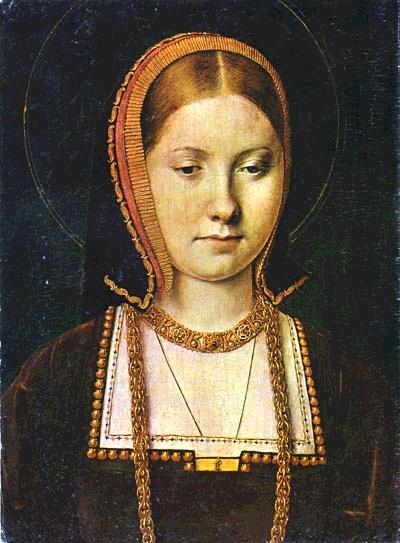
I'm going to have to back-track a bit, as I've already got the corset, smock, farthingale and kirtle mostly done.
I made my corset from the pattern on Drea Leed's awesome site, It worked wonderfully, the only thing I needed to do was lengthen the waist a tad. I made the corset from some lightweight cotton canvas I got for 50 cents a yard. I did use a layer of white 3.5 oz linen on the outside as it looked a lot better than the canvas. For boning I ended up using the metal strips from the big hanging file folders. They work great! They do have a tendency to bend and stay bent, but I'm not a very big person so they work fine for me. I got my dad to help me grind off the ends to the right length, then I spray-painted them white to prevent rust. I ended up only using 8 or so bones across the front and sides of the corset. The back I boned with plastic boning. I hand-bound the eyelets. Contrary to many people's opinions I actually find sewing eyelets to be fun. But maybe that just because I love hand sewing.
The smock was based on the Smock Pattern Generator on Drea Leed's site, but I altered the sleeves to make them widen out enough for the "poofs" that are pulled through the undersleeves of Tudor gowns. I made my smock out of 3.5 oz linen from fabric-store.com and I highly recommend it, I haven't found cheaper linen at that quality anywhere. I did a bit of embroidery around the neckline similar to that in the Catherine of Aragon portrait, with small alternating gold and black X's and running stitches along the edge. I wanted to do this with silk thread, but didn't want to mail-order some, so I got creative. I picked apart a pieces of black and gold silk dupioni and used the threads! I got the idea after getting some dupioni samples and noticing how easily the stuff frayed.
The Kirtle
In order to get the double neckline, I decided to sew a kirtle which could be worn on its own or underneath future doublets, etc. Rather than do an entirely black kirtle, which would be pretty boring, I opted to make a red wool kirtle with black wool guards around the neckline and down the front opening skirt. But finding red wool that I could actually afford was tricky. I am a bit leery about ordering fabric online, I like to be able to see how it feels and drapes before I buy it. So I had to find something locally. I soon discovered that finding red wool for under $12 a yard is not an easy feat. I ended up buying some lovely wool crepe in a not-so-lovely shade hot pink for $10, confident that I could dye it. Well, that turned into an all-day ordeal involving 6 pots of hot water, 2 packs of green Rit dye (something about complimentary colors-dye pink with green and it turns red), and a cooler. It was the only thing big enough to hold 6 yards of wool. I ended up getting too much green in the water, so I could only have the wool in the dyebath for about 10 seconds! Somehow my mom and I managed to get the fabric into the cooer, totally submersed in the hot dye, and out into the sink in about that amount of time. Amazingly, the wool actually dyed pretty evenly. There's a bit of variation, but once in a skirt its really hard to notice.
For a pattern, I made my own. I laced my duct-tape-dummy into my corset and draped a pattern directly on it. There are curved side seams which angle towards the back and the square neckline in front turns into a "v" neckline in the back. I didn't make the center front point very deep, since this is meant to be an early Tudor dress, and if I want to wear the kirtle with a later-period doublet or something, the doublet will hide the kirtle waistline anyway.
The bodice went together very easily, I cut a layer of the wool, a layer of the same canvas used for my corset as interlining, and some red linen for lining. I assembled these in such a way that while the bodice is essentially flat-lined, but the side seams are turned under the lining which is whip-stitched over top of the seam allowance. Kind of hard to explain, but it makes the inside nice and finished off and I think its a period technique. Then I finished the armholes and bottom edge with some linen bias tape. on the front opening edge and neckline I finished the ege with the black wool guards. I have no idea if this is a historically-correct method. The black wool was felted enough that I didn't have to worry about fraying, and I just treated it as an applique which i folded over the edge to the lining side, where I stitched it to the lining and interlining.
Want pictures? Here's my kirtle. That "forpart" is just some random fabric I stuck in there to cover the farthingale, which clashes rather horribly with the wool.


