 Versión Castellano


The "antioqueño" social groupThe sociological analysis of Rafael Uribe Uribe's national leadership for the modernization of the Nation and the State, is forged with some of the images of the antioqueño social group. It examines the family order, their genealogy and relationship, it teaches the critique to the myth of the surnames of Basque origin, it studies María Luisa Uribe Uribe's family nucleus and Tomás Uribe Toro and their influence in Rafael Uribe Uribe´s formation.
The jurisprudence and its ascent in the politicsHe teaches as the profession of the Jurisprudence in the Major College of the Rosary, represented in Rafael Uribe Uribe a way of ascent and status in the local, regional and national liberal politics, result of his defense of the liberal politics in the battle of the Chancos in the Sovereign State of the Cauca. Which family was displeased by the political violence of the conservative president Pedro Justo Berrio of the Sovereign State of Antioquia and came to the Cauca where they took part in different activities: Heraclio pioneering in the settling and foundation of the coffee municipality of Seville (Valle), Tomás as doctor and defender of the liberal politics in Tuluá (Valle) and Julián Uribe Uribe as practical engineer in the construction of the railroad of the Pacific Ocean and national ways in Nariño, Cauca and Huila.
The legitimacy of the StateIt exposes the problem of the genuineness of the centralist State, starting from the Regeneration in 1886, alliance among independent liberals of Rafael Núñez and conservatives of Miguel Antonio Caro, that they didn't guarantee stability in three iterative topics that have originated the institutional uncertainty at the end of the XIX century and during the XX century: the electoral vote, the all-embracing abilities of the Executive power and the relationship among the Catholic Church and the State, that had an orientation extremely liberal anti, lay anti in the education and enemy of the freedom of cults, and responsible direct of the violence against the liberals that could not be Christian and Catholic, from the altars inviting the citizens to vote in the elections for the conservative party that were tunes deeply with the society liberal anti and the state. He defended the rights of the pacifist liberals, radicals and excluded historical conservatives of the political power, he had an excellent relationship with the liberals of the neighboring countries as Cipriano Castro from Venezuela, José Santos Zelaya of Nicaragua and Eloy Alfaro of Ecuador, for the defense of the liberalism in the civil war of the a Thousand Days, because the Regeneration was an authoritarian government integrated for independent liberals and conservative, excluding as a small conservative island. He had relationships with liberals as El Espectador's Fidel Cano pioneer founder, Aquileo Vine, Santiago Pérez, pursued as liberals. When not having echo the reformations and the accusations in the Congress, only had the alternative of the civil war of the a Thousand Days 1899-1902, led by Rafael Uribe Uribe, for the defense of the political rights.
National and international coffee leaderHe obtained a national and international coffee recognition, he represented the liberal and conservatives against the coffee obligation for the public order in 1896, he impelled the diffusion of the knowledge for the coffee industry in Colombia, as extraordinary correspondent and Plenipotentiary Minister in Brazil analyzed in detail the treaty of Taubate among Mines Gerais, Sao Paulo and River of Janeiro, studied the producers, the middleman and the consumer in the politics of the coffee market, he proposed a propaganda strategy for the consumption of the coffee in China, Japan, Russia, Chile and United States in 1910, he explain the politics of the North American coffee toaster. He clarified the speculative paper of the London Stock Exchange and the four North American toaster houses that obtained the biggest utility in the coffee trade and the producing countries should associate for better control of the prices in the international market.
The superior educationHe presented an educational politics related with the exploration and technical exploitation of the mines, the agriculture and the factory in Antioquia, to have a space in the national or international market it demanded a modern agriculture guided by new knowledge, he exposed the necessity of a National University related with the basic topics of the country that a correspondence existed among the theoretical and empiric to have a reciprocity between society and university, he defended the necessity of a Military School to defend the national frontiers with a professional army and a School of Officials to improve the administration in the different spheres of the State.
The Monroe doctrine and the Saint AllianceAs international politics he exposes the defense of the Monroe doctrine of 1823 and defends it against the countries of the Saint Alliance (Austria, Prussia and Russia), he explained the changes of the Monroe doctrine in the North American politics, their nature like imperial nation that entered in dispute of the seas and territories with Germany, England and France that began it to lose, he detailed the defense of the Urrutia-Thomson treaty with the lost of Panama, he argued which were the rights of Colombia in the panama channel in spite of not making part of the national territory and why it should be in the national shield. He was not in agree with any North American protection on the national territory in the treaty of April 6 of 1914 after the lost of the territory of Panama. The necessity of a critical politics with the United States that had kept the garment of the treaty of 1846 (Panama), because for the nation of the north - it hstter polar of Marco Fidel Suárez - judicial, neither political shortcomings didn't exist, but interest that to defend, it was necessary to trust distrusting, he defends a frontier politics with the neighboring countries as Venezuela, Peru, Panama, Ecuador and Brazil.
The commercial treaties
The reconciliation, the peace and the murder
He defended the peace, after the civil war of the
a Thousand Days (1899-1902) and the national reconciliation, always he exposed that
while the liberal-conservative elite, were not solving the conflicts from the
right or they were allowing that the time should do it, It would not leave of
the barbarism with the weapons, which they were promoting from the Clubs, but
those who were stimulating it, were not taking part in the battlefields, because
Colombia like that, in this way had saved itself too many blood and destruction,
in the orders economically, socially, politically and culturally.
The literature and the cinemaRafael Uribe Uribe remains represented for memory of the country, in the Gabriel García Márquez's work of Hundred Years of Solitude as the personage of fiction Aureliano Buendía, there it he appears as the rebelled one, the prisoner, the victorious one, the defeated one, the revolted one and dead man, the armed risings, the fourteen attacks, the three ambushes, the shooting platoon, not to have accepted the Medal to the President's Grouper, the commandant of the revolutionary forces, the capitulation of the liberal in the Neerlandia country property in Ciénaga - Magdalena, the national government offered five thousand pesos for the highwayman and her head, while the liberals in Bogotá wanted participation in the parliament. Oneself was filmed “The Drama of October 15” of the "Di Doménico & Cia" italians brothers, in respect of at the murderer , being reproved and restricted by the order public when the conservative interest shoot against the curtain in its presentation on Girardot - Cundinamarca.
|
|
Autor: Edgar Toro Sánchez. Sociólogo. Universidad Nacional de Colombia Title: El Liderazgo de Rafael Uribe Uribe, la Modernización de la Nación y el Estado
Presentation: Jorge Cárdenas Gutiérrez Academic evaluation: Jaime Jaramillo Uribe Academic opinions: Marco Palacios, Jaime Jaramillo Uribe, Charles Berquist
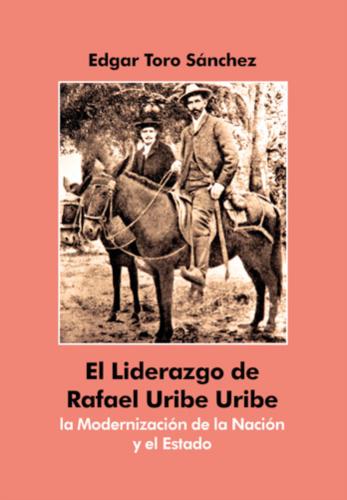
Mask design: Rafael Uribe Uribe to mule loin with Carlos Adolfo Urueta at the atlantic coast in 1901. Between Aracataca and Cienaga. Editor: Federación Nacional de Cafeteros de Colombia Printer: Legis - Junio 2008. Second edition, enlarged and corrected. Númber of pages: 266 Índex of pictures: 15 Índex of documents: 24 Size: 24 x 16.5 x 1.5 cms. Analitic Index National and foreigner bibliography.
ISBN: 978-958-98008-2-9
|
Web Sites:www.geocities.com/elcafecolombiano www.geocities.com/museo_rafael_uribe_uribe
WebSites, Notes, Third Party Opinions
Contact:Edgar Toro Sánchez Phone number: (571) 3 36 25 76 Adress: Calle 27 No. 4-18. Barrio La Macarena
Electrónic mail:
Bogotá, D.C., Colombia. South America. 2008
|
