|
|
|
|
Over the weekend, there were three charreadas, as well as a Spanish Mass Sunday morning. After breakfast in the casino's Wickiup Grill, we went to the third charreada.
We knew that we were going to see a "Mexican rodeo," but we hadn't realized how different a charreada is from the rodeo we're used to watching. We expected mariachi music, sombreros, and colorful traditional costumes, in
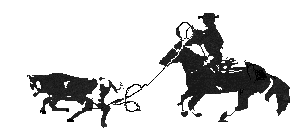
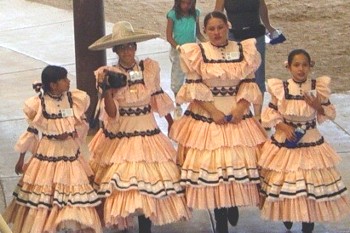
addition to horses, bulls, and roping, but the traditional Mexican-style "rodeo" is quite different in more essential ways, too. The national sport of Mexico, charrer�a has a 500-year-old history. The ten suertes, or individual and team events, show off the traditional skills of the charros, the "cowboys" of Mexican history. The charros compete with roping tricks and feats of herding, roping, bull riding, and bronc riding. Only men compete in the charreada, but charras -- women riders, also called amazonas -- participate in the escaramuza, which literally means "skirmish." Dressed in colorful, often elaborately embroidered, ruffled dresses, teams of charras demonstrate their skills at reining their horses from a full gallop and guide their mounts through elaborate patterns of crisscrossing and sharp turns. All while riding sidesaddle! For charreada, a keyhole-shaped arena, called a lienzo. The "top" of the keyhole is the ruedo, a circle 40 meters in diameter. The long, straight "bottom" of the keyhole is the manga, or "sleeve." It is 12m wide by 60m long. The first suertes take place in the manga.
In English:
A Companion Guide to La Charreada
Art of the Charrer�a: A Mexican Tradition In Spanish: La Charrer�a: El mas mexicano de los deportes
|
|

|
|
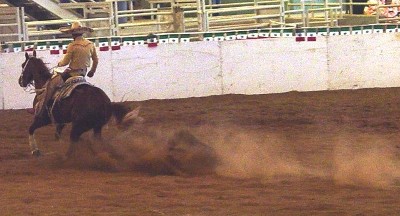 A charro and his horse leave a trail of dust as they slide into la punta, the opening of the Cala de Caballo, the "Test of the Horse" -- the first suerte.
|
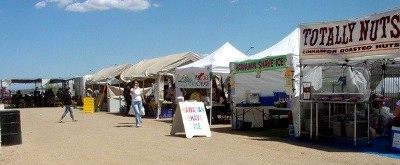 Outside the pavillion, vendors sold Mexican food and carnival treats.
|
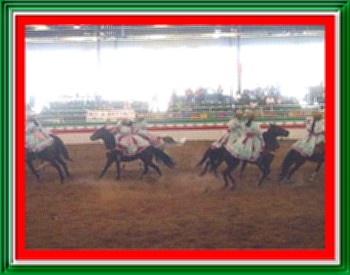 The escaramuza
|
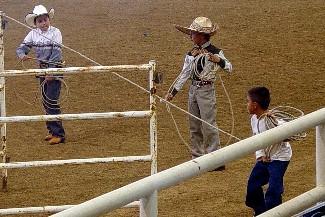
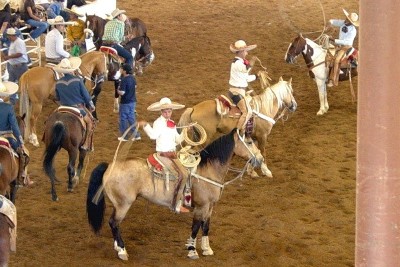 Charros practice their roping.
|
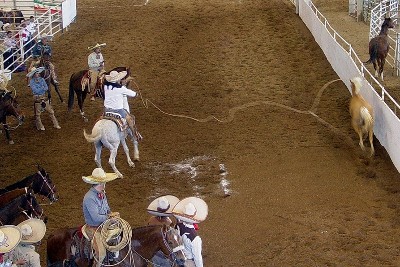 Piales en Lienzo: the charro must throw a lariat to catch the hind feet of a running wild mare; all the broncos used in a charreada are mares, or yeguas
|
|
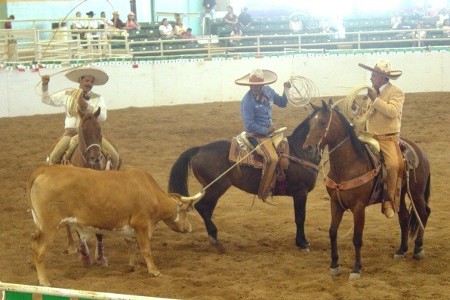 Terna en el Ruedo: after a team mate has ridden a wild bull into the ring (the ruedo,) three charros have 8 minutes in which to rope the bull by the neck and hind legs and bring it to the ground
|
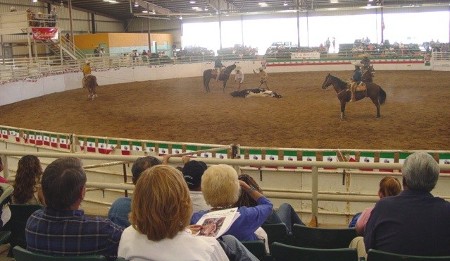 A bull is down
|
|
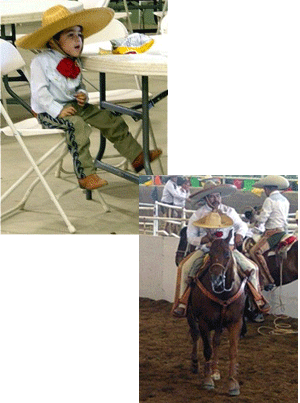
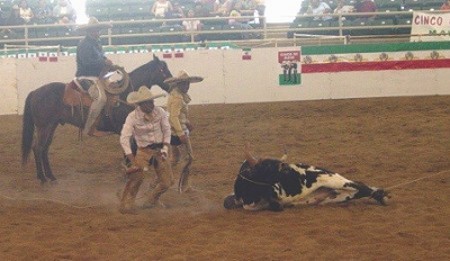
�Un charro muy peque�o con un sombrero muy grande!
|
|