| Home |  |
 |
 |
|
Electronic Language Resources: www.geocities.com/elangresources |
Subjects and Objects: An essential Part of Language Learning
Knowing the functions of words in a sentence is essential to learning a language. It enables you to know which pronoun to use in French and Spanish, as well as which case to use in German! In this lesson, English examples will be used, but the same principle can be applied to foreign languages. It is important to note, that what may work in one language will not necessarily translate directly into another. For example, my mother was given a present does not translate into other foreign languages to make a sentence which is grammatically correct, for example French, *ma mère était donnée un cadeau
The Subject of the sentence
The subject of a sentence is the "doer" of the verb. It can appear as a noun (either a person or an object) or as a pronoun (I, you, he, she, it...)
I went to town - 'I' did the action of going to town
Dave ate a sandwich - 'Dave' did the action of eating a sandwich
A vase sits on the table - 'A vase' does the action of sitting on the table
Objects
Objects "receive" the action of the verb in one way or another. An object can be a direct object, an indirect object, prepositional object or a complement.
Direct Object
The Direct Object directly receives the action of the verb from the subject. It has the action "done to it" by the subject.
Example: John kicks the ball

'Kicks' is the verb. John is the subject, as he is doing the kicking, whilst the ball is the direct object as it receives the action of being kicked.
I write a letter - 'A letter' is what is being written
I bought a coat - 'A coat' is what was bought
Dave ate a Sandwich - 'A sandwich' is what was eaten
Indirect object
The indirect object either receives the direct object, or describes 'to' or 'for' whom is done.
Example: John gives a present to his mother

'Gives' is the verb. John is the subject, as he is doing the giving. The present is the direct object, as it is being given, whereas his mother is the indirect object as she receives the direct object (the present)
I bought a car for my daughter - 'my daughter' receives the direct object (the car)
I sent him a letter, I sent a letter to him - 'him' receives the direct object (the letter)
Please see the section on intransitive verbs below to learn more about how an indirect object is used with certain verbs
Prepositional object
A prepositional object is very similar to an indirect object, but does not receive the direct object. Prepositional objects are preceded by prepositions (words such as on, in, at, with, without, by, above, under...). They often refer to manner or place
the
I sent the letter by post - 'by post' refers to the manner in which the letter was sent
I bought a car for my daughter with my credit card - 'with my credit card' again is referring to the manner
We sat down at the table - 'at the table' here refers to the place where the action took place
I live in London - 'in London' again refers to the place in which the action takes place.
Complement
A subject complement provides additional information about the subject. Verbs such as to be, to become, to seem, to look all take complements.
Example: John is a teacher
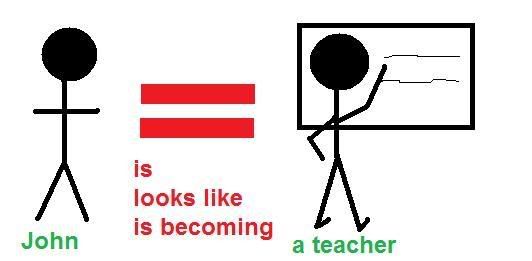
Teacher is an additional quality or piece of information about John. In this sentence, John is not performing an action to something (which would need a direct or indirect object), but the two components can be interpreted as being equal. i.e. The teacher is John
Transitive Verbs (vt)
Transitive verbs are verbs which take a direct object
John kicks a ball - 'a ball' is a direct object; making the verb 'kick' transitive
Dave ate a sandwich - 'a sandwich' is the direct object, making 'ate' transitive
If one verb is transitive in one language, it is not always transitive in another language. For example 'to help' in English is transitive 'I help my Mum', but in German, 'helfen' is intransitive 'Ich helfe meiner Mutter', 'meiner Mutter' as the indirect object.
Intransitive Verbs (vi)
Intransitive verbs are verbs without a direct object:
'I read' is intransitive because there is no direct object, it is just a general statement
'I read a book' is transitive, because 'a book' is the direct object
'I read to my daughter at night' is intransitive because there is no direct object, just 'to my daughter' as an indirect object
'I read a book to my daughter at night' is transitive because there is a direct object, 'a book' as well as an indirect object 'to my daughter'

Some verbs cannot take a direct object and therefore have to take an indirect object, for example 'to go':
I go to town - 'to town' is the indirect object
*I go town - 'town' as a direct object does not make the sentence grammatically correct
Verbs such as to die and to arrive follow this pattern. Most verbs can be used either transitively or intransitively, such as to read above.
© 2007 Electronic Language Resources. Contact [email protected]. Last updated 07/12/2007