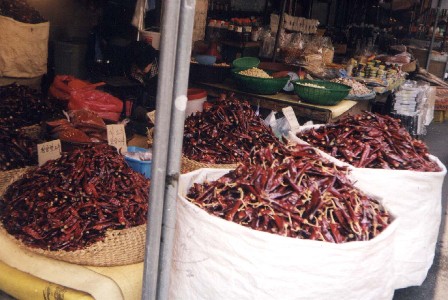
This picture was taken about three years ago at an outdoor market near my apartment. These are Korean red peppers, or "gochu." Just about every Korean dish that exists contains this stuff, if not in powder form ("gochu-garu") or paste form ("gochu-jang"), then fresh. I am surprised they haven't tried making a "red pepper ice cream" yet. Anyhow, it is Korean red pepper that makes Korean food so difficult for many Westerners to eat (although I'm completely addicted).
 .
. 
 .
. 
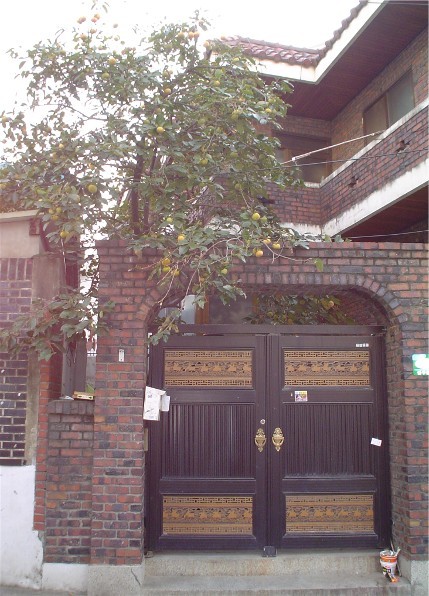
In October and November, I saw many persimmon trees, like this one, growing in front
of people's houses. Persimmons are a popular snack and recipe ingredient here.
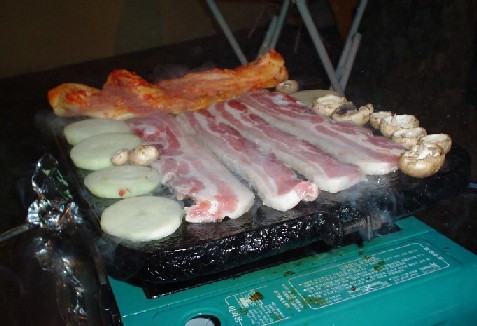
This is "sam-gyup-sal," a dish which is cooked at your table, in this case on a stone slab. If the meat looks a little like bacon, that's because it's pretty similar. It's just a bit thicker, and not quite as salty. On the left are onion slices, on the right are mushrooms, and in the back is kimchi. The idea is to cut the pork in smaller pieces with scissors once cooked or while cooking, place a piece in a lettuce leaf (usually you're given a wide variety of lettuce types) with various other things (rice, kimchi, soybean paste, garlic, etc.), and eat it.
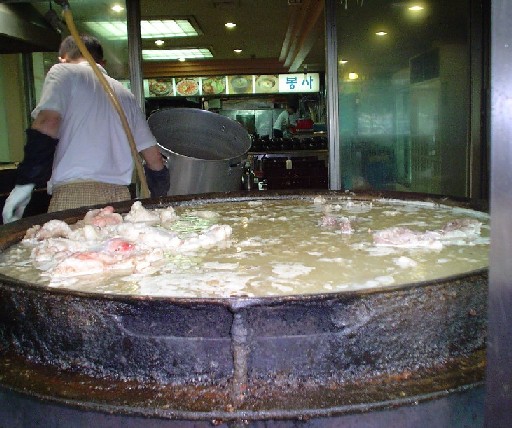
Near my apartment there is a restaurant that serves "seollung-tang," a kind of boiled beef soup. In the front of the restaurant were a few giant vats used (I guess) for boiling the fat off of the beef. Looks tasty, doesn't it?! Don't you just want to dive right in? Of all the photos I've taken so far, this is my favorite.
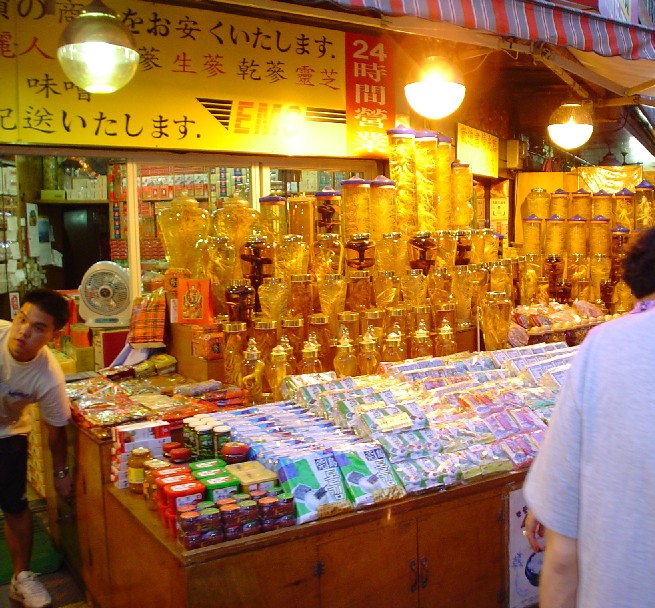
Namdemun Market is a huge outdoor market that attracts many tourists.
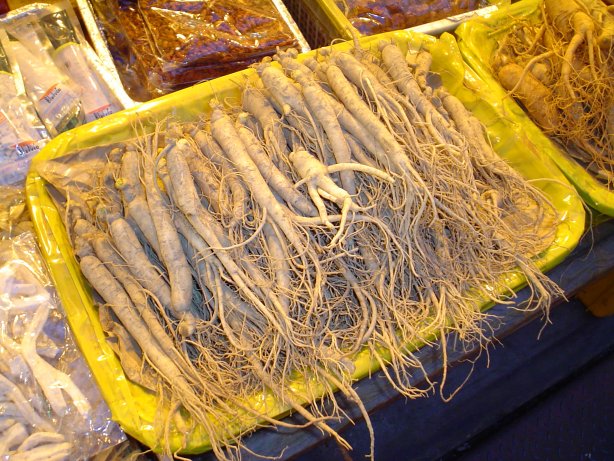
One of the biggest reasons people visit this market is for Korean products
such as "kim" (salted sheets of seaweed), Korean red pepper paste ("gochu-
jang"), and Korean ginseng. Here you can see all three of these products.
The bottles in the back contain ginseng. In front of the bottles is the
kim. On the left is the red pepper paste.
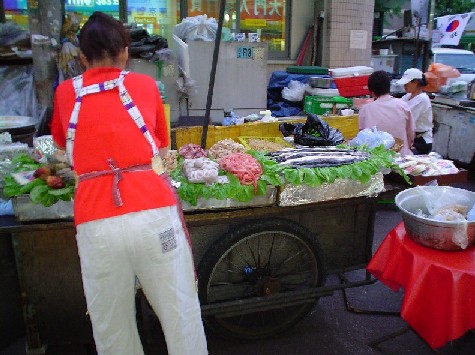
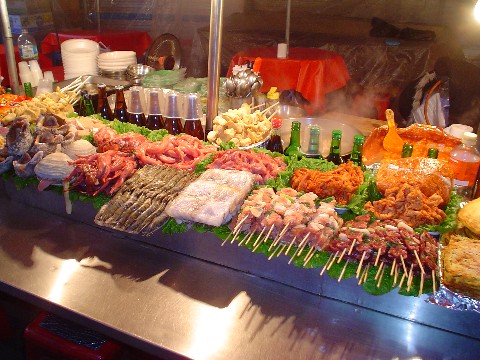
At Namdemun Market, you can also buy lots of fresh fruits, vegetables,
and meats. This picture shows a woman tending a seafood cart.
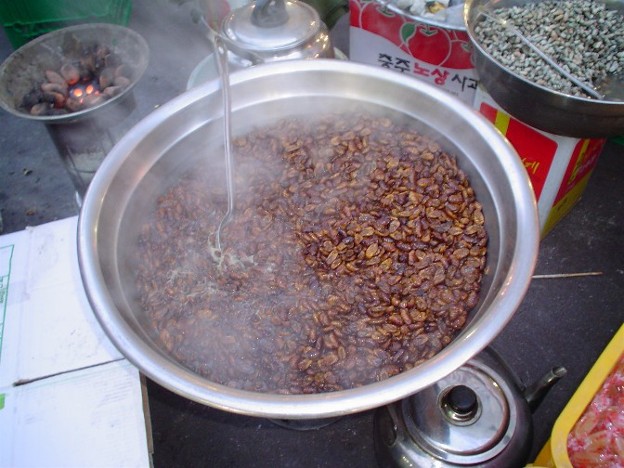
This picture, taken at Namdemun Market, shows one of the most... interesting foods Korea has to offer. It's called "bundaegi," which translates roughly to "roasted silkworm pupae." If you are able to overlook not only that these are in fact *worms*, but also that they smell rather like burnt hair while they are cooking, they are quite tasty, I'm told.
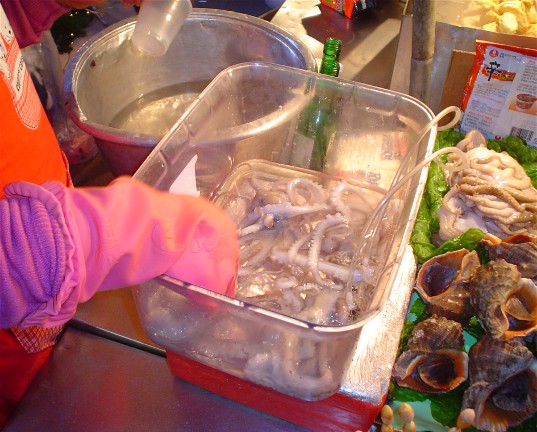
As strange as bundaegi might seem, at least it's dead. That cannot be said for "sannakchi," which is featured in the picture above. I am not sure whether these are baby octopuses or just small octopuses, but whatever the case, they are octopuses, and they are served live. They are sliced up before they are eaten, of course, but they are still wriggling when you dip them in the sauce and put them in your mouth. In the picture, a woman is adding water to the octopuses' container to keep them moving aound, thereby attracting customers. Recently, an elderly Korean man died while eating sannakchi. The octopus suctioned onto his throat and he choked to death. This has happened before, but for some reason, people continue to eat it. Must be good.
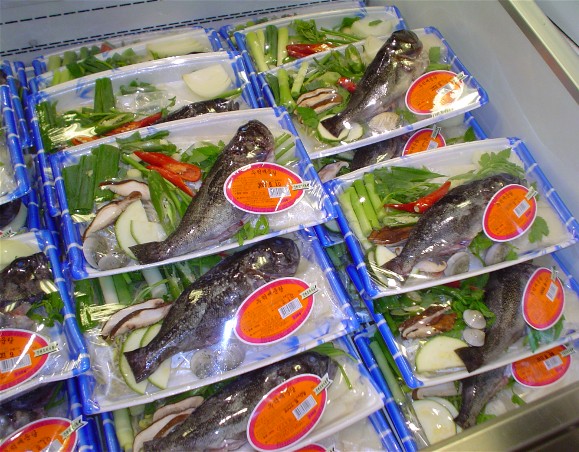
Need to throw together a quick soup? Just dump the contents of this
package into a pot of water and you're good to go. Don't worry about removing
the fish's head or skin... just dump it in the pot! You can pick up this
package of "u-reok mae-un-tang" at at your local Korean Costco!
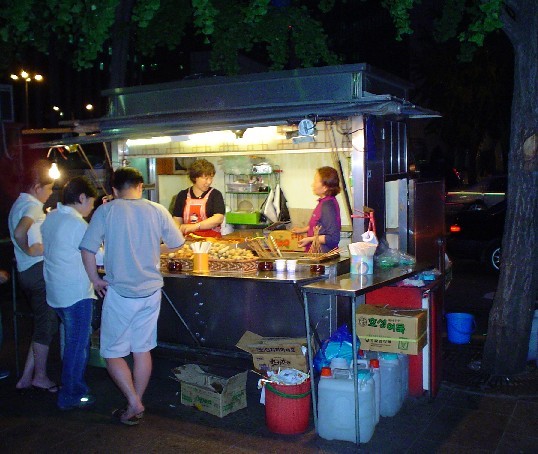
There are tons of these little "ddeokpokki" stands all over Seoul. Customers, such as the ones in this photo, generally stand at the stand and eat their ddeokpokki, but you can also ask for it "to go." Ddeokpokki is a dish consisting of these fat, two-inch-long rice cakes in a spicy (sometimes very spicy) red pepper sauce. The red pepper sauce also has sugar in it, so it can range from sorta sweet to very sweet. Many ddeokpokki recipes also contain slices of hard-boiled egg, green onions, and fish cake (odeng). See the wooden sticks in front of the woman on the far right? On the end of each stick is more fish cake, sitting in a big container of salty fish broth. If you stand and eat, they will give you a paper cup filled with this fish broth to drink. You can of course also buy a fish-cake stick to eat. A plate/bowl of ddeokpokki costs only about $1.50, and will easily feed two moderately hungry people.

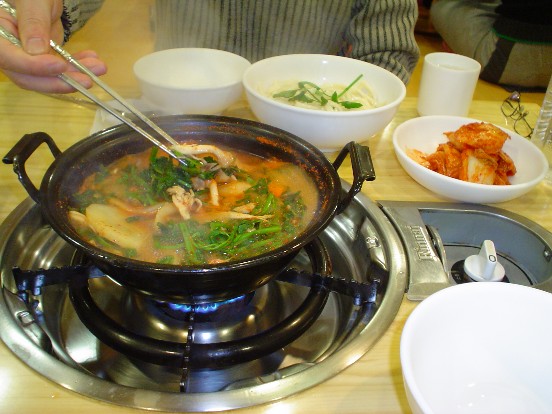
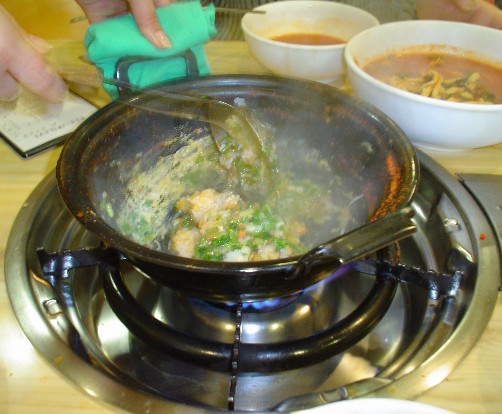
This is currently my favorite Korean meal. I know it doesn't sound like anything special (spicy mushroom soup), but it's delicious. Its Korean name is "peo-sot mae-un-tang kal-kuk-su." On the particular Sunday when these pictures were taken, there was a line outside the door. The soup, which contains fresh mushrooms, sweet potatoes, and greens, cooks at your table (first picture). When it's ready, thick noodles are added to individual bowls and mixed with the soup. When the big bowl has been emptied, they add a rice, egg, and vegetable mixture to the bowl and fry it (second picture). This soaks up the remaining spiciness. It's sooooooo delicious.