
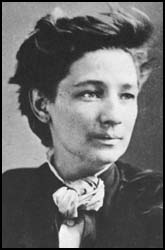
At the age of fifteen Victoria married Canning Woodhull. The following year she gave birth to Byron Woodhull. Over the next few years she earned a living by telling fortunes, selling patent medicines and performing a spiritualist act with her sister, Tennessee Claflin.
Canning Woodhull was an alcoholic and in 1864 she divorced him and two years later married Colonel James Blood. In 1868 Victoria Woodhull moved to New York City where she became friends with millionaire railroad magnate, Cornelius Vanderbilt. With Vanderbilt's backing, the enterprising sisters went into business as Wall Street's first female stockbrokers. The sisters made a large amount of money and this enabled them to publish their own journal, Woodhull and Claflin's Weekly.
Woodhull's journal was used to promote women's suffrage and other radical causes such as the 8 hour work day, graduated income tax, and profit sharing. Woodhull also exposed fraudulent activities that were then rampant in the stock market. Woodhull became the leader of the International Workingman's Association in New York and in 1872 controversially became the first person to publish The Communist Manifesto by Karl Marx and Frederick Engels.
In May 1872 Victoria Woodhull was nominated as the presidential candidate of the Equal Rights Party. Although laws prohibited women from voting, there was nothing stopping women from running for office. Woodhull suggested that Frederick Douglass should become her running partner but he declined the offer.
During the campaign Woodhull called for the "reform of political and social abuses; the emancipation of labor, and the enfranchisement of women". Woodhull also argued in favour of improved civil rights and the abolition of capital punishment. These policies gained her the support of socialists, trade unionists and women suffragists. However, conservative leaders of the American Woman Suffrage Association, such as Susan Anthony and Elizabeth Cady Stanton, were shocked by some of her more extreme ideas and supported Horace Greeley in the election.
Friends of President Ulysses Grant decided to attack Victoria Woodhull's character and she was accused of having affairs with married men. It was also alleged that Victoria's previous husband was an alcoholic and her her sister, Utica Claflin, took drugs. Woodhull became convinced that Henry Ward Beecher was behind these stories and decided to fight back. She now published a story in the Woodhull and Claflin's Weekly that Beecher was having an affair with a married woman.
Woodhull was arrested and charged under the Comstock Act for sending obscene literature through the mail and was in prison on election day. (Woodhull's name did not appear on the ballot because she was one year short of the Constitutionally mandated age of thirty-five.) Over the next seven months Woodhull was arrested eight times and had to endure several trials for obscenity and libel. She was eventually acquitted of all charges but the legal bills forced her into bankruptcy.
In 1878 Woodhull moved to England. She continued to campaign for women's rights and in 1895 she established the Humanitarian newspaper. Victoria Woodhull died on 9th June, 1927.
