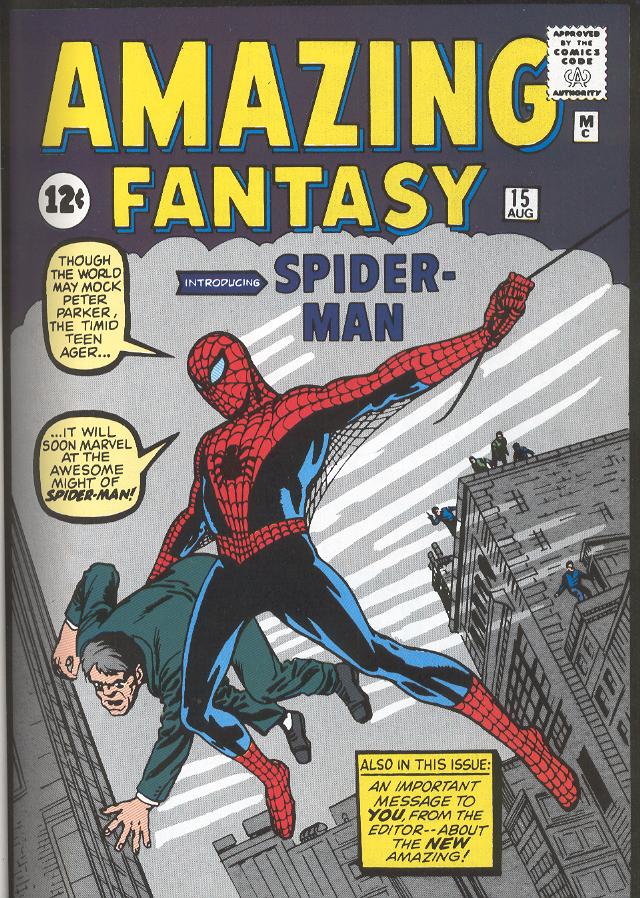
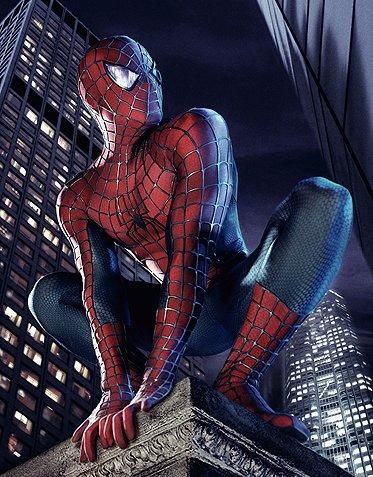
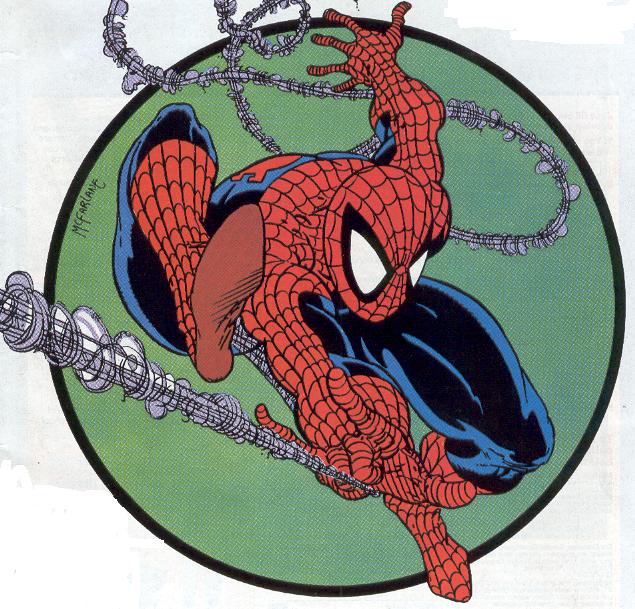
As we compare Spider-Man�s movie and comic origins, it must be noted that I will be using the original
1962[1] comic book version for comparison. An �updated� version of Peter Parker�s transformation was created in 1998[2]�but it stinks and is unnecessarily bloody. I�ll stick with the classic story (by Stan Lee and Steve Ditko) that I grew up knowing. In addition, another Spider-Man series was started in 2000 with a new origin that closely resembles the movie[3]. But this series is �out of continuity� with the other Spider-Man series (think of it as an evil parallel world from Star Trek) and is obviously based on the movie script�so I�m ignoring it.
When the comic origin begins, Peter Parker is merely a high school freshman. In the movie, he�s a senior (probably a good choice�Tobey Maguire as a 15-year-old would be quite a stretch). The theatrical Peter attends the fateful genetics lab with his class, while the four-color Parker goes alone to an open-to-the-public radiation experiment. In the 60�s, radiation was a great unknown, so a crapload of Marvel�s heroes/villains were the result of radiation (remember what those darn gamma rays did to Bruce Banner?). Today, the possibilities of genetic engineering are the big scientific mystery�so a nice change by the script writers. Ouch! Comic Peter gets bitten by the irradiated arachnid just as it dies. The movie�s genetically-enhanced super-spider crawls away after chomping our hero.
As Peter discovers his new powers, we reach THE big debate among comic geeks (like myself)�mechanical vs. organic web-shooters! In the movie, the creepy stuff comes right out of his wrist. In the comic, Parker (not just a science whiz but a virtual scientific genius) invents the chemical webbing which neatly dissolves in one hour (wouldn't want to leave unsightly webs hanging all over the city). The mechanical shooters are useful plot devices for the monthly comics�as our hero must periodically overcome damage to his shooters or running out of web fluid. Plus being a near-genius allows Spidey to create machines/chemicals to defeat villains--instead of always just beating the crap out of them. However, my heresy knows no bounds! I prefer the organic webbing from the movie. It makes Peter even more of an outcast (since none of his other powers really have that �ick� factor) and eliminates the question: �Doesn�t anyone ever wonder why this kid keeps buying these same chemicals over and over?� Also, the comics are forced to ignore the fact that Peter could sell the chemical compound (which can suspend a car and dissolves completely in exactly hour) for millions of dollars.
The origin story continues with Parker�s foray into the wrestling ring. Movie Peter takes on Bonesaw (and actually has some trouble beating him) for $3000. Comic Peter whips Crusher Hogan (who never even lays a hand our boy) for $100 (Hey, it was 1962.); afterwards, a TV producer from the audience makes Comic Spider-Man a variety-show television star. Fame goes to the head of comic Peter and becomes his downfall as he lets that darn burglar run past him and escape�an act mirrored by the movie. Of course, that miscreant comes back to haunt both Peters as he kills Uncle Ben: during break-in at the Parker�s house in the comic, and during a carjacking (a nice modern crime) in the theater. Hungry for vengeance, Movie Spider-Man chases the killer into a warehouse where the villain accidentally falls to his death. The police already have the bad guy trapped in the warehouse by the time Comic Spider-Man arrives�who then captures Ben�s killer and turns him over to the police alive. (Comic Ben�s murderer even returns years later to harass Peter some more[4].) Just to note�Comic Spider-Man�s TV career is shot when the Daily Bugle publishes a scathing anti-Spidey editorial by J. Jonah Jameson[5].
The final piece of the Spider-Man legend is put in place during the movie as Peter gets a freelance photographer job with the Daily Bugle by obtaining the first pictures of Spider-Man. In the comic, Peter gets his break with J. Jonah Jameson�s other publication, Now Magazine, for taking the first photos of the Vulture�the dreaded flying thief[6]. |