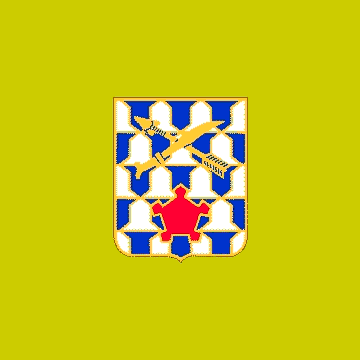
I served in D Co. 2nd Battalion 16th Infantry Regiment from 1991-1993 at Fort Riley, Kansas.
The 11th and 34th Infantry Regiments consolidated into the 16th Infantry Regiment on 3 March 1869. The 11th Infantry, organized 4 May 1861, had battle streamers for Gaines Mill, Bull Run, Fredericksburg, Chancellorsville, Gettysburg, Wilderness, Lauren Hill, Spottsylvania Courthouse, Cold Harbor, Petersburg, Weldon Railroad and Chapel House. The 34th Infantry (which had been the 3rd Battalion of the Civil War 16th Infantry) had banners for Shiloh, Murfeesboro, Chickamuaga, Missionary Ridge, New Hope Church, Kenesaw Mountain, Neal Dow Station, Peach Tree Creek, Atlanta and Joesboro. Each Regiment possessed a bloody and honorable record. Both Regiments were doomed to lose their designations for the new Regiment was numbered the 16th, and were consolidated by merging the enlisted men of one Regiment with the company of the same letter of the other, and assigning the officers by rank as provided by the order of consolidation. The new Regiment thus formed was stationed at six different posts, engaging in assisting the civil authorities in carrying out the provisions of the Reconstruction Act of Congress. The headquarters of the Regiment, with Companies D and I, was at Grenada, Mississippi. The lieutenant colonel was located with Companies B, E and G at Jackson, Mississippi. The major was located with Companies C and F at Vicksburg, Mississippi. Company A was located at Nanchez, Mississippi, H at Lauderdale, Mississippi, and K at Corinth, Tennessee. This extensive scattering of the Regiment at this time was unfortunate, with the two Regiments coming together from distant parts of the country and the officers being unacquainted with each other. This want of personal knowledge of his Regiment was felt more especially by the Regimental commander, Colonel Galusha Pennypacker, the youngest Regimental commander in the Civil War. Care was taken by the new commander to remedy and allay any discordance that might exist. Frequent visits were made to all of the posts both by the colonel and his staff and, by reason of these visits, one of the chief disadvantages was in a short time overcome. The company officers became thoroughly acquainted with the headquarters of their Regiment and an esprit de corps soon commenced to show itself, which gives to the Regiment a distinctive reputation to this day. Reconstruction duty was considered by most of the Regimental soldiers as a disagreeable task from 1869 to 1877. The companies of the Regiment were called upon to act in unison only three time during the period mentioned. Once when Companies B, E, F, G, I and K made a march in October, November and December, 1870 through Alabama, Georgia and South Carolina for the suppression of the Ku Klux Klan. Again, when Companies C and I, under the command of CPT Thomas Rose during the Brooks-Baxter political imbroglio at Little Rock, prevented what threatened at one time to become a most serious outbreak. This occurrence attracted, at the time, the attention of the nation. Fears were entertained that it might prove to be a national disaster, but the determine and energetic action of the commander, who already had a national reputation for energy, skill and nerve, averted the calamity without bloodshed. The third time was when all of the Regiment, except Company H, was concentrated at New Orleans during the Packard-Nichols troubles in 1876. This ended the Reconstruction service of the Regiment. In eight years in which it was so engaged its headquarters were at Grenada, Mississippi; Nashville, Tennessee; Newport, Kentucky; Mount Vernon Barracks, Alabama and New Orleans, Louisiana. Its companies were stationed in Kentucky, Tennessee, Alabama, Mississippi, Louisiana and Arkansas. The duties imposed were performed conscientiously, though in nearly every case they were distasteful to soldiers. While no open conflicts occurred, they were imminent almost daily at some locality. In 1877 the Regiment was for the first time called to new, and what was considered the more legitimate duties of the profession. Leaving the Southern States and all the political complications involved in service there, it crossed the Mississippi and commenced a new career in Indian country. Headquarters, with Companies A, C and H were stationed at Fort Riley, Kansas; K at Fort Gibson, Indian Territory; B and D at Fort Sill, Indian Territory; E and I at Fort Reno, Indian Territory; F at Fort Wallace, Kansas and G at Fort Hayes first and subsequently at Fort Wallace. For three more years the Regiment was stationed as above, except that I and K exchanged stations. During this time, companies D and H went with General Buell in the Victorie campaign through New Mexico. Company H was detached and went as escort with a railroad surveying party through Arizona. Companies F and G were engaged in the pursuit of Cheyenne Indians who escaped from the Indian Territories and were not captured till they got to the sandhills near Ft. Robinson, Nebraska. Company A was engaged with these same Indians below Ft. Dodge, Kansas. Companies C and G were with General Ronald Mackenzie in the campaign of 1870-80 and Company F made a campaign against the Utes into middle Colorado. In 1880 the Regiment was ordered to Texas and was stationed as follows: Headquarters and Company F first at San Antonio, but soon afterward with D, E, G, H, I, and K at Ft. McKavett; A, B, C, and I at Ft. Concho. In June 1888 the Regiment was moved to the Department of the Platte. Headquarters, with B, D, E, G, H, and I being stationed at Ft. Douglas and A, C, F, and K at Ft. Duchesne, Utah. While stationed at these posts, individual service of CPT Rose and some enlisted men at Ft. Duchesne was mentioned in orders, and Companies D, E, G, and H were engaged in the campaign against the Sioux Indians in 1891. With peace restored in the West, elements of three Regiments were scattered about various garrisons throughout the newly settled West. Garrison life with its monotony filled the years until the outbreak of the Spanish-American War. Battalions and companies were assembled at Tampa, Florida in May of 1898. Very shortly it was one of the first American organizations to disembark at Siboney, Cuba. Almost immediately the Regiment plunged into the short, bloody Cuban campaign. On July 1st it lost 7 officers and 112 enlisted men at the �Bloody Ford� at the base of San Juan Hill. Despite severe losses, the 16th assaulted the famous ridge and it was two of its first men�Sergeant Diehl and Corporal Van Horne�who planted the first American flag to fly from the Spanish blockhouse on the hill. The comment of a neutral military observer who witnessed the charge is interesting. With the Fifth U.S. Corps was a German military attach� noted for his appreciation of things military. After the capture of San Juan, the officer reported ��the dash and spirit displayed by the 6th and 16th Regiments of Infantry which came under my immediate observation were marvelous.� Less than two decades later, crack Prussian troops were to feel the irrepressible �dash and spirit� of these same American doughboys. Decimated by the roll of many battles and fever-ridden, the 16th returned to Montauk Point, Long Island, New York, in August 1898. Less than half its strength remained available for duty. The Regiment went into camp. Duration-of-war men were discharged. Recruiting began and full time peace strength was built up. A move was made to originally camp in Alabama, then sent piecemeal to Fort Crook, Leavenworth, and Jefferson Barracks. Training of the new men went on at this station until the summer of 1899 when the 16th embarked for its first tour of duty in the Philippines. In these tropic islands the Spaniards had relinquished their rule, but fierce Filipino insurgents battled for release not only from domination by the Spaniards but also from any hint of government by the United States. For two years the 16th trekked over tortuous mountain trails and hacked its way through thick tropical jungles. In that time, it fought 27 engagements with the greater part of its activities concentrated against the wily rebels in the Cagayan Valley. Back to the United States in 1901, the normal course of garrison duties was resumed at Ft. MacPherson, GA. Four years of this and back to the Philippines went the 16th. From August 1901 to March 1907, a few companies of the Second Battalion were in inactive service against the Pulajanes on Leyte. On this same island, almost four decades later, more American Infantry waged a desperate campaign against the Japanese invaders who had dominated the islands for almost four years. Another return to the states put the Regiment in garrison most of the time for the next three years. These years of comparative activity were broken only once when Companies I and M were dispatched to round up a few Ute Indians who had broken off their reservation in South Dakota. With the U.S. entry into World War I the 16th began its association with the 1st Infantry Division. The 16th was one of the four original Infantry Regiments used to form the Division in June 1917. It was this Regiment that took part in the July 4th parade in Paris in which the words �Lafayette we are here� were stated and which marked the commitment to the Allied cause. The 16th became the first unit to engage the enemy in battle and was the first to spill is blood on French soil. On 3 November 1917 the first three Americans killed by the enemy were Corporal James B. Gresham, PVT Thomas F. Enright and PVT Mark D. Hay, all of F Company, 16th Infantry. In addition 1 sergeant and ten privates were taken prisoners. During the battle for Cantigny in May 1918, which was the first major offensive action for the American army, the 16th was called upon to relieve the 28th and 18th Regiments and to consolidate the new front in spite of determined efforts by the Germans to recapture the town. This action cost the 16th 372 casualties. During the war the 16th Infantry took part in every major campaign that the 1st Division conducted and added seven more campaign streamers to its colors. These campaigns all had a cost. During the battle for Soissons, for example, the Regiment, at the end of five days of fighting, had a Battalion with only forty non-injured soldiers out of the 1100 men who had started over the top. Never before had the 16th suffered such heavy losses in the same length of time. Near Fleville, France, the 16th gained seven miles in a single day and was the only Allied unit to take its objective during the opening drive of the Meuse-Argonne Campaign. Despite the vicious German counterattacks to retake the town on 4 October, the 16th Infantry was able to hold on. In celebration of this feat, 4 October is still celebrated as the 16th Infantry organizational day. With the armistice going into effect at 1100, 11 November 1918, the war to end all wars was over. The 1st Division, along with the 16th, would remain as occupational forces. On 1 December 1918, the 1st Infantry Division for the first time marched on German soil. The march into Germany took 27 days, during which a distance of more than 200 miles was covered. Returning home in September 1919, the Regiment was stationed at Ft. Jay, New York on Governer�s Island. It was during this time that New York City Mayor La Guardia named the 16th �New York�s own� and the �Sidewalks of New York� became the Regimental song. The breakout of war in Europe in September 1939 found the 1st Division scattered among the various garrisons of the Atlantic seaboard. In February 1941 the Division was brought together at Ft. Devens, Massachusetts for maneuvers and training. Following the Japanese bombing of Pearl Harbor on 7 December 1941, the division�s training intensified. The 16th and the rest of the division moved to Camp Blanding, Florida for amphibious training and then to Ft. Benning, Georgia for additional division level training. The Regiment sailed to England and then to Scotland in August 1942 for training in preparation of the first major offensive operation of the European theatre. The 16th Infantry received their baptism of fire during Operation Torch, the invasion of North Africa, on 8 November 1942. The city of Oran, Algeria was the original objective of the Regiment and after three days of fighting it was secured. For the next six months, the 1st Division participated in the Allied effort to force the Axis out of North Africa, and participated in several key actions to include Kasserine Pass and the Tunisian Campaign. Due to its heroic stand at Kasserine, the 16th received the French Croix de Guerre, and also received its first Presidential Unit Citation for actions at Mateur, Tunisia. With Sicily secured, the 16th returned to England where it prepared for its third amphibious assault landing of the war�Operation Overlord, the landing at Omaha Beach. On D Day, 6 June 1944, soon after the 11th hour the 16th was fighting for its very life on a strip of beach marked East Red. By early evening the Regiment had obtained its objective after suffering heavy casualties, but was preparing to push forward. The day was truly the longest day and individual courage was the mark of the 16th Regiment. By nightfall, the 16th had earned its third Presidential Unit Citation, its second Croix de Guerre and two soldiers (1LT Jimmie Montieth and Tech 5 John Pinder) had earned the Medal of Honor. During the weeks that followed, the Regiment moved through the Normandy hedgerows, raced across France and Belgium, breached the Siegfried Line on 15 September and attacked the first major German city. In defense of the Fatherland, the German soldiers fought fiercely, but after days of bitter and bloody fighting the German commander surrendered the rubble of Achen to 1st Division on 21 October 1944. Few buildings remained intact. On 16 December the Germans launched a massive counter-attack in the Ardennes Sector. The Battle of the Bulge was underway. On 15 January the 16th was once again on the attack. This time the Regiment would continue its drive across Germany, crossing the Rhine River for the second time in its history on 16 March. On 8 April the Regiment crossed the Weser River into Czecholslovakia. On 8 May 1945, the war ended for the 16th Infantry after 443 days of combat. In addition to those already noted, the Regiment was awarded six more combat streamers. Additionally, the 16th was awarded the Medaille Militaire with streamer embroidered �France,� the French Medaille Militaire Fourragere and the Belgium Fourragere. Two more Presidential Unit Citations for Hurtgen Forest and Hamich Germany were awarded to the Regiment. Post war, the 16th was once again part of the Occupation Force. In 1948 the Regiment assembled at Grafenwoehr for division maneuvers. In the summer of 1955 the 1st Division was replaced by the 10th Mountain Division in Operation Gyroscope, and after 13 years of overseas duty the 16th Infantry would again call Ft. Riley its home. In the summer of 1965 the 16th was once again deploying overseas for combat. The 2nd Battalion deployed in June 1965 to South Vietnam. On 22 July 1965 the division�s first offensive operation of the war was conducted. For nearly five years the 1st and 2nd Battalions fought a war against the jungle, as well as regular and irregular North Vietnamese forces. For its battle record in Vietnam, the 16th was awarded eleven campaign streamers, the Republic of Vietnam Cross of Gallantry Unit Citation with Palm Streamer and the Vietnamese Civil Action Honor Medal Unit Citation with First Class Streamer. C Company of the 2nd Battalion was awarded the Valorous Unit Citation. In addition, PSG Matthew Leonard of the 1st Battalion and SGT James Robinson of the 2nd Battalion were awarded the Medal of Honor. From the return of the division in April 1970 until the deployment to Saudi Arabia in November 1990 the 16th was at Ft. Riley enjoying 20 years of peace. During this time active Battalions expanded to five under the new U.S. Army Regimental System. The 2nd and 5th Battalions were at Ft. Riley, the 3rd Battalion was Army Reserve at Scarborough, Maine, and the 1st and 4th Battalions in Germany as part of the 1st Infantry Division (Forward). The 1st Division deployed to the Persian Gulf in November 1990 as part of Operation Desert Shield for its fourth overseas war. On 24 February 1991 the 5th Battalion, as part of the 1st Brigade, spearheaded the division�s main armor attack into Iraq by breaching the lines for the rest of VII Corps to follow. For the next 100 hours both the 2nd and 5th Battalions took part in the race across Iraq, a trip that would cover 260 kilometers, destroying all or part of eleven enemy divisions, more than 550 enemy tanks, and 480 armored personnel carriers. In addition, the division captured over 11,400 enemy prisoners of war. Two new campaign streamers were added to the Regimental standards�the Defense of Saudi Arabia and the Liberation of Kuwait. In addition, the 5th Battalion was awarded the Valorous Unit Citation.