|
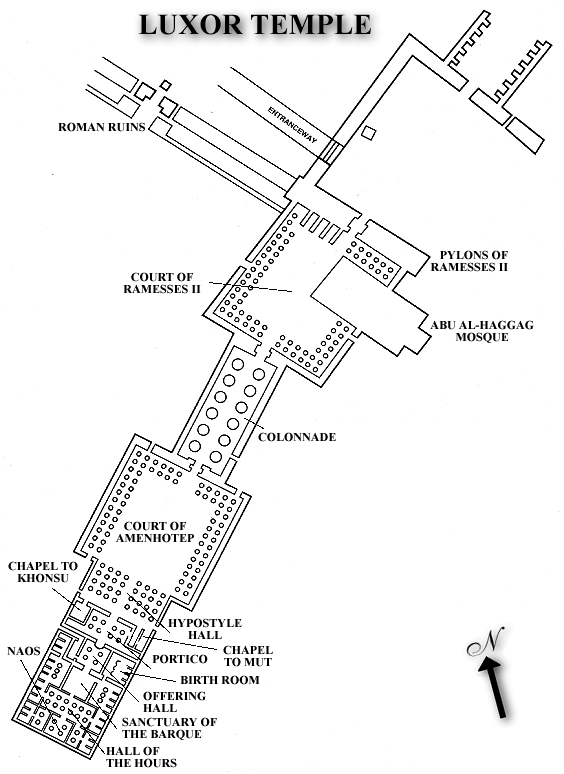
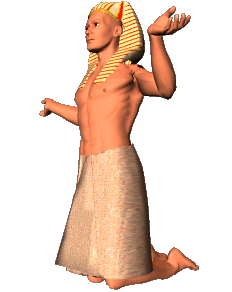
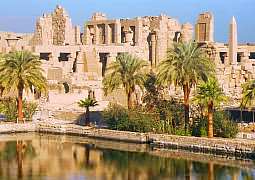
This is the Temple of Luxor, located in Luxor, Egypt. This temple is almost never mentioned without its companion, the Temple of Karnack, famous for its 2 mile road leading from the Temple of Luxor lined by ram-headed gods/sphinxes leading into the Temple of Karnack's outer court. The Temple of Luxor is also known as the Temple of Man, due to its layout. When one is looking at the blue prints the shape of a (hu)man is noticeable, albeit the figure is not blatently present, but after careful study it can be made out. The Naos and the Hall of Horus form the head, the Sanctuary of the Barque the neck, the Offering Room, Birth Room, Portico, Chapel to Mut, Chapel to Khonsu form the chest. The Hypostle Hall and the pillars surrounding the Court of Amenhotep form the shoulders and arms respectivley, the court itself forming the stomach. The Collonade forms the lower stomach and pelvis, and the pylons surrounding the Court of Ramasses II form the legs and feet. At the time in which the temple was in service, Luxor was known as Thebes, the capital of ancient Egypt. The building of the temple was begun by Ramasses II and finished by Amenhotep III. The site of the temple itself made it ideal for festivals, and was the center of attention at least once a year at the festival of Opet, which signified the renewal of the godliness of the king, the re-entering of his ka. The temple itself is dedicated to three gods the so called "Thebian Triad", Amun, Mut, and Khons. More information on these gods will be available at a later date on another page. During the festival of Opet, the statues of the gods and goddesses were carried from the Temple at Karnack to the Temple at Luxor by a road connecting the two temples, however starting in the late eighteenth dynasty the statues were carried by barges on the Nile, each statue with its own barge. In order to unearth the ruins of the Temple, the archiologists literally had to move an entire town that had been built on top of it, the locals, however, refused to let the Abu Al-Haggag mosque to be removed, since it is dedicated to the towns patron saint. There will be another page added shortly that will go further into detail on the spiritual aspects of both the Temples of Luxor and Karnak. |
|