Martin-day A long time ago this day was an important day being the last day of the autumn.
In some parts of Hungary the herd was taken in for the winter. In Baranya it
was meant that in March the weather will be during the whole next year like
that on Martin-day. Others thought, that the weather this day will determine
the weather of the next 40 days. Martins goose was remembered on this day,
because this is the time to feed up the goose, and on this day it is compulsory
to eat goose. Those who do not eat goose on this day, will be hungry for the
whole year. The celebration also involves drinking the new season’s wine.
Martin is the judge of the wine.
(by Zoltán Biczó XI.A)
The”Stump”
Marriage
I am a student living in Slovenia but
studying in Hungary at Kölcsey Ferenc Gimnázium. I’d like also to present a
tradition from my village Hodos, which is near to the Hungarian-Slovenian
border.
In my country in Slovenia we have got a
nide-spride folk custom of the „Rönkhúzás”. We celebrate this custom when there
has not been a marriage in the village for a year. We select a man, who will be
play the bridegroom, then go to the forest to bring the „rönk” (rönk=stump) to
the house of the „girl” who must be an old woman. She will marry the groom.
There is also a vicar who will marry the couple. The people who are watching
the „rönkhúzás” come to the stump to buy it. Together with the young married
couple many other men and women come who are playing different roles: one is a
bear, the other is a devil and many more others. They are entertaining the
people who are watching the „rönkhúzás”. Everybody is very cheerful and have a
lot of fun. This custom is also very famous in some parts of the „Õrség”,
the western part of Hungary. (by Dusan
Orban XI.A)
The Hungarian hand-made
embroidery is famous. “Hövej” white embroidery is made
in handicraft 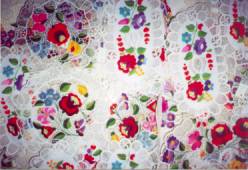 co-operatives according to folk artists’ patterns/designs. It is
embroidered on coloured batiste or white flax linen in „spider technique”
Hungary exports it in great quantities to some contries of Western Europe. “Matyó” is a Hungarian ethnic group
with numerous cherished traditions living in villages of Mezõkövesd,
Szentistván and Tard Borsod counties. They were famous from the middle of the
19th century for their high-level embroidering trade and coloured
national costumes. In the twenties the level of embroidery began to fall
because of commercialism. Nowadays they wear their national dresses on festive
occasions only. The “buzsák” embroidery takes its origin from Somogy country,
it is famous for coloured handicraft embroidering. Their favourite colours are
red and blue. Sárköz is situated between Szekszárd and Bátaszék. It is famous
its national costumes. The characteristic feature of this embroidery is a white
pattern on black linen, which is mainly used on bonnets and lace. In addition
to paprika Kalocsa is famous for its point lace.
co-operatives according to folk artists’ patterns/designs. It is
embroidered on coloured batiste or white flax linen in „spider technique”
Hungary exports it in great quantities to some contries of Western Europe. “Matyó” is a Hungarian ethnic group
with numerous cherished traditions living in villages of Mezõkövesd,
Szentistván and Tard Borsod counties. They were famous from the middle of the
19th century for their high-level embroidering trade and coloured
national costumes. In the twenties the level of embroidery began to fall
because of commercialism. Nowadays they wear their national dresses on festive
occasions only. The “buzsák” embroidery takes its origin from Somogy country,
it is famous for coloured handicraft embroidering. Their favourite colours are
red and blue. Sárköz is situated between Szekszárd and Bátaszék. It is famous
its national costumes. The characteristic feature of this embroidery is a white
pattern on black linen, which is mainly used on bonnets and lace. In addition
to paprika Kalocsa is famous for its point lace.
(Klaudia Fodor XI.A)