Kjetil Kjernsmo's illustrated guide on
This is a very easy lesson, and I
would say, not sufficient for those who would like to travel safely
in unfamiliar terrain.
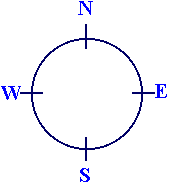
The first thing you need to learn, are the directions. North,
South, East and West. Look at the figure
and learn how they are. North is the most important.
There
are several kinds of compasses, one kind to attach to the map,
one kind to attach to your thumb. The thumb-compass is used mostly
by orienteers who just want to run fast, and this is the kind
of compass I normally use.
But not in this tutorial. I would recommend the third kind of
compass. Let's take a look at it:
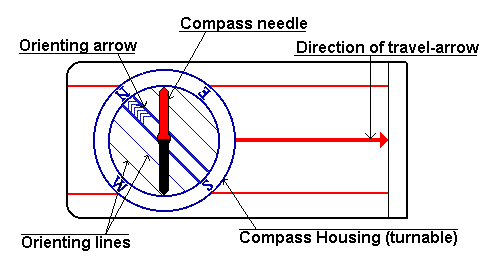
You see this red and black arrow? We call it the compass needle. Well, on some compasses it might be red and white for instance, but the point is, the red part of it is always pointing towards the earth's magnetic north pole. Got that? That's basically what you need to know. It's as simple as that.
But if you don't want to go north, but
a different direction? Hang on and I'll tell you.
You've got this turnable thing on your compass. We call it the
Compass housing. On the edge of the compass housing,
you will probably have a scale. From 0 to 360 or from 0 to 400.
Those are the degrees or the azimuth (or you may also
call it the bearing in some contexts). And you should have the
letters N, S, W and E for North, South, West and East. If you
want to go in a direction between two of these, you would combine
them. If you would like to go in a direction just between North
and West, you simply say: "I would like to go Northwest
".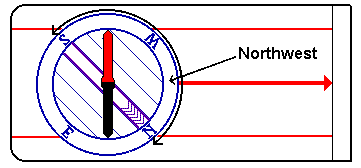
Let's use that as an example: You want to go northwest. What
you do, is that you find out where on the compass housing northwest
is. Then you turn the compass housing so that northwest on the
housing comes exactly there where the large direction of travel-arrow
meets the housing. 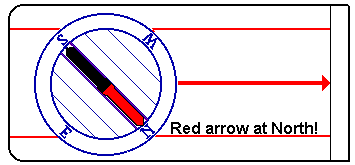 Hold
the compass in your hand. And you'll have to hold it quite flat,
so that the compass needle can turn. Then turn yourself, your
hand, the entire compass, just make sure the compass housing doesn't
turn, and turn it until the compass needle is aligned with the
lines inside the compass housing.
Hold
the compass in your hand. And you'll have to hold it quite flat,
so that the compass needle can turn. Then turn yourself, your
hand, the entire compass, just make sure the compass housing doesn't
turn, and turn it until the compass needle is aligned with the
lines inside the compass housing.
Now, time to
be careful!. It is extremely important
that the red, north part of the compass needle points at north
in the compass housing. If south points at north, you would walk
off in the exact opposite direction of what you want! And it's
a very common mistake among beginners. So always take a second
look to make sure you did it right!
A second problem might be local magnetic attractions. If you are
carrying something of iron or something like that, it might disturb
the arrow. Even a staple in your map might be a problem. Make
sure there is nothing of the sort around. There is a possibility
for magnetic attractions in the soil as well, "magnetic
deviation", but they are rarely seen. Might occur if
you're in a mining district.
When you are sure you've got it right, walk off in the direction
the direction of travel-arrow is pointing. To avoid getting off
the course, make sure to look at the compass quite frequently,
say every hundred meters at least.
But you shouldn't stare down on the compass. Once you have the
direction, aim on some point in the distance, and go there. But
this gets more important when you use a map.
There is something you should look for to avoid going in the opposite direction: The Sun. At noon, the sun is roughly in South (or in the north on the southern hemisphere), so if you are heading north and have the sun in your face, it should ring a bell.
When do you need this technique?
If you are out there without a map, and you don't know where you
are, but you know that there is a road, trail, stream, river or
something long and big you can't miss if you go in the right direction.
And you know in what direction you must go to get there, at least
approximately what direction.
Then all you need to do, is to turn the compass housing, so that
the direction you want to go in, is where the direction of travel-arrow
meets the housing. And follow the above steps.
But why isn't this sufficient? It is not very accurate. You are
going in the right direction, and you won't go around in circles,
but you're very lucky if you hit a small spot this way. And that's
why I'm not talking about declination here. And because
that is something connected with the use of maps. But if you have
a mental image of the map and know what it is, do think about
it. But I think you won't be able to be so accurate so the declination
won't make a difference.
If you are taking a long hike in unfamiliar terrain, you should always carry a good map that covers the terrain. Especially if you are leaving the trail. It is in this interaction between the map and a compass, that the compass becomes really valuable. And that is dealt with in lesson 2.