Kjetil Kjernsmo's illustrated guide on
How to use a compass
Magnetic Declination
Unfortunately, sometimes, for some quite
often, it is even more complicated. There is something called
magnetic declination. You see, the compass is pointing
towards the magnetic northpole, and the map is pointing
toward s the geographic northpole, and that is not the
same place.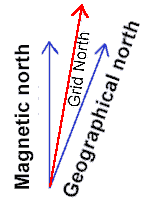 To make things even more complicated,
there is on most hiking-maps something (that is very useful) called
the UTM-grid. This grid doesn't have a real north pole,
but in most cases, the lines are not too far away from the other
norths. Since this grid covers the map, it is convenient to use
as meridians.
To make things even more complicated,
there is on most hiking-maps something (that is very useful) called
the UTM-grid. This grid doesn't have a real north pole,
but in most cases, the lines are not too far away from the other
norths. Since this grid covers the map, it is convenient to use
as meridians.
On most orienteering maps (newer than the early 70's), this
is corrected, so you won't have to worry about it. But on topographic
maps, this is a problem.
First, you'll have to know how large the declination is, in degrees.
This depends on where on the earth you are. So you will have to
find out before you leave home. Or somewhere on the map, it says
something about it. One thing you have to remember in some areas,
the declination changes significantly, so you'll need to know
what it is this year.
If you are using a map with a "UTM-grid",
you want to know how this grid differs from the magnetic pole.
When you are taking out a course, you
will do that more or less as described in lesson 2,
but
this time, you must also look out so that you don't align the
orienting lines with the grid lines pointing west or east, or
south for that matter. When you have taken out a course like you've
learned, you must add or subract an angle, and that angle is the
angle you found before you left home, the angle between the grid
lines or meridians and the magnetic north.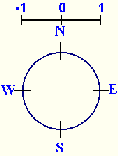
The declination is given as e.g. "15 degrees east".
When you look at the figure, you can pretend that plus is to the
right, or east, and minus is to the left and west. Like a curved
row of numbers. So when something is more than zero you'll subtract
to get it back to zero. And if it is less, you'll add.
So in this case you'll subtract 15 degrees to the azimuth, by
turning the compass housing, according to the numbers on the housing.
Now, finally, the direction of travel-arrow points in the direction
you want to go. Again, be careful to aim at some distant object
and off you go.
You may not need to find the declination before you leave home,
actually. There is a fast and pretty good method to find the declination
whereever you are. This method has also the advantage that corrects
for local conditions that may be present (I am thankful towards
Jim Cross who pointed this out to me). This is what you do:
- Determine by map inspection the grid azimuth from your location
to a know, visible, distant point. The further away, the more
accurate it gets. This means you have to know where you are,
and be pretty sure about one other feature in the terrain.
- Sight on that distant point with the compass and note the
magnetic azimuth. You do that by turning the compass housing
so that it is aligned with the needle. You may now read the number
from the housing where it meets the base of the direction of
travel-arrow.
- Compare the two azimuths. The difference is the declination.
- Update as necessary. You shouldn't need to do this very often,
unless you travel in a terrain with lots of mineral deposits.
There are a few riddles and rhymes to help you remember whether
you should add or subtract. I don't know them. If you live in
an area where you don't go far for it to change between east and
west, it is so small you wouldn't need to worry about it anyway.
So it's best to just remember whether you should add or subtract.
Nevertheless, I have collected some of the rhymes people use.
Uncertainty
You can't always expect to hit exactly
what you are looking for. In fact, you must expect to get a little
off course.
How much you get off course depends very often on the things
around you. How dense the forest is, fog, visibility is
a keyword. And of course, it depends on how accurate you
are. You do make things better by being careful when
you take out a course, and it is important to aim as far ahead
as you can see.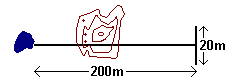
In normal forest conditions we say that as a rule of thumb,
the uncertainty is one tenth of the distance traveled. So if it
is like in the figure, you go 200 meters on course, it is possible
that you end up a little off course, 20 meters or so. If you're
looking for something smaller than 20 meters across, there is
a chance you'll miss. If you want to hit that rock in our example
you'll need to keep the eyes open!
In the open mountain areas, things are of course a lot easier
when you can see far ahead of you.
This was the last of the lessons you
should know. But more lessons are upcoming. Now it is time to
log out and get into the backyard, and then backcountry. Try it
out! That is after all, the only way to learn this properly. Good
Luck!
I said navigating in the mountains is easier. Well that is
until the fog comes. Fog can make orienteering in the mountains
and in the forest extremely difficult, and therefore, it can also
be dangerous to the unexperienced. The principles of orienteering
are still the same, but there are a few hints in the next lesson
that will help you get trained.
EHGSAR HOME