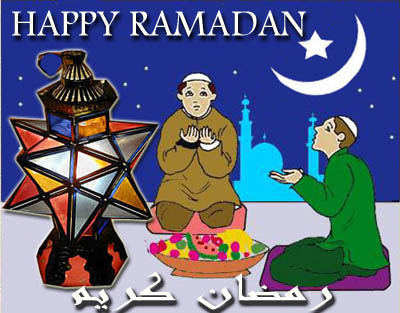
Ramadan is the month during which Prophet Mohammed received the inspiration of Quran. The month of Ramadan moves ten days earlier each year. Ramadan is a holy month for Muslims, in which they don't eat or drink, starting from dawn. And At sunset, they break their fasting usually with a date, since it is a "sunna", i.e. a habit taken from Prophet Mohammed.
Ramadan is a month that follows the lunar calendar, the basis of Islamic (or Hijri) calendar. With an eleven-day difference than the Gregorian, the exact timing of Ramadan during the year becomes variable, sometimes falling in summer, and sometimes in winter. The first day of Ramadan too is variable, since "Sha�aban", the preceding month, sometimes comes in 29 days and sometimes in 30. Astronomical calculations are utilized to detect the birth of the moon, yet the cornerstone remains to be its visualization after sunset. Ramadan lasts for 29 or 30 days, as most lunar months.
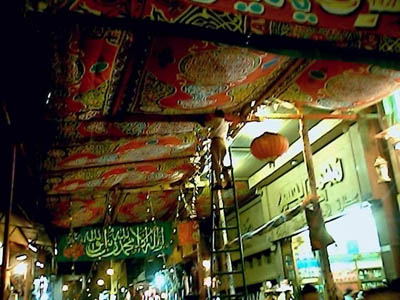
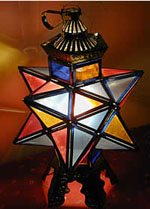
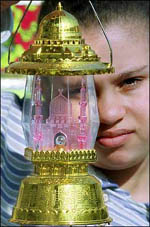
Muslims celebrate that month with joy & happiness. They prepare for it by hanging up colored decorations in the streets & banners announcing that Ramadan is coming soon. They also hang up what Muslims call "Fanous", i.e. lanterns of different shapes & colors, some of which are lightened simply by candles, while others are electrical. At sunset the roads are usually empty, every one is hurrying home since all the family has to be ready at the dinning table before the canon shot - announcing the break of fasting - at least by 10 minutes, so that they start it as soon as they hear "Al Azan"= "call for prayer".
celebrations!!!
Since Egyptians are big eaters, they usually look forward to Ramadan ,for it is known for special sorts of desserts such as "Kunafa", "Kataief" & "Khushaf"(a cocktail consists mainly of dates apricot,black plums & raisins) , as well as a very delicious juice called "Kamar El Din" i.e. apricot juice. They also eat lots of almonds & nuts, which get too pricey during that month.
TV becomes over loaded with various shows, programs & serials during Ramadan, most of which are Islamic. One of the prominent programs that people used to watch during Ramadan is the quizzes, what Egyptians call "El Fawazir", it is one of Ramadan's features. Some people get really obsessed with TV during that month to the extent that they disregard their religious perceptions that should be performed during that holy month.
Ramadan in its very nature is a month of mercy & good deeds. It has very spiritual aspects, since a real fasting is not confined to keep from eating & drinking only, but also to abstain from committing sins that Islam prohibited. So, it's not only a matter of food, it is of actions as well. Hence, Muslims try to be more self-restrained & to get more control on their misbehaviors during Ramadan. They alms, prayers & reading Quran. They have to read the whole Quran Book at least once during that month
Don't be astonished if I said that Christian Egyptians like and enjoy Ramadan as well - of course not out of religious sense - motivated by the various sorts of food stuffs that Ramadan is distinguished by and that become available in the market only during Ramadan. They are also attracted by the way television celebrates it, since it transmits the best it has over the 24 hours of the day, which is not the case in usual time. They try not to hurt the feelings of Muslims during that month, they do not eat during daytime in public.

In the earliest days of Islam, when the fledgling Muslim community was so small and close-knit that not even the now-trademark �adhaan� call to prayer was necessary.
�When the number of Muslims increased and their residences became distant from the mosque and each other, they thought of introducing a means of announcing the time of prayers. Many suggestions were made including ringing a bell like Christians, lighting a fire like the Zoroastrians, sounding a horn like the Jews, erecting a banner or beating a drum. They did not reach any consensus to adopting any of those means. It is narrated that Abdullah ibn Zayd, one of (Prophet Muhammed�s) companions, was very concerned over that issue and he saw an angel in his dream who taught him the adhaan as we know it now. The Prophet (Peace Be Upon Him) gave his permission to use the adhaan and signaled Bilaal, who was known for his good voice, to start using it,then in Fatimid period, they used the cannon shot in announcing the start of fasting before sunrise and then announcing the break of fasting at sunset, Fatimid Caliph gave an order to place the canon in the highest point of the city to make sure that all muslims in the city will be capable of hearing the shot of canon.
some people think fasting is very hard thing to do specially the part about not drinking even a drop of water starting from the dawn time till the sunset, Not drinking water for Muslims who really believe in the concept of fasting, is not a big deal, specially it�s more healthy to not drink anything on empty stomach ,besides there is a meal we eat before Dawn that normally our body preserves it to strengthen our bodies during the day.. and Believe it or not our bodies be incredibly strengthen during fasting more than anytime else..
after all, if you have a strong faith in what you do then you can achieve miracles.
**2) Why should Muslims stand this hardships during a whole month??
Muslims believe that Ramadan confers great blessings, In this month, the doors of the Heavens are said to be widely open while those of Hell are tightly closed.
the Prophet, peace and blessings be upon him, said: "There is a gate to Paradise that is called Ar-Rayyan. On the Day of Resurrection it will say: 'Where are those who fasted?' When the last [one] has passed through the gate, it will be locked."
the intention must be made clear that this action is undertaken in obedience to God, in response to His command and out of love of Him.
**3)Do people work in Ramadan??
Certainly they do, Ramadan is a month of working and worship, Muslim fasters resume their normal life thereafter, until before sunrise.
In Egypt ,work hours are shrunk to five hours from 8 hours, to give the enough time to people to get back home early before the sunset then they can break their fasting with their families..
**4)Should the foreign and non Muslims fast during Ramadan??
Islam doesn�t require from non-Muslims to fast ,but it would be as an act of respect to the culture you visit that you don�t o eat or drink(specially Alcoholic drinks) in public (this is only if you want to)..
Fasting during Ramadan is obligatory for every adult Muslim.
Fasting Ramadan is compulsory upon every Muslim, male or female, who has these qualifications:-
1. To be mentally and physically fit, which means to be sane and able.
2. To be of full age, the age of puberty and discretion, which is normally about fourteen. Children under this age should be encouraged to start this good practice on easy levels, so when they reach the age of puberty they will be mentally and physically prepared to observe fasting.
3. To be present at one's permanent settlement, your home town, one's farm, and one's business premises, etc. This means not to be on a journey of about fifty miles or more.
4. To be fairly certain that fasting is unlikely to cause you any harm, physical or mental, other than the normal reactions to hunger, thirst, etc.
Exemption From Fasting:
These said qualifications exclude the following categories:-
1. Children under the age of puberty and discretion.
2. Insane people who are unaccountable for their deeds. People of these two categories are exempted from the duty of fist, and no compensation or any other substitute is enjoined on them.
3. Men and women who are too old and feeble to undertake the obligation of fast and bear its hardships. Such people are exempted from this duty, but they must offer, at least, one needy poor Muslim an average full meal or its value per person per day.
4. Sick people whose health is likely to be severely affected by the observance of fast. They may postpone the fast, as long as they are sick, to a later date and make up for it, a day for a day.
5. Travelers may break the fast temporarily during their travel only and make up for it in later days, a day for a day
6. Pregnant women and women breast-feeding their children may also break the fast, if its observance is likely to endanger their own health or that of their infants. But they must make up for the fast at a delayed time, a day for a day.
7. Women in the -period of menstruation (of a maximum of ten days or of confinement (of a maximum of forty days).; They must postpone the fast till recovery and then make up for it, a day for a day.
General Recommendations:
It is strongly recommended by Prophet Muhammad to observe these practices especially during Ramadan:-
1. To have a light meal before the break of the dawn, known as Suhoor.
2. To eat a few dates or start breaking the fast by plain water right after sunset, saying this prayer Allah humma laka sumna, wa 'ala rizqika aftarna. (O God! for Your sake have we fasted and now we break the fast with the food You have given us).
3. To make your meals as light as possible because, as the Prophet put it, the worst thing man can fill is his stomach.
4. To observe the supererogatory prayer known as Taraweeh.
5. To exchange social visits and intensify humanitarian services.
6. To increase the study ant recitation of the Qur'an.
7. To exert the utmost in patience ant humbleness.
8. To be extraordinarily cautious in using one's senses, one's mind and, especially, the tongue; to abstain from careless gossip and avoid all suspicious motions.
****************************************************************************************
"The Qur�an says (O you who believe, fasting is prescribed for you as it was prescribed for those who were before you, in order that you may learn taqwa (piety))
(Al-Baqarah2:183).
Fasting is not just abstaining from food, drink, and sexual intercourse from dawn until sunset but Fasting is also considered to be a training in controlling one's needs and desires, in restraining oneself from self-indulgence, and in deepening one's spiritual life.. Fasting also teaches us Patience.
Muslims fast to improve their health, as the Prophet Muhammad (PBUH) said:
"If you fast you will have better health," and also, "Eat less; you will be healthier.",
The hunger which Muslims experience while fasting also enables them to appreciate the hunger of the poor and the needy, and to be grateful for the good graces that been given By �Allah� � God� to human beings in life ..
Ramadan is a period of time that you can work on promoting your way of life to better one by abstaining the bad habits .. If one is fasting, he/she should not use foul language, or raise his/her voice, or behave foolishly. If someone reviles him/her or fights with him/her.. he/she should say, 'I am fasting,' twice.
The Prophet Mohammed (peace and blessings be upon him) said that fasting is a shield. It protects a person from sin and lustful desires. When the disciples of Jesus asked him how to cast the evil spirits away, he is reported to have said, �But this kind never comes out except by prayer and fasting.� (Matthew 17:21).
Therefore ,Never miss the Great chance of Ramadan to re-consider your life to learn new virtues and also be rewarded by Allah..
"Happy Ramadan..Ramadan Kareem"