A Short history of
Thessaloniki
Steven Lowe
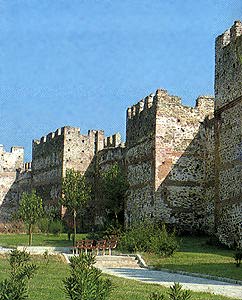
The walls of
Thessaloniki, probably late 4th century, but with many later repairs and additions
This is not by any
means a complete history of Thessaloniki during the Byzantine period. Between
the battles, the massacres and the sieges, there were long periods during which
the city presumably got on calmly with its main business, as a thriving seaport
and centre of trade. (If the Saracen raid of 904 is anything to go by, it must
have previously enjoyed a very long interval of peace for the walls to be in
such a state of unpreparedness.)
Thessaloniki was commonly regarded as
the second city of the Empire, and was certainly its second biggest port. It was
known as Therma in ancient Greek times, and its modern name is Salonika. It is
located in the region of Greece known as Makedonia, near Thessaly. In mediaeval
times, the city had an annual fair which attracted merchants from as far away as
Flanders (Godfrey pp 17-18), and was on the pilgrim route to the Holy Land in
the 10th century (Runciman Vol. 1, p 48). Though its patron Saint Demetrios, who
was martyred in Roman times, was originally conceived as a civilian, by our
period he was thought of as a military saint and was believed to be the city’s
protector. (Cormack, pp.54, 66)
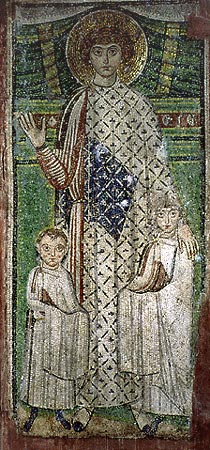
A mosaic representation of St Demetrios, probably
early 7th century; from the church bearing his name
In 321 AD, while engaged in a campaign
against his rival the Eastern Emperor Licinius, Western Emperor Constantine I
based himself at Thessaloniki and deepened its harbour to take his fleet. In a
combined operation in 323 his army and navy defeated those of Licinius, and
Constantine became sole Emperor, beginning the period we now know as the
Byzantine era. (Norwich Vol. 1, p 48)
The Eastern Emperor Valens was
defeated and killed by the Goths at the battle of Adrianople in 378, and was
succeeded by Theodosius, who established his military headquarters at
Thessalonika. After two years restoring order in Thrace, Theodosius made his
formal entry into the capital, Constantinople. (Norwich. Vol. 1, p108.) In 390
AD 7000 people were massacred at the Thessalonika hippodrome on Theodosius’
orders after a mob murdered the unpopular captain of the city garrison. (Norwich
Vol. 1, p112)
In the 5th and 6th centuries, after plagues caused massive
depopulation in Greece and the Balkans, huge numbers of Slavs and Bulgars moved
into the vacuum, and had effectively taken possession by the end of the 6th
century. Thessaloniki was one of the few cities in the region not to fall to the
Slavs despite at least three sieges, and became the provincial capital. In 586
the city was saved from plague and an Avar/Slav seige, with credit going to St
Demetrios. (Cormack pp. 54,58,66)
In 609 AD, General Heraclius sailed
from Carthage and using Thessaloniki as a base to rally support and increase his
fleet, he went on to overthrow Emperor Phocas the following year. Emperor
Heraclius went on to rebuild the Empire after attacks from Avars and Persians,
but by the time he died vast tracts of territory had been lost to the newly
arisen Arabs. (Norwich Vol. 1, p 282-3)
In 688-9 AD Justinian II
Rhinometus ("cut-nose") carried out a large scale military expedition into the
Slav lands of the Balkans. He made a triumphal entry into Thessaloniki, and
transported large numbers of Slav captives to resettle depopulated areas of Asia
Minor. (Norwich Vol. 1, p 329)
864 AD. Emperor Michael III sent two
monks, the brothers Cyril (Constantine) & Methodius, to Moravia to convert
the Slavs to Orthodox Christianity saying, "you are both natives of
Thessaloniki, and all Thessalonikans speak pure Slav." (Obolensky, p 138).
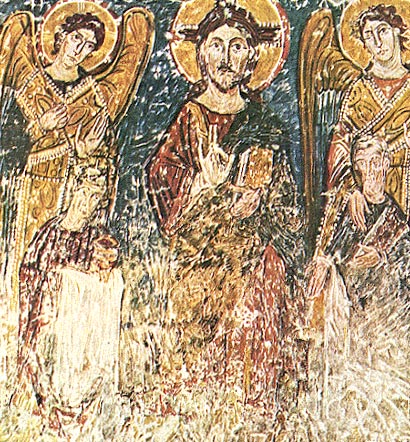
Saints Cyril and Methodius with Christ and angels
Saints Cyril and Methodius invented the first alphabet for Slavic languages,
known as the Cyrillic alphabet.
In 894 corrupt officials forced Bulgarian
merchants to bring their goods into the Empire through Thessaloniki instead of
Constantinople (making official scrutiny more difficult), and dramatically
increased customs dues. This imposed great hardships: Thessalonika was much
further from Bulgaria, and the road was rough and frequently impassable in
winter. Protests by Tsar Symeon proving futile, a Bulgar army invaded Thrace, at
a time when the Empire was particularly vulnerable. After a long and costly war
Emperor Leo agreed to pay a large tribute to Bulgaria in return for peace, and
Constantinople again became the centre of trade with Bulgaria. (Norwich Vol. 2,
p109-110)
In 904, a Saracen fleet, beaten off by the Imperial fleet not
far from Constantinople, turned aside and attacked Thessaloniki. The city’s
walls were in bad condition and its two commanders were at each other’s throats;
after three days, on 29 July, the city fell. After a week of bloodshed and
butchery, the Saracens left, taking with them priceless treasures and over
30,000 prisoners. Emperor Leo rebuilt the fortifications of Thessaloniki, and
the Imperial fleet, destroying the Saracen ships sent out to intercept it, laid
waste the large Saracen seaport of Tarsus in revenge. Leo of Tripoli, the Greek
renegade who had led the raid on Thessaloniki, made further devastating attacks
on the Empire, but was finally defeated and his fleet destroyed by John Curcuas
in 923. (Norwich. Vol. 2, pp110, 120, 149)
In 989, Tsar Samuel of
Bulgaria invaded the Empire, capturing the fortress of Berrhoea at the
approaches to Thessaloniki. Emperor Basil II began a carefully organised
campaign which ended twenty-five years later with the destruction of Bulgaria as
a military power. In spring 991, Basil went to Thessaloniki, strengthened its
defences, and prostrated himself before the altar of the city’s patron Saint
Demetrios. (Norwich Vol. 2, p248, 249) In 1001 he recaptured Berrhoea and
expelled the Bulgar garrison from Thessaly. (Norwich Vol. II, p 258)
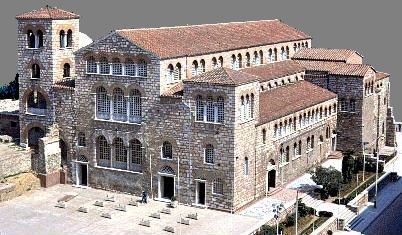
The church of St Demetrios in Thessaloniki, 5th
century
In 1009 the
Tsar suffered a crippling defeat at a village called Creta, near Thessaloniki,
and in 1014 Basil trapped and destroyed the Bulgarian army in a defile at
Clidion. Samuel died shortly afterwards (Norwich Vol. 2, p 261).
In 1040
a revitalised Bulgaria under Tsar Peter Deljan and his cousin Alusian invaded
the Empire. When the news arrived Emperor Michael IV was in Thessaloniki at the
tomb of St Demetrios, consumed with guilt over his assassination of his
predecessor, Emperor Romanus III Argyrus. Though in agonising pain from a
disease which had caused his body to swell grotesquely and would soon kill him,
Michael organised a counter-campaign and led the army into the field. A
Bulgarian seige of Thessaloniki became so disorganised that the city garrison
was able to come out and destroy the beseigers and the Bulgarian campaign
collapsed. (Norwich Vol. 2, p286, 288)
In 1096 the armies of the First
Crusade passed Thessaloniki on their way to Constantinople - Robert of Normandy
and Steven of Blois stayed before its walls 4 days before moving on, and the
Bishop of le Puy, who had been attacked by Pecheneg police after straying off
the road, had to leave Raymond of Toulouse’s force at Thessaloniki to have his
wounds tended; without his calming influence brigandage by crusaders worsened.
(Runciman Vol. 1, pp 156,161, 168)
In 1147-8 King Conrad of Hohenstaufen
passed through Thessaloniki on his way to and from the Holy Land on the Second
Crusade. He was officially welcomed by the Emperor’s cousin Michael Paleologus,
and on his return voyage the following year he was received by Emperor Manuel in
person. (Runciman Vol. 2, pp.260, 285)
On August 24, 1185, after a brief
siege, Thessaloniki was brutally sacked by an army of freebooters, (the fleet
even included pirate vessels) under the Norman William II of Sicily. (Godfrey
pp. 17-18) Emperor Andronicus, convinced that Constantinople would be next,
strengthened the City’s defences, and even approached Saladin for help. But
Andronicus was deposed and killed by Isaac II Angelus, who made a humiliating
peace that stopped the advance of William II’s army.(Runciman Vol.. 2, p 429)
[Runciman disagrees with Godfrey (Runciman Vol. 3, p 4) stating that William’s
troops had tried to capture Thessaloniki and been heavily defeated]. In 1195
Western Emperor Henry VI sent a letter to Isaac demanding cession of lands taken
by William in 1185. (Godfrey p22)
In 1201 Boniface, Marquis of
Montferrat, was made leader of the Fourth Crusade. Boniface’s brother Rainier
had been married to the daughter of Emperor Manuel, receiving Thessaloniki as
his personal estate. (Godfrey pp. 52-53).
After the capture of
Constantinople in 1204, the new Latin Emperor Baldwin promised Boniface
overlordship of Anatolia, but as it was in Turkish hands he was made King of
Thessaloniki instead. (Godfrey p136, Runciman Vol. 3, p125) The two set off
together to take possession of Thessaloniki, but quarreled and parted company.
Boniface went to Demotica and besieged Adrianople, which was garrisoned by
Baldwin’s troops, but failed to capture it. Baldwin, on the other hand, captured
Thessaloniki; however, his army was weakened by plague and he sent Villehardoin
to reason with Boniface. The two patched up their differences and Boniface was
given Thessaly, centred on Thessaloniki.(Godfrey p138)
Michael I Komnenos
Dukas, cousin of Emperors Isaac II and Alexios III, attached himself to Boniface
after the fall of Constantinople, but seceded during the Latin invasion of
northern Greece, and set himself up as independent ruler (Despot) of Epiros. He
recaptured Durazzo and Corfu from Venice, and harboured refugee artists and
craftsmen from Constantinople. (Godfrey p158-9)
In 1207 Boniface was
fatally wounded in a skirmish with Bulgarians under King Kalojan (Godfrey
p142-3). Kalojan conquered most of Makedonia, but was murdered by Manastras, the
Voivoda (leader) of the Cumans while besieging Thessaloniki. The Thessalonikans,
however, credited his death to their patron Saint, Demetrios.
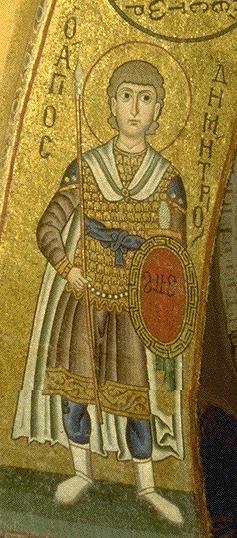
An 11th century representation of St Demetrios as a military Saint, from the church of Hosias Loukas in Phokis
In 1224
Theodore I , Despot of Epiros, seized Thessaloniki from Boniface’s son
Demetrius. Theodore was proclaimed and crowned Emperor at Thessaloniki, and
threatened Constantinople itself. However, jealousy between Thessaloniki and the
other Byzantine Empire-in-exile based at Nicea allowed the ineffective Latin
Empire to continue after death of Emperor Henry of Flanders. Theodore was
defeated by the Bulgarians in 1230; the Thessalonikan "empire" collapsed and was
conquered by the second Nicaean Emperor Vatatzes in 1246. Epiros, ruled by
Theodore’s nephew Michael II Dukas, remained independent but came under
influence of Nicea. (Godfrey p158-9)
After the fall of the Latins,
Thessaloniki was part of the restored Byzantine realm. In 1342, during a period
of instability and peasant uprisings throughout the Empire, the Zealots party
gained power in Thessaloniki and ran the city for seven years as what has been
described as a "People’s Republic" (Alastos p191). However, at the end of that
period it was returned to Imperial rule and remained so until conquered by the
Ottoman Turks in the final years of the Empire.
References
Alastos,
Doros Cyprus in History Zeno, London 1976
Godfrey, John 1204 The Unholy
Crusade Oxford University Press 1980
Norwich, John Julius Byzantium: (Vol 1:
the Early Centuries, Vol. 2: the Apogee) Guild London 1988
Obolensky, Dimitri
The Byzantine Commonwealth Weidenfeld and Nicolson London 1971
Runciman, Sir
Steven A history of the Crusades Penguin London 1991
Cormack, Robin Writing
in Gold: Byzantine Society and Its Icons George Philip, London
1985