 |
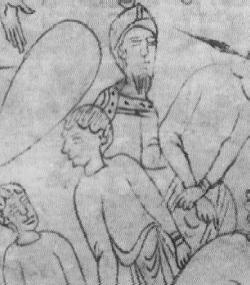
| Fig. 10 - from the Golden Psalter of St Gallen |
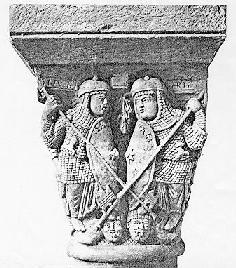
| Fig. 9 - Church column from Clermont, France |
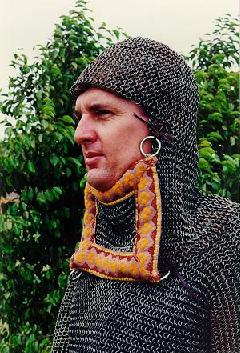
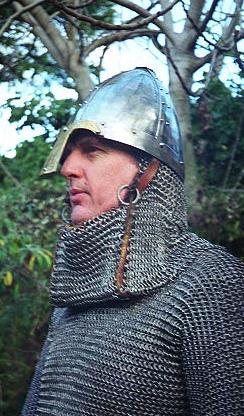
| Fig. 12 - The ventail closed - 1992 version |
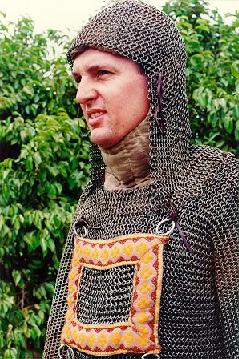
| Fig. 13 - The ventail closed - 1997 version (still in use) |
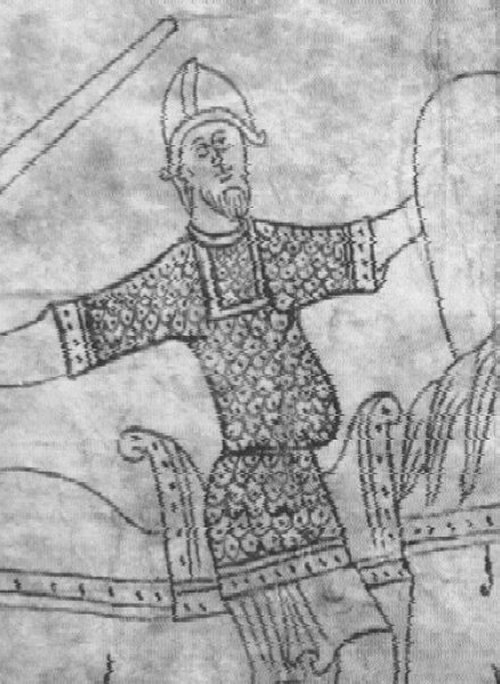
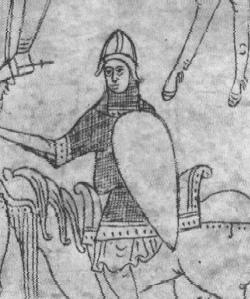
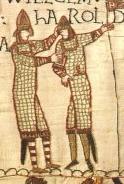
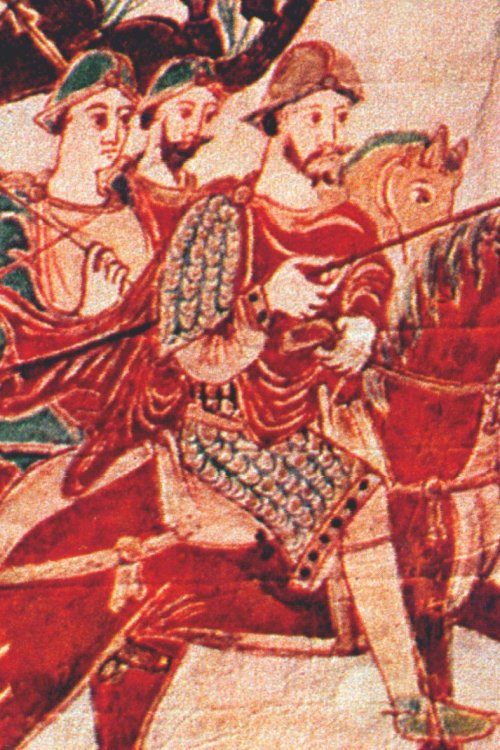
| I first tried a reconstruction of the "bib" in 1992. As part of a continuing correspondence we were having on the subject, Graeme Anderson in Tasmania came up with an explanation which led us to a solution of the problem. He proposed that the mysterious circular "blobs" at the corners of the square were actually large metal rings, two of which were tied to the byrnie by leather thongs just below neck level. When the ventail was open, the square would hang from these two rings, falling across the chest as in the Tapestry and other illustrations. When in use, the other two rings would be tied to thongs already attached to the coif, with the ventail covering the throat. This is even more clearly shown in the Bible of Rhodes (though the large rings do not appear - perhaps they used two sets of laces instead); the warrior in Fig. 4 has his ventail open, while the one in Fig. 6 has his done up. There are two other illustrations in the Bayeux Tapestry which add to understanding this feature. In Fig. 1, William of Normandy is making a gift of arms to Harold Godwinson. William has an open ventail, and appears to have untied laces at his neck, and in Fig. 8 a cavalryman has an untied ventail with "laces" hanging from the bottom of it. The church pillar in Fig. 9 is particularly useful, as it shows the item in three dimensions. |
| Borders |
| I was also interested in the coloured borders shown on byrnies in the Bayeux tapestry and elsewhere. An illustration from the Golden Psalter of St. Gallen of c. 800 AD (Fig. 10) shows decorative borders on a byrnie. But in this depiction its pattern is identical to the braid on the sleeves of the warrior's tunic. The Bayeux Tapestry and the Bible of Rhodes also show decorated borders on mailshirts which duplicate the braid on the tunic (Figs. 1, 4, 6 and 7) and based on this I added braid to both mail shirt and ventail. However, in my 1992 version I sewed braid on both sides of the mail, with the thread passing through the mail-rings, not sewn to them. The ventail was simple to make and worked quite well (see Figs. 11 & 12) but it hung awkwardly if I bent forward and was a bit of a nuisance, and when tied up it didn't look quite like the Tapestry illustrations. I wasn't all that happy with it, and ended up recycling the mail into a later style ventail, integral with the coif. In 1997 I decided to have another go, this time sewing braid to only one side of the ventail. This meant stitching it directly to the rings, which made the bond considerably firmer, and stiffened the edges of the ventail. I attched it as before, and - Lo and behold! The thing worked beautifully. No more flopping about when I leant forward. I have been using this version ever since. |
| There is still a little restriction on turning your head from side to side, which I think is a fault inherent in the design. This would be an incentive to leave the ventail open when not in use ( and also to develop a better form of ventail). But in general it is most satisfactory, and as Fig. 13 shows, looks very similar to the contemporary illustrations. It's quick and easy to do up by "feel", even when you're wearing a helmet. By the way, due to its design, this type of ventail always seems to be done up under the chin, not over the mouth. If you do it that way, it sags and falls under the chin anyway. (Since making this, it has been suggested to me that this design of ventail could cover the mouth if hooks were used instead of laces). From this reconstruction I have satisfied myself that the "bib" is a form of ventail which though simple, works efficiently and well, and that the borders on the armour of the Bayeux tapestry were probably braid, a fashion which lasted from c. 800 AD but seems to have vanished after the early 12th century. A further argument in favour of braid (against, say, leather), is that the braid cushions the underside of the chin when the ventail is tied up. |
| Fig. 11 - The ventail open |
| Reconstruction |
|
 |
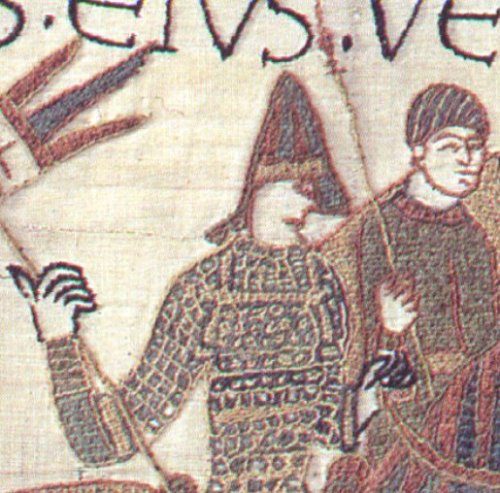 |
| Fig. 8 - from the Bayeux Tapestry |
 |
 |
 |
| References Edge, D. and Paddock Arms and Armour of the Mediaeval Knight, Bison, London 1988 Foss, M. Chivalry (publisher and date unknown) Owen D.D.R. (trans) The Song of Roland, Boydell, Woodbridge 1990 |

|
| There have been |
| visitors to this site |
| The information in this page is for educational and non-commercial purposes only. |