Home

Topics

Resources

Forum


Search Strategies


 There are three steps to effective information finding.

*      The first step is to define the search. What is the topic?

*      The second step is to decide how to access the Web. Will a web directory give the best results? Is a search engine going to be more efficient?

*      Finally, the third step, involves creating the actual search query. A simple query uses one word, while a more precise query would link several words.

For a query that links several words, most directories and engines use Boolean logic. Boolean logic utilizes four primary operators: AND, OR, NOT and NEAR. Using the word AND narrows the results, while using the word OR broadens the results. The word NOT narrows the results by excluding terms and the word NEAR is a proximity operator, which finds words within a certain number of characters. Different search engines incorporate Boolean logic in different ways.

It is important to read the instructions for each directory, search engine, or meta-engine before entering your search terms.

AND narrows the search results because it specifies that all elements must appear in the search results. A search for dogs and cats would access websites in which both the word dogs and the word cats appear.

OR broadens a search because it allows either element to appear in the search results. A search for dogs or cats would access websites in which either the word dogs or the word cats appears. The Boolean operator OR can be very useful when there are many synonyms for a concept. For example, teenagers OR adolescents OR youth will yield many more citations than any of these words by itself.

NOT limits search results because it eliminates an element. A search for dogs not cats, would access websites in which only the word dogs appears; the word cats will not appear because it has been excluded in the search.

*  Boolean Logic

Computers can be very effective tools to locate information, but they are ONLY machines. It is important to understand that computer output depends upon human input, and is only as useful as the instructions we provide. Computerized search mechanisms are based on Boolean logic; the better we understand how it works, the better will be the results we obtain.

Boolean logic utilizes three primary operators: AND, OR, and NOT. It is helpful to diagram the effects of these operators:

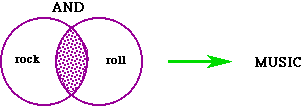
The first diagram shows two intersecting circles with only their overlapping portions
 colored.  Searching for rock AND roll yields information about a musical genre.

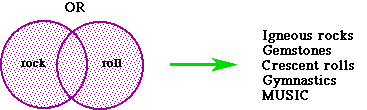
Using the word "AND" actually narrows the results obtained in a search, while using the word "OR" broadens the results.

The second diagram shows two intersecting circles entirely colored.  Searching for rock OR roll yields information about igneous rocks, gemstones, crescent rolls, gymnastics, AND music.

The Boolean operator "OR" can be very useful when there are many synonyms for a concept, and we do not know which one might have been chosen by the author or indexer. For example, teenagers OR adolescents OR youth will yield many more citations than any of these words by itself.

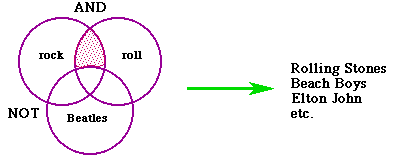
We can also limit the results by using the Boolean operator "NOT".

The third diagram shows three intersecting circles with only the overlapping portions of the top two colored.  Searching for rock AND roll NOT Beatles yields information about the Rolling Stones, the Beach Boys, Elton John and others.

It is important to read the instructions for each directory, search engine, or meta-engine before entering your search terms.


Hosted by www.Geocities.ws

1