
At Tikal (TI - place, kal - spirits), we first came upon a mock-up of the ancient city at the visitor's center, where our guide ran us through the layout and our tour. Then we walked down a path to a large Ceiba tree, the national tree of Guatemala. From there, we ventured to the Twin Temples. Four temples are aligned with the four main compass points, so East has a twin to the West, and North and South are twins. The mortar used in construction is an acid oxide drawn from cooking limestone with wood coals; the limestone bricks were cut with obsidian; all the construction was done by hand. Here we learned of the Stela - a ceremonial tombstone that reviews the life of a Mayan ruler. The Mayans had a concept of zero, illustrated with a pictograph of a seashell, which also represented evil. We also found out that the end of the Mayan calendar is December 20, 2012. From the Twin Temples, we walked up a path, behind Temple One (the Jaguar Temple), to the central acropolis. This was the royal living quarters, with dorm rooms, meditation rooms, spas, and a courtyard for ceremony rehearsals. Here a bolster, made of the Zapote tree, dates back to 300 BC. Everything was plastered white and painted, not like you would see today. From behind the central acropolis, we saw the main courtyard, with a view of Temples One and Two, and the North Acropolis. We journeyed down to the main courtyard and explored. Ernie even scrambled up to the top of Temple Two. Next was Temple Three, built around 680 AD. Then we went to the Lost World, which was the first construction site in Tikal, built around 750 BC. By 300 AD, five levels of the main temple here were done - each one representing different ruling classes - and the Jaguar masks were complete (the Jaguar was considered ruler of the underworld). There were also two other smaller pyramids built with similar architecture as the Mexican pyramids, as they had married into the Guatemalan Mayan ruling class. But, as time went on, the Guatemalans developed their own style. From the Lost World, we went to Temple Four, where a film crew shot a scene for Star Wars in the 1970's. The top of Temple Four is the only excavated part of this temple, and it offers great views.
After Temple Four, we headed through the jungle (and spied some Howler Monkeys on the way) to have lunch. We ate red beans and rice, barbecued beef, and vegetables, with a cool Squirt to wash it down. Then we napped on our way back to the border. At the border, we stopped to get visa pictures for Noga ($5.00 for four), then breezed through customs and were on our way back to Windy Hill. We tried to feed the resident macaw and parrot some granola, but found out that they're picky eaters. So, we dropped our stuff off at the cabana and had a nice dinner of fry-jacks and black bean soup, beef tips and mushrooms, lightly seasoned potatoes, and fried squash - all with a slight pineapple taste. After dinner, we relaxed at the bar with John, who makes a killer pina colada, and 'Uncle Bob' - the owner of Windy Hill.

June 20, 2000 (cont.)


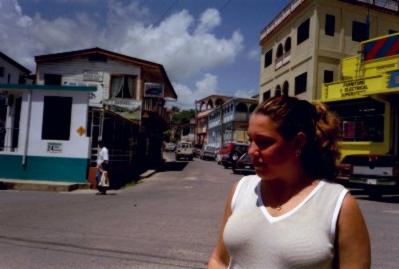
downtown San Ignacio
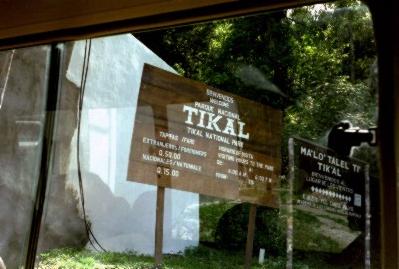
Tikal Nat. Park entrance
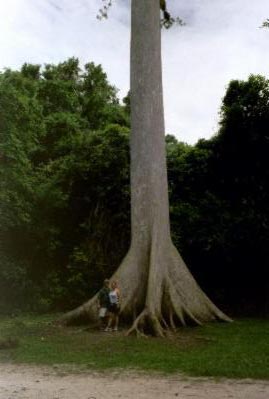
Ceiba tree
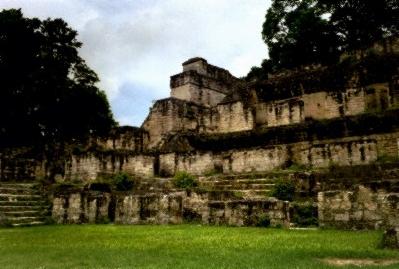
central acropolis