|
|
|||
|
|
|||
Search Strategies
|
|||
|
|
|||
|
There are three steps to effective information finding.
For
a query that links several words, most directories and engines use Boolean logic. Boolean
logic utilizes four primary operators: AND, OR, NOT and NEAR. Using the word
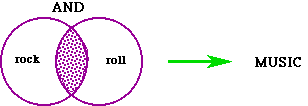
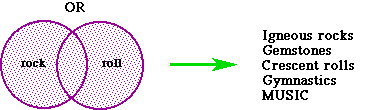
AND narrows the results, while using the word OR broadens the results. The
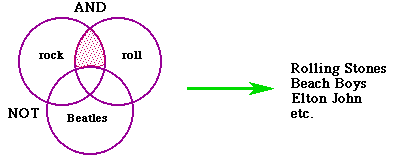
word NOT narrows the results by excluding terms and the word NEAR is a
proximity operator, which finds words within a certain number of characters.
Different search engines incorporate Boolean logic in different ways. It is important to read the instructions for each directory, search
engine, or meta-engine before entering your search terms.
AND narrows the search results because it specifies
that all elements must appear in the search results. A search for dogs and cats would access
websites in which both the word dogs and the word cats appear. OR broadens a search because it allows
either element to appear in the search results. A search for dogs or cats would access
websites in which either the word dogs or the word cats appears. The Boolean
operator OR can be very useful when there are many synonyms for a concept.
For example, teenagers OR
adolescents OR youth will yield many more citations than any of
these words by itself. NOT limits search results because it
eliminates an element. A search for dogs
not cats, would access websites in which only the word dogs
appears; the word cats will not appear because it has been excluded in the
search.
|
|||