
Chapter 1
2 kings deliverance
from out of the fish rendered him a type of our blessed Lord, who mentions it,
so as to show the certain truth of the narrative. All that was done was easy to
the almighty power of the Author and Sustainer of life. This book shows us, by
the example of the Ninevites, how great are the Divine forbearance and
long-suffering towards sinners. It shows a most striking contrast between the
goodness and mercy of God, and the rebellion, impatience, and peevishness of his
servant; and it will be best understood by those who are most acquainted with
their own hearts.
Jonah, sent to Nineveh, flees to Tarshish. (1-3) He is stayed by a
tempest. (4-7) His discourse with the mariners. (8-12) He is cast into the sea,
and miraculously preserved. (13-17)
1-3. It is sad to think how much sin is committed in great cities. Their
wickedness, as that of Nineveh, is a bold and open affront to God. Jonah must go
at once to Nineveh, and there, on the spot, cry against the wickedness of it.
Jonah would not go. Probably there are few among us who would not have tried to
decline such a mission. Providence seemed to give him an opportunity to escape;
we may be out of the way of duty, and yet may meet with a favorable gale. The
ready way is not always the right way. See what the best of men are, when God
leaves them to themselves; and what need we have, when the word of the Lord
comes to us, to have the Spirit of the Lord to bring every thought within us
into obedience.
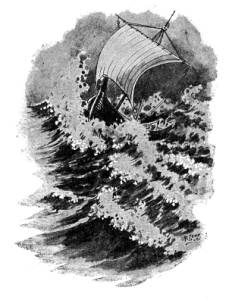
Verses 4-7 God sent
a pursuer after Jonah, even a mighty tempest. Sin brings storms and tempests
into the soul, into the family, into churches and nations; it is a disquieting,
disturbing thing. Having called upon their gods for help, the sailors did what
they could to help themselves. Oh that men would be thus wise for their souls,
and would be willing to part with that wealth, pleasure, and honor, which they
cannot keep without making shipwreck of faith and a good conscience, and ruining
their souls for ever! Jonah was fast asleep. Sin is stupefying, and we are to
take heed lest at any time our hearts are hardened by the deceitfulness of it.
What do men mean by sleeping on in sin, when the word of God and the convictions
of their own consciences, warn them to arise and call on the Lord, if they would
escape everlasting misery? Should not we warn each other to awake, to arise, to
call upon our God, if so be he will deliver us? The sailors concluded the storm
was a messenger of Divine justice sent to some one in that ship. Whatever evil
is upon us at any time, there is a cause for it; and each must pray, Lord, show
me wherefore thou contendest with me. The lot fell upon Jonah. God has many ways
of bringing to light hidden sins and sinners, and making manifest that folly
which was thought to be hid from
 the
eyes of all living.
the
eyes of all living.
Verses 8-12 Jonah
gave an account of his religion, for that was his business. We may hope that he
told with sorrow and shame, justifying God, condemning himself, and explaining
to the mariners what a great God Jehovah is. They said to him, why hast thou
done this? If thou fear the God that made the sea and the dry land, why were
thou such a fool as to think thou couldst flee from his presence? If the
professors of religion do wrong, they will hear it from those who make no such
profession. When sin has raised a storm, and laid us under the tokens of God's
displeasure, we must consider what is to be done to the sin that raised the
storm. Jonah uses the language of true penitents, who desire that none but
themselves may fare the worse for their sins and follies. Jonah sees this to be
the punishment of his iniquity, he accepts it, and justifies God in it. When
conscience is awakened, and a storm raised, nothing will turn it into a calm but
parting with the sin that caused the disturbance. Parting with our money will
not pacify the conscience; the Jonah must be thrown overboard.
Verses 13-17 The
mariners rowed against wind and tide, the wind of God's displeasure, the tide of
his counsel; but it is in vain to think of saving us any other way than by
destroying our sins. Even natural conscience cannot but dread blood-guiltiness.
And when we are led by Providence God does what he pleases, and we ought to be
satisfied, though it may not please us. Throwing Jonah into the sea put an end
to the storm. God will not afflict forever, He will only contend till we submit
and turn from our sins. Surely these heathen mariners will rise up in judgment
against many called Christians, who neither offer prayers when in distress, nor
thanksgiving for signal deliverances. The Lord commands all creatures, and can
make any of them serve his designs of mercy to his people. Let us see this
salvation of the Lord, and admire his power, that he could thus save a drowning
man, and his pity, that he would thus save one who was running from him, and had
offended him. It was of the Lord's mercies that Jonah was not consumed. Jonah
was alive in the fish three days and nights: to nature this was impossible, but
to the God of nature all things are possible. Jonah, by this miraculous
preservation, was made a type of Christ; as our blessed Lord himself declared, Matthew
12:40.
Chapter 2
The prayer of Jonah. (1-9) He is delivered from the fish. (10)
 Verses
1-9 Observe when Jonah prayed. When he was in trouble, under the tokens of
God's displeasure against him for sin: when we are in affliction we must pray.
Being kept alive by miracle, he prayed. A sense of God's good-will to us,
notwithstanding our offences, opens the lips in prayer, which were closed with
the dread of wrath. Also, where he prayed; in the belly of the fish. No place is
amiss for prayer. Men may shut us from communion with one another, but not from
communion with God. To whom he prayed; to the Lord his God. This encourages even
backsliders to return. What his prayer was. This seems to relate his experience
and reflections, then and afterwards, rather than to be the form or substance of
his prayer. Jonah reflects on the earnestness of his prayer, and God's readiness
to hear and answer. If we would get good by our troubles, we must notice the
hand of God in them. He had wickedly fled from the presence of the Lord, who
might justly take his Holy Spirit from him, never to visit him more. Those only
are miserable, whom God will no longer own and favor. But though he was
perplexed, yet not in despair. Jonah reflects on the favor of God to him, when
he sought to God, and trusted in him in his distress. He warns others, and tells
them to keep close to God. Those who forsake their own duty, forsake their own
mercy; those who run away from the work of their place and day, run away from
the comfort of it. As far as a believer copies those who observe lying vanities,
he forsakes his own mercy, and lives below his privileges. But Jonah's
experience encourages others, in all ages, to trust in God, as the God of
salvation.
Verses
1-9 Observe when Jonah prayed. When he was in trouble, under the tokens of
God's displeasure against him for sin: when we are in affliction we must pray.
Being kept alive by miracle, he prayed. A sense of God's good-will to us,
notwithstanding our offences, opens the lips in prayer, which were closed with
the dread of wrath. Also, where he prayed; in the belly of the fish. No place is
amiss for prayer. Men may shut us from communion with one another, but not from
communion with God. To whom he prayed; to the Lord his God. This encourages even
backsliders to return. What his prayer was. This seems to relate his experience
and reflections, then and afterwards, rather than to be the form or substance of
his prayer. Jonah reflects on the earnestness of his prayer, and God's readiness
to hear and answer. If we would get good by our troubles, we must notice the
hand of God in them. He had wickedly fled from the presence of the Lord, who
might justly take his Holy Spirit from him, never to visit him more. Those only
are miserable, whom God will no longer own and favor. But though he was
perplexed, yet not in despair. Jonah reflects on the favor of God to him, when
he sought to God, and trusted in him in his distress. He warns others, and tells
them to keep close to God. Those who forsake their own duty, forsake their own
mercy; those who run away from the work of their place and day, run away from
the comfort of it. As far as a believer copies those who observe lying vanities,
he forsakes his own mercy, and lives below his privileges. But Jonah's
experience encourages others, in all ages, to trust in God, as the God of
salvation.
Verse 10 Jonah's
deliverance may be considered as an instance of God's power over all the
creatures. As an instance of God's mercy to a poor penitent, who in distress
prays to him: and as a type and figure of Christ's resurrection. Amidst all our
varying experiences, and the changing scenes of life; we should look by faith,
fixedly, upon our once suffering and dying, but now risen and ascended Redeemer.
Let us confess our sins, consider Christ's resurrection as an earnest of our
own, and thankfully receive every temporal and spiritual deliverance, as the
pledge of our eternal redemption.
Chapter 3
Jonah sent again to Nineveh, preaches there. (1-4) Nineveh is spared upon
the repentance of the inhabitants. (5-10)
Verses 1-4 God
employs Jonah again in his service. His making use of us is an evidence of his
being at peace with us. Jonah was not disobedient, as he had been. He neither
endeavored to avoid hearing the command, nor declined to obey it. See here the
nature of repentance; it is the change of our mind and way, and a return to our
work and duty. Also, the benefit of affliction; it brings those back to their
place who had deserted it. See the power of Divine grace, for affliction of
itself would rather drive men from God, than draw them to him. God's servants
must go where he sends them, come when he calls them, and do what he bids them;
we must do whatever the word of the Lord commands. Jonah faithfully and boldly
delivered his errand. Whether Jonah said more, to show the anger of God against
them, or whether he only repeated these words again and again, is not certain,
but this was the purport of his message. Forty days is a long time for a
righteous God to delay judgments, yet it is but a little time for an unrighteous
people to repent and reform in. And should it not awaken us to get ready for
death, to consider that we cannot be so sure that we shall live forty days, as
Nineveh then was that it should stand forty days? We should be alarmed if we
were sure not to live a month, yet we are careless though we are not sure to
live a day.
Verses 5-10 There
was a wonder of Divine grace in the repentance and reformation of Nineveh. It
condemns the men of the gospel generation, Matthew
12:41. A very small degree of light may convince men that humbling
themselves before God, confessing their sins with prayer, and turning from sin,
are means of escaping wrath and obtaining mercy. The people followed the example
of the king. It became a national act, and it was necessary it should be so,
when it was to prevent a national ruin. Let even the brute creatures' cries and
moans for want of food remind their owners to cry to God. In prayer we must cry
mightily, with fixedness of thought, firmness of faith, and devout affections.
It concerns us in prayer to stir up all that is within us. It is not enough to
fast for sin, but we must fast from sin; and, in order to the success of our
prayers, we must no more regard iniquity in our hearts, psalms
66:18. The work of a fast-day is not done with the day. The Ninevites hoped
that God would turn from his fierce anger; and that thus their ruin would be
prevented. They could not be so confident of finding mercy upon their
repentance, as we may be, who have the death and merits of Christ, to which we
may trust for pardon upon repentance. They dared not presume, but they did not
despair. Hope of mercy is the great encouragement to repentance and reformation.
Let us boldly cast ourselves down at the footstool of free grace, and God will
look upon us with compassion. God sees who turn from their evil ways, and who do
not. Thus he spared Nineveh. We read of no sacrifices offered to God to make
atonement for sin; but a broken and a contrite heart, such as the Ninevites then
had, he will not despise.
Chapter 4
Jonah repines at God's mercy to Nineveh, and is reproved. (1-4) He is
taught by the withering of a gourd, that he did wrong. (5-11)
Verses 1-4 What all
the saints make matter of joy and praise, Jonah makes the subject of reflection
upon God; as if showing mercy were an imperfection of the Divine nature, which
is the greatest glory of it. It is to his sparing, pardoning mercy, we all owe
it that we are out of hell. He wishes for death: this was the language of folly,
passion, and strong corruption. There appeared in Jonah remains of a proud,
uncharitable spirit; and that he neither expected nor desired the welfare of the
Ninevites, but had only come to declare and witness their destruction. He was
not duly humbled for his own sins, and was not willing to trust the Lord with
his credit and safety. In this frame of mind, he overlooked the good of which he
had been an instrument, and the glory of the Divine mercy. We should often ask
ourselves, is it well to say thus, to do thus? Can I justify it? Do I well to be
so soon angry, so often angry, so long angry, and to give others ill language in
my anger? Do I well to be angry at the mercy of God to repenting sinners? That
was Jonah's crime. Do we do well to be angry at that which is for the glory of
God, and the advancement of his kingdom? Let the conversion of sinners, which is
the joy of heaven, be our joy, and never our grief.
 Verses
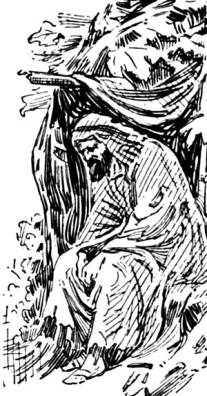
5-11 Jonah went out of the city, yet remained near at hand, as if he
expected and desired its overthrow. Those who have fretful, uneasy spirits,
often make troubles for themselves that they may still have something to
complain of. See how tender God is of his people in their afflictions, even
though they are foolish and froward. A thing small in itself, yet coming
seasonably, may be a valuable blessing. A gourd in the right place may do us
more service than a cedar. The least creatures may be great plagues, or great
comforts, as God is pleased to make them. Persons of strong passions are apt to
be cast down with any trifle that crosses them, or to be lifted up with a trifle
that pleases them. See what our creature-comforts are, and what we may expect
them to be; they are withering things. A small worm at the root destroys a large
gourd: our gourds wither, and we know not what is the cause. Perhaps
creature-comforts are continued to us, but are made bitter; the creature is
continued, but the comfort is gone. God prepared a wind to make Jonah feel the
want of the gourd. It is just that those who love to complain should never be
left without something to complain of. When afflicting providences take away
relations, possessions, and enjoyments, we must not be angry at God. What should
especially silence discontent, is, that when our gourd is gone, our God is not
gone. Sin and death are very dreadful, yet Jonah, in his heat, makes light of
both. One soul is of more value than the whole world; surely then one soul is of
more value than many gourds: we should have more concern for our own and others'
precious souls, than for the riches and enjoyments of this world. It is a great
encouragement to hope we shall find mercy with the Lord, that he is ready to
show mercy. And murmurers shall be made to understand, that how willing so ever
they are to keep the Divine grace to themselves and those of their own way,
there is one Lord over all, who is rich in mercy to all that call upon him. Do
we wonder at the forbearance of God towards his perverse servant? Let us study
our own hearts and ways; let us not forget our own ingratitude and obstinacy;
and let us be astonished at God's patience towards us.
Verses
5-11 Jonah went out of the city, yet remained near at hand, as if he
expected and desired its overthrow. Those who have fretful, uneasy spirits,
often make troubles for themselves that they may still have something to
complain of. See how tender God is of his people in their afflictions, even
though they are foolish and froward. A thing small in itself, yet coming
seasonably, may be a valuable blessing. A gourd in the right place may do us
more service than a cedar. The least creatures may be great plagues, or great
comforts, as God is pleased to make them. Persons of strong passions are apt to
be cast down with any trifle that crosses them, or to be lifted up with a trifle
that pleases them. See what our creature-comforts are, and what we may expect
them to be; they are withering things. A small worm at the root destroys a large
gourd: our gourds wither, and we know not what is the cause. Perhaps
creature-comforts are continued to us, but are made bitter; the creature is
continued, but the comfort is gone. God prepared a wind to make Jonah feel the
want of the gourd. It is just that those who love to complain should never be
left without something to complain of. When afflicting providences take away
relations, possessions, and enjoyments, we must not be angry at God. What should
especially silence discontent, is, that when our gourd is gone, our God is not
gone. Sin and death are very dreadful, yet Jonah, in his heat, makes light of
both. One soul is of more value than the whole world; surely then one soul is of
more value than many gourds: we should have more concern for our own and others'
precious souls, than for the riches and enjoyments of this world. It is a great
encouragement to hope we shall find mercy with the Lord, that he is ready to
show mercy. And murmurers shall be made to understand, that how willing so ever
they are to keep the Divine grace to themselves and those of their own way,
there is one Lord over all, who is rich in mercy to all that call upon him. Do
we wonder at the forbearance of God towards his perverse servant? Let us study
our own hearts and ways; let us not forget our own ingratitude and obstinacy;
and let us be astonished at God's patience towards us.
