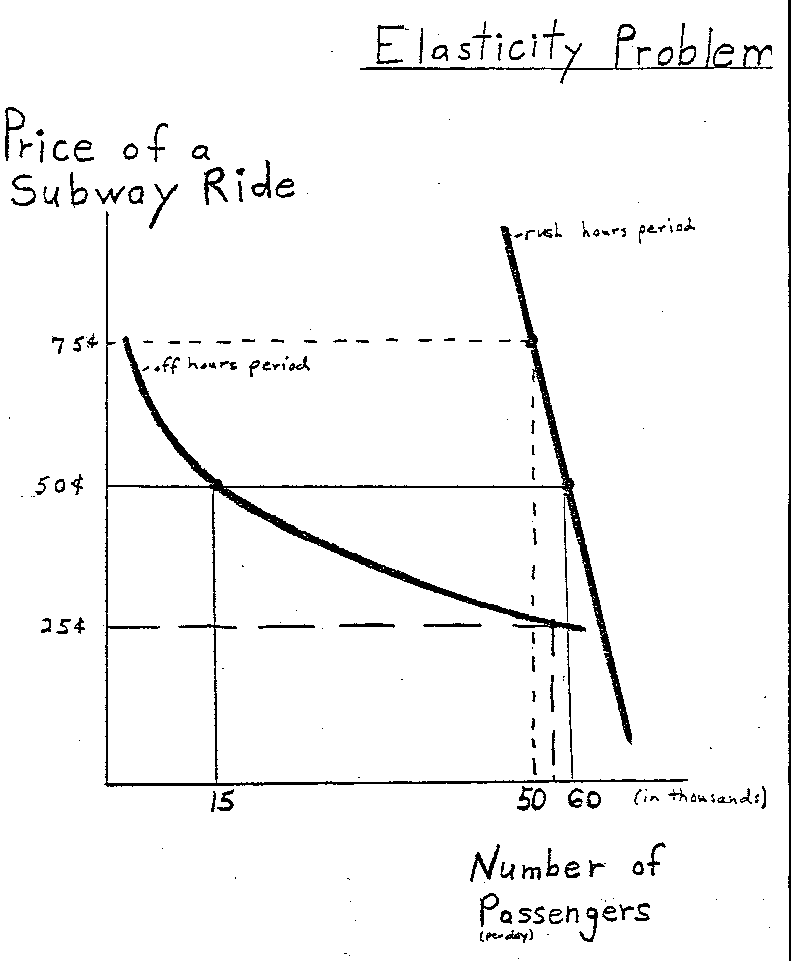
Problem: The city has a budget problem caused by the subway.
They are losing money at a rate of $6250 per day. Costs exceed revenues.
They can do nothing about costs, but they have hired you to work on the
revenue side. You have been brought in because the last consultant
had a dispute with the Mayor and was fired. His work is shown on
the graph. He estimated the demand for subway ridership during each
week day. He found that there are actually two distinct demand curves.
One for the rush hours and the other for the off hours. You believe this
work to be accurate. You need to interpret what it means and make
recommendations.
Here are some facts:
Currently the fare is 50 cents at all times. Costs will not be
affected in any way by fare changes. You are free to explore rate
increases, decreases or whatever. A split fare system is practicable,
if that is your decision. Stick with round numbers for your price(s).
You want to break even rather than make a profit.
Solution: The rush hour demand curve is apparently inelastic, since it is steep. The Total Revenue Test tells you that if demand is inelastic, raise price to increase revenue. The off hours demand is elastic, since it is flat-ish. Reduce price to raise revenue is cases where demand is elastic. You, therefor, have 3 choices. Raise the rush fare, lower the off fare, or do both. You should crunch some of the numbers which follow, to make sure you understand.
Since you have a $6250 deficit to make up, test what happens when you raise to $0.75 at all times (compute revenue in rush plus off: deficit is smaller, but still there). What if you cut to $0.25? Deficit still there. How about raise rush and cut off? Massive profit. What would be the most politically acceptable kind of solution. One in which nobody gets hurt. Conclusion, try cutting to $0.25 in off, leaving rush at $0.50. Voila! the deficit is exactly covered.
Comment: this is the philosophy behind NY's plan to go to a multiple fare system for the subways. Washington DC, and many other cities already have it.
Incidentally, this problem is based on a factual case. The consultant's
suggestion was rejected as "impossible". (How can you eliminate a
deficit by cutting price?). The city council had not studied elasticity.