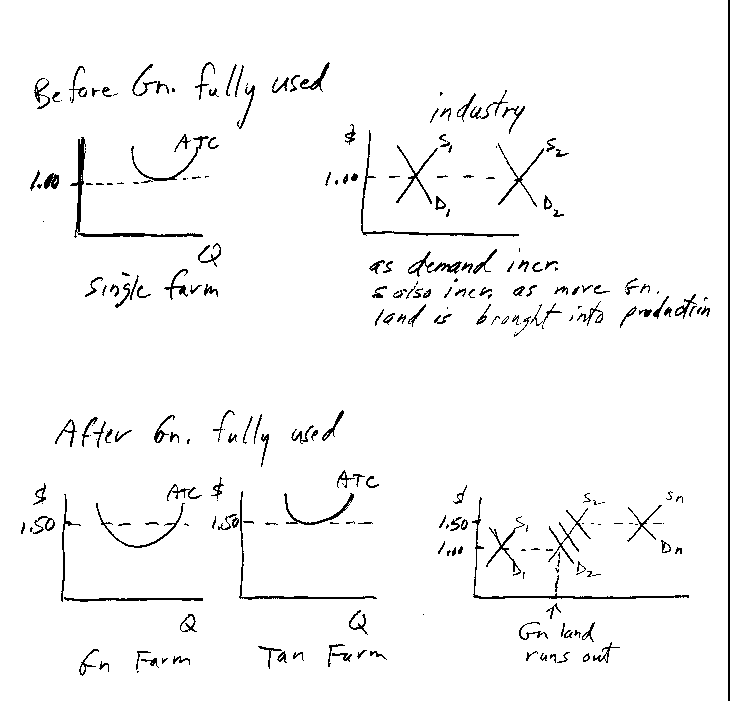
A previously unknown oasis is discovered in the Sahara. This lush but remote place begins to draw world-weary inhabitants, who find its isolation a benefit. The government makes the land available at no cost to the new settlement's people -- much as the US gave land away in the American West. One problem the people have is the high cost of "imported" products, which must be flown in. Because of this, much of the food is locally grown. The staple of the inhabitant's diet is dates, which grow well in certain parts of the oasis.
Agriculture at the oasis is concentrated in the "green zone", at the center, which has good growing conditions. The tan zone, which surrounds the green zone, bulls-eye style, is not adequately productive to be useful. The brown zone which surrounds the tan zone is even less productive. The many date farmers in the green zone compete with each other, such that a "going" price of dates of $1.00 per lb. has been established. As usually happens in competitive conditions, the farmers bring in enough to cover their expenses and make a modest(normal)profit. The land in the tan and brown zones are not in use, but the ownership of that land has been parcelled out to hopeful owners who think it may be valuable in the future.
The farmers in the green zone pay nominal rent to the owners of the land. Since even the green land was free, and there is more of it than farmers can currently use, the owners can't expect much rent.
Now let's say the demand for dates starts to increase -- say, due to a preference for that item over other (imported) foods. Say there are 1000 acres of date land in the green zone, and each acre yields 100 Ibs. of dates. Thus,once the quantitity demanded at $1.00 exceeds 100,000 pounds, the price starts to rise. Up until that point farmers are happy to supply additional dates at a $1.00 price by placing remaining acres of the green zone under cultivation. (The supply curve is at first perfectly elastic at $1.00.)
When the price is pushed up to a point where date growing in the tan zone becomes remunerative, that land begins to come under cultivation. Since the tan zone requires irrigation, farmers can not be successful there unless the price is $1.50. When that price is reached the supply again becomes perfectly elastic. But, the farmers in the green zone are now getting $.50 per pound above their "cost" (including a normal profit). The land owners will claim the excess in the form of higher rents. (Rent per acre will rise by $50, i.e., 100 Ibs. X $.50). There is plenty of farming talent, but there is a limited amount of green land. As the scarce factor, the green land will be bid up. Once the tan land starts to be used, farmers can use that land and make a modest profit, or green and make a large profit. They will bid up the green land in their attempt to take advantage of this profit opportunity, until they eliminate that profit -- actually transfer it to the owners.
By this reasoning, the brown land might eventually be brought into production -- if the price of dates rises enough to justify it.
This very useful model of how the "scarce factor" is able to grab
the spoils is applicable to things other than the rent on land. In
a general way, it explains the super-high salaries of star athletes, and
just about any situation where an input is able to command more than its
"opportunity cost". That is, more than the amount which is just enough
to retain the input in its current application. For example, say that some
some basketball star is able to get $5 million a year in the bidding by
major teams. Say that his next best alternative is selling used cars
at $40,000 per year. All of that difference is rent (here, its called
quasi-rent). Moreover, that approximately $5 million in excess pay,
should be about equal to the added money that the presence of the star
brings to the team owner.