Chapter 21 -- Case and Fair -- Aggregate Expenditure, etc. (Updated 10/06)
This chapter covers Keynesian Theory. The important material of
the chapter is covered in the illustration and comments given below.
You should read the chapter, but concentrate on the things brought up below.
Print out this page and have it with you as you go through the chapter.
Keynesian Theory -- Now Known as Income-Expenditure Analysis
Keynes relied on the proposition that consumption is a function of income.
The information underlying the Consumption function on the graph is
as follow:
If Income is Then Consumption is
and Saving is
0
100
-100
150
200
-50
300
300
0
450
400
50
600
500
100
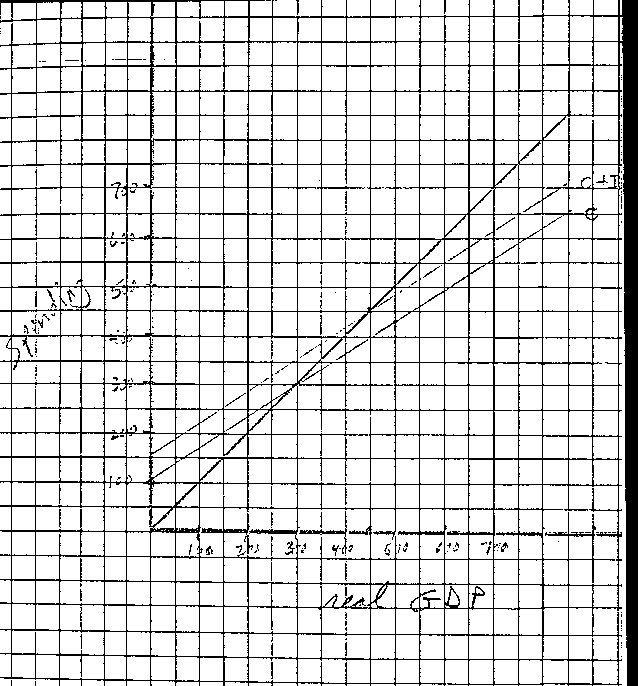 the lower axis is measured
in real GDP, which is (practically) the same as Income
the lower axis is measured
in real GDP, which is (practically) the same as Income
the marginal propensity to consume is 2/3 (change in cons. over change
in income)
the marginal propensity to save is 1/3
note that the MPC plus the MPS sum to one
the slope of the consumption function will equal the MPC (since slope
= deltaY/deltaX)
autonomous consumption is 100 here (Con. at zero income)
saving is measured as the gap between C and 45 degree line (dissaving
on left side of break even)
investment is taken to be 50 here and it is exogenous (doesn’t depend
on income or GDP)
in reality this is not a good assumption, but makes little difference,
here
Aggregate Expenditure here (with no government or foreign trade) is
C+I
Equilibrium GDP is 450 bil, since C+I crosses 45 at that point.
explanation: at 450, spending = output, whereas if GDP were 600 there
would be unsold goods equal to 50 (unwanted inventory accumulation, unplanned
investment) and firms would respond by cutting output.
Also, note that saving = planned investment at the equilibrium GDP.
The equilibrium is not necessarily a desirable outcome. Perhaps
this economy needs GDP=600 to achieve potential. If so, there is
a recession. Keynes pointed out that weak spending will produce a
recession and that the recession may be semi-permanent since nothing will
change so long as the agg. expenditure remains as it is.
If consumption or investment rose by 50 (from the original 50 up to
a new 100), the equil. GDP would rise to 600. This suggests that
government policies to stimulate demand can be helpful in combatting recession.
Note: we observe the multiplier here, since 50 additional agg.
expend. yields 150 additional equil. GDP. We see it is three in this case.
The relationship which pertains is:
change in A.E. x mult. = resulting change in GDP (remember this)
The multiplier is equal to 1/MPS (or 1/1-MPC) , which in this case
is 1/(1/3)=3