CANDLERS in Southwest Virginia,
by Ed Marsh © 2000The following article stems from a branch of my research on John Candler (c1730-1802). Specifically, I am trying to determine what he was doing during the American Revolution. Because he was a childhood friend and neighbor of Charles Lynch, Jr. who was a Colonel in the Virginia Militia and General Washington's superintendent of lead mines, I have wondered if Candler was working for Lynch in some civilian capacity. As I searched into the records of far western Virginia (which are sparse and disorganized) I found many interesting clues.
Below the article per se is a letter that I wrote to another Candler researcher explaining what lay behind this research.
http://www.ls.net/~newriver/nrv.htm
The map you see below (thank you Mapquest.com) shows the area around the town of Candler in Russell County, Virginia.
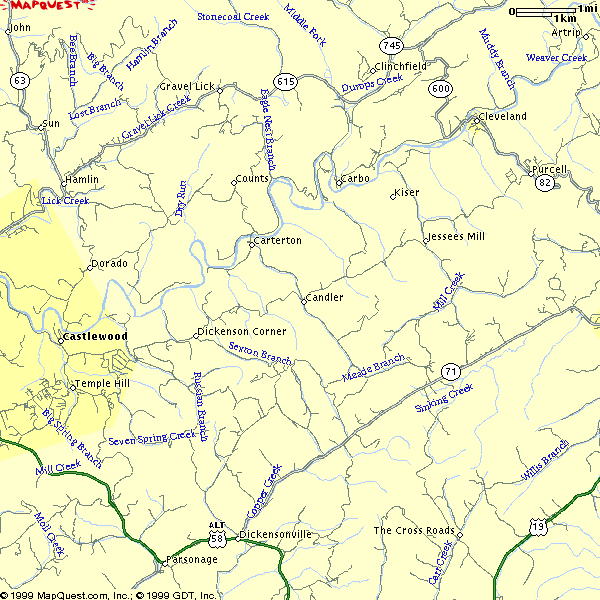
According to the U. S. Geological Survey, there is a town of Candler and a Candler cemetery at this location.
John Candler, Jr. was from present-day Lynchburg, VA. He was probably born in the Lynch cabin which his father John Candler, Sr. bought from the Lynches in 1759.
At the very earliest times in present-day Russell County (1769), John Lynch owned a Mill (which eventually became known as Bickley's Mill). I believe that John Candler, Sr. came down there to scout the Lynch mill seat prior to 1769 and acquired land which his son (John, Jr.) settled on 20 years later. Why? Because the town of Candler, Russell County, VA is located on Meade's Creek at the present-day intersection of state roads 640 & 614. This is no more than 4 miles from Lynch's Mill. Also, there is no record of John Candler, Jr. getting or having a grant in the early land books of Russell, which leads me to believe that the land was acquired while this area was part of Augusta, Botetourt, Fincastle or Washington County."
Wilderness Road
(author's note added 2001)It is worth noting that this area of Virginia came to be on the main migration path westward - The Wilderness Road. This map shows Castle's Woods (see in article below) at the extreme eastern side. I didn't realize (when I wrote this article) that this area (today, a very rural and isolated part of Virginia) used to be on this vital artery to the west. I wondered why John Candler would leave Lynchburg and settle in the middle of nowhere. Now I see a very different picture.
Bickley Mills
By Emory L. Hamilton
In Castlewood, on lower Mill Creek there are the foundations of two old water mills and three abandoned mill burrs. In these remnants of a by-gone day one could almost say lies buried the history of Castlewood - the history of the first settlements ever made along the Clinch River, for it was around this spot that John Morgan led his settlers in 1769. Little is known of Morgan and his settlers who came into the beautiful Clinch River Valley, other than that each was to take up 400 acres of land for settlement. We do not know the names of any of the original settlers for sure, other than John Morgan and John Smith, not even the number in the settlement party, or from whence they came.
Somewhere in this vicinity also lived the legendary Jacob Cassell, for whom Cassell's Woods was named, shrouded in the mists of the past, about whom all sorts of legendary tales are told. Despite the fact that he was an ordinary person, but who probably preceded even Morgan's settlement the place bears his name after more than two centuries have blown over his dim footprint.
Mill Creek is a clear, beautiful stream emerging from under the red hills of Russell and cascading over an ancient limestone cliff to form a lovely waterfall. Just below this fall, which furnished water for the mill race, lie the two foundations and three grinding wheels, nostalgic reminders of a restless roaming race of men who were not content to remain here, but who helped to settle the great central part of America.
Nearest to the fall is the smaller and older of the two foundations. Some fifteen feet downstream is the other and larger of the two foundations and here lies the three heavy stone grinding wheels. This latter mill, built probably around 1783, creaked and groaned its way through well over a century of time, and lasted well into the memory of older citizens of Castlewood. No doubt the Red Men many times gazed upon these mills with hatred, seeing them as the symbols of the ever encroaching white men upon their land.
From scanty records it appears that John Lynch, who was a merchant and who did not live in the area had the smaller mill built and it was probably operated for him by Frederick Fraley. Colonel Daniel Smith, who was assistant Surveyor for old Fincastle County, which Russell was then a part of, wrote to his superior Colonel William Preston, on March 22, 1774, saying: "Yesterday, (March 21, 1774) I surveyed John Lynch's mill seat."
At this time Smith was making surveys for the original settlers from 1769, and Lynch either had the mill in operation at this time or soon thereafter. We also find in the court records of old Fincastle County in the year 1773 where John Lynch and his brother Christopher Lynch, business partner, brought suit against Castlewood residents for debts which appear to have been made at the mill. No record has been found permitting the erection of this mill and it may have been erected without permit sometime between 1769 and 1774.
John Lynch assigned his "mill seat" property to Frederick Fraley, the latter having apparently settled upon the land when he arrived from Rowan Co., NC in 1769. It is highly probable that Fraley had managed the mill for Lynch before he bought it, and it may be that he and his neighbors built the mill soon after their arrival in 1769, as bread is a necessity and a means of obtaining it would have been their first consideration.
Sometime around 1780, Frederick Fraley seems to have sold the mill to Henry Hamlin, and moved to the Moores Fort property in lower Castlewood which he had bought. Before acquiring the mill seat Hamlin had been living on land on the north side of Clinch River opposite the mill. Hamlin received his patent for the mill land sold him by Fraley from the Washington County Court on November 11, 1782, but had possession for sometime prior to receiving the patent.
Hamlin had the second mill built sometime around 1782 or 1783, for it was surely this mill upon which Charles Bickley, Simon Auxier and Henry Dickenson were working when 17 Indians attacked and scalped Ann Bush, later Ann Niece. It was around this old mill which was undoubtably built of logs that the community grew. The mill shown in the picture while on the same foundation has to be of later construction.
Again we go to Daniel Smith, the Surveyor and Captain of Militia for Confirmation. In a letter written to Colonel William Campbell, dated May 19, 1783, he writes: "On my return from the Cumberland, I came through Cassell's Woods, just after the Indians had been at the Fort at Hamlin's Mill."
Henry Hamlin ran the mill for a few years and on June 19, 1787 sold it to James Bush with the deed showing, "it being part of land patented to him on November 12, 1782, the same land he purchased from Frederick Fraley. As further evidence of Bush's ownership is a Russell County deed of September 17, 1795 which reads: "lying on the waters of Moccasin Creek and Clinch River up to Bush's Mill Creek."
James Bush sold the mill tract on May 27, 1800 to Charles Bickley. It was Charles Bickley who put Bickley's Mills on the map, and who still had possession of it at his death in 1839.
Under Bickley's management Bickley's Mills became a trading center for the western frontier. He converted it into a rolling mill for grinding wheat and buckwheat. He opened up a mercantile business which flourished. One of the old Bickley Mills ledgers is now in possession of Mr. L. E. Gibson of Castlewood, a descendant of Bickley. Many of the items mentioned in the 1830's sound strange today.
Charles Bickley not only expanded the mill, but built a sawmill further upstream, and along with Henry Dickenson, as a partner had installed Carding and Fulling Machines for cloth work. In his will dated April 3, 1825, Henry Dickenson leaves to his son, Henry, Jr., "My interest in the Carding and Fulling machines at Charles' Bickley's."
A Carding Machine was a machine for carding wool by separating fibers and cleaning them of extraneous matter, making it soft and ready for the bobbin. Before invention of the Carding Machine, and for a long time after, wool was "carded" by hand with devices known as wool cards. The wool cards were brush like devices with stiff wire bristles for combing the wool and removing foreign matter much as the carding machine did, but much slower.
A Fulling Machine was for fulling cloth by means of pestles or stampers which beat and pressed it to a close, compact state, cleaned it, and made a finer, less coarse cloth.
Here at Bickley's Mills on February 3, 1832, was established a post office, with John Bickley, son of Charles, as postmaster, known as Bickley's Mills, Russell Co., VA. This post office continued to serve Castlewood until February 1, 1907. Also here, for several years the "Bickley's Mills Post" newspaper was published, copies of which can still be found as proud possessions of Castlewood residents.
The late Mrs. Mamie Gose, descendant of both Charles Bickley and Henry Dickenson, and who remembered the last old mill, told me, "it stood and rotted and finally the wind blew it down."
The Washington County Surveyors Record 1781-1797, © by Rhonda Robertson, 1998; presented by permission. Many Thanks!
Page 199 - Henry Hamlin...325 ac...Commissioners Certificate...on the south side of Clynch River and on both sides of Mill Creek in Castles Woods...Beginning corner to William Harroldsons land...on Osburns line...at the mouth of a branch...November 12, 1782 - Henry Hamblin, assignee of Abraham Cooper, assignee of Michael Kirkham, assignee of Frederick Fryly, assignee of John Lynch...400 ac in Castles Woods on both sides of the Mill Creek on the south side of Clynch...216 ac surveyed on March 21, 1774 for Frederick Fryly, includes improvements, actual settlement made in 1769...August 23, 1781
Thanks for the info about the Russell County CANDLER marriages. Peripherally, it was news to me that book #1 was gone. Too bad. Above is my mission statement for new Russell County area research. Here are some more thoughts. Try them out on _____ and maybe she will have a brainstorm. Taking her lead, I have been exploring means by which our John Candler, Sr. may have served in the Rev. War.
I have been collecting data about Colonel Charles Lynch of the Bedford County militia. Charles was a representative in the VA legislature (for which he was disowned by the Quakers). He seems not to have been in direct command of troops for the most part. Lynch was superintendent of the lead mines at Ft. Chiswell, and he also owned a powder works near New London (Old Bedford Courthouse). The Armory for the Southern Army was located in New London. Thomas Jefferson, in his Notes On The State Of Virginia, mentions how the lead shot manufactured at Ft. Chiswell on the New River was carried 150 miles cross-country on a good road to New London.
Lynch held court in Bedford County which is where the "Lynch Law" terminology originated. Apparently, "Lynching" meant be strung up by the thumbs until the desired effect was acheived - and it is claimed that he did not kill anyone. I doubt this because Geo. Washington and Patrick Henry led the effort to pass a bill pardoning Lynch and his subordinates for their illegal acts during the revolution. That pardon reads like they killed people.
John Candler is not listed in this respect.I have looked through the payroll indices for Dunmore's War and there is not a "Capt. Lynch's Company" listing. According to the "Biographies of American Revolutionary War Officers" that I searched, Col Chas. Lynch did serve under General Nathaniel Greene's campaign in North Carolina. Also no sign of John Candler there.
Here is my interest in Russell County the area.
About 1769, a bunch of North Carolina pioneers made their way up to the Cassell's Woods (Castlewood) area and laid claim to the choice pieces of real estate. In 1773, Captain Daniel Smith (one of these pioneers - captain in the militia) deputy surveyor of Fincastle County (under surveyor Preston) went through there and formally surveyed these earlier claims. It is thanks to him that I know of Lynch's Mill (later Bickley's Mill). He wrote in his log (...surveyed Mr. Lynch's mill seat).
In the Southwest Virginia Historical Society article on Mills, all the author new of this Lynch was that he was a business man who lived elsewhere in the state and had the mill run by a tennant miller. The author knew this because there was a lawsuit filed by Mr. John Lynch and Mr. Christopher Lynch of Bedford County, VA against such persons as failed to pay outstanding debts to the mill. Note: Charles Lynch, Sr. was said to be a lawyer trained by his wife's father, Captain Christopher Clark. Thank goodness that the Lynches were litigious.
So..., I read further that many of the western Virginians held onto their land warrants rather than filing them in order to receive deeds. You can ask _____ about this, but I believe that it worked this way. You scout out a piece of unclaimed land, get a surveyor to describe the claim, strike the deal with the land agent and get a warrant (which I'm guessing is like a claim of first rights, or maybe an endorsement on the agent's part that you have claim), then you file that warrant and receive a deed, patent, or grant. According to an article that I read, some of these early pioneers never traded in their warrants. They sometimes used them like currency or put them down as collateral. They traded them in land transactions.
I suspect that our John Candler, Sr. held a land warrant for land at Candler, VA, and gave it to John, Jr. at some later date. This may be why John, Jr. does not appear in the early deed books of Russell County. The authorities would completely respect his property rights because he (like many of his neighbors) held one of those warrants. I'll bet that somewhere in later Russel County land records, the existence of a land warrant appears. Perhaps when John's and Dorothy's estates were settled. The fact that Candler, VA s just three or four miles from Lynch's Mill makes coincidence seem impossible.Candler, VA lies on Meades Creek. I researched the Meade Family of Russell County and noticed that they have many marriages that intersect the Jessee, Browning, Kiser, Bickley, Candler (and others) group.
In 1808, James Candler (c1756-1826) bought some land on Beaver Creek from his brothers William (1751-1836) and Daniel (c1753-1810) and his sister's estate (Jane Candler Guthrie who married James died in 1807). I believe that this piece of land belonged to John, Sr. and had passed to son Henry Candler (1769-1806) after John's death in 1802. After Henry's death, all four of these (William, Daniel, Jane, and James) apparently enherited the land from their unmarried, childless brother. I have always wondered why John, Jr. and sister Hannah Candler Irby weren't included. I had assumed that it was because they had moved away (Douglas Irby moved to Botetourt County - died in Roanoke).
Recently, I have become aware that there were Erbys (Irbys) in early Russell County that married into the same families into which your Candlers did. Perhaps we will find more on this at some future time.
Maybe it was because John, Sr. had given John, Jr the land out west and that was his whole piece. Yet, maybe it was just Henry leaving it to his neighborhood family. I believe that this is the Henry Candler who paid the surety on several of the late 18th and very early 19th century Candler marriages in Campbell County.