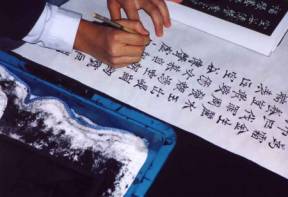
 Japanese
writing takes a long time to learn and it requires constant practice. To do every day work, Japanese people use
pens and pencils to write with.
Japanese
writing takes a long time to learn and it requires constant practice. To do every day work, Japanese people use
pens and pencils to write with.
There are 3 different
writing systems in Japan. The Chinese
characters called kanji are very complicated.
Kanji was brought to Japan in the sixth century. Kanji is used to express an idea, whole word
or symbol, not a sound like our alphabet.
By the end of elementary school students know 1000 symbols and by the
end of junior high they know the 2000 symbols.
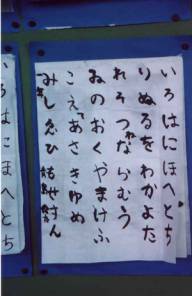
Because kanji is so complicated, two other
systems, hiragana and katakana, were created.
These other writing systems are used to spell words that can’t be
written with kanji. Letters stand for
sounds. Each of these alphabets has 46
letters. Hiragana is used to write
Japanese words. K, s, t, n, h, m, y, r,
w, g, z, d, b and p are added to the 5 vowels of a (short a sound ), e (short e
sound), i (long e sound), o (long o sound), and u (oo sound). Katakana is used to write words that can’t
be translated into Japanese. Even
though it has the same vowels and consonants as hiragana, they are written in a
different way.
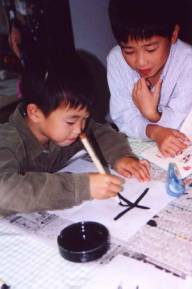 The art form called calligraphy is called
shodo in Japanese. This writing is so
special to Japanese culture. Special
brushes are dipped in black ink to make kanji characters. To create beautiful characters there is
special shading of the ink using special brush strokes. The kanji is placed on calligraphy paper in
specific spots. Since calligraphy is so
hard to do, students practice it over and over starting in elementary school.
The art form called calligraphy is called
shodo in Japanese. This writing is so
special to Japanese culture. Special
brushes are dipped in black ink to make kanji characters. To create beautiful characters there is
special shading of the ink using special brush strokes. The kanji is placed on calligraphy paper in
specific spots. Since calligraphy is so
hard to do, students practice it over and over starting in elementary school.
www.jin.jcic.or.jp/kidsweb/virtual/shodo/what-is.html
www.japan-guide.com/ele2048.html