Religion
The Japanese mostly practice two religions.
Shinto and Buddhism influence Japanese culture and people’s daily life.
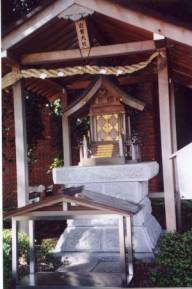
Shinto is found only in
Japan. There are shrines
everywhere. There are more than 80,000
Shinto shrines in Japan.
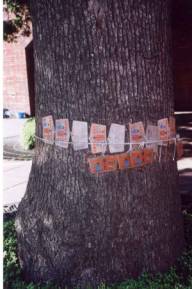
One practice is to write
a wish (prayer) on a wooden square called an ema. Then you hang it on a tree near a shrine.
Shrines sell good- luck charms called o- mamori that bring good luck. You can buy your fortune, a written report of your family’s future.
Shinto shrines and
Buddhist temples are all over Japan.
People visit these to enjoy peace and tranquility. Shrines belong to the Shinto religion. People believe there are sacred spirits that
take on forms in nature like rocks, mountains, water and the sun.
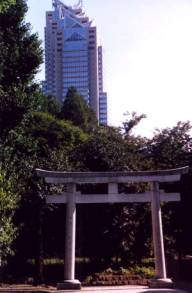
To get to a shrine, a
person usually walks through a gate like this one. It is called a Torii gate.
It separates the sacred world from the real one. The gates come in many sizes. The gate started as a chicken perch because
chickens were used as sacrifices.
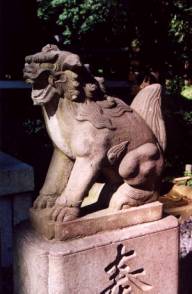
At the entrance to a
temple you will find 2 dogs that look like lions. One is on the left and one is on the right. The one on the left has its mouth open while
the one on the right has it closed.
They represent the beginning and end of everything.
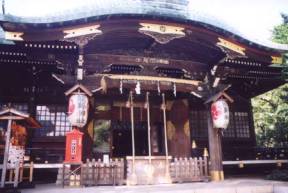 A
temple belongs to the Buddhist religion.
Buddhists believe in reincarnation where a person comes back after he
dies as another person or in another form.
A
temple belongs to the Buddhist religion.
Buddhists believe in reincarnation where a person comes back after he
dies as another person or in another form.
Even though Tokyo is
ultra modern and hitech in many ways, it is filled with many treasures like its
historical and traditional sites.
Asakusa in the northern part of the city is where early Japanese
merchants originally settled.
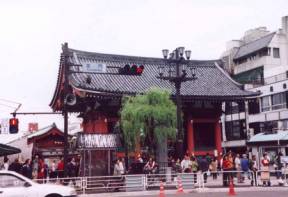
This is part of the
Kaminari-mon Gate in Asakusa.
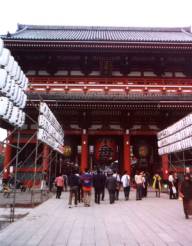
Once you walk through the gate there are many traditional colorful shops selling pottery, kimonos, fans, toys and other goods on a 300 meter promenade. At the end of this walking area are temple buildings and shrines.
The Buddhist Senso-ji
Temple symbolizes this area. Many old and young worship here. This temple is dedicated to Kannon, the
Buddhist goddess of mercy.
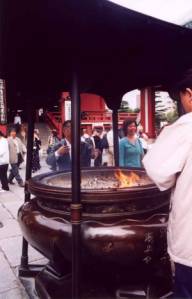
You can brush the smoke
of the incense burner into your face to bring yourself good health, heal an
injury or illness or to gain wisdom.
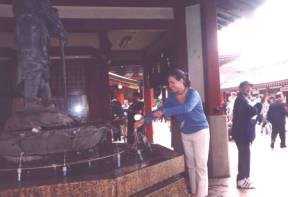 You
should cleanse your hands and mouth before you enter a shrine or temple using
the flowing stone water fountain. With
the dipper you pour water into your cupped hand and bring the water to the
mouth without letting the dipper touch your lips.
You
should cleanse your hands and mouth before you enter a shrine or temple using
the flowing stone water fountain. With
the dipper you pour water into your cupped hand and bring the water to the
mouth without letting the dipper touch your lips.

In Kamakura you can get
to the temples by a rickshaw, a cart a man pulls you in.
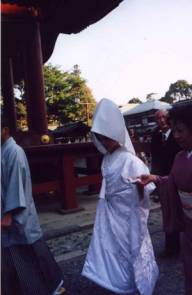
Often the marriage
ceremony is performed as a Shinto ceremony.
Many couples are now also married in a ceremony where the bride dresses
in a western white wedding gown.
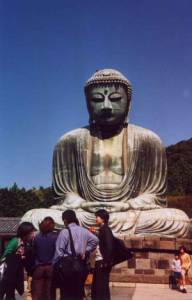
Buddhist temples are in open
areas. We saw the enormous daibutsu,
the Great Buddha statue, at the Kotoku-in Temple. It was made in 1252 and stands 13.35 meters high which is 37
feet. It weighs 274,428 pounds.
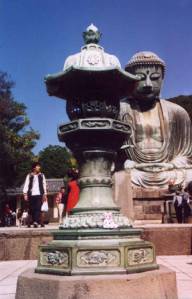
Near this Buddha is a
pogoda statue.
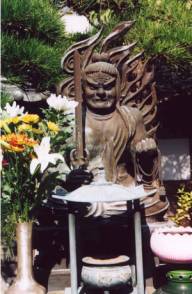
You enter gates to the
Hassen Kannen Temple to see this statue.
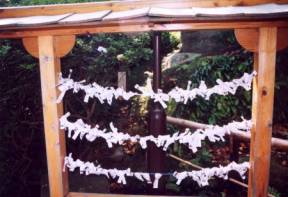 Not
everyone is superstitious in Japan.
However, near shrines you can drop a coin in a box and pick up a
fortune. If it’s a good one you should
put it in your pocket. If it’s a bad
one you should tie it on the rack of bad fortunes and let the wind blow it
away.
Not
everyone is superstitious in Japan.
However, near shrines you can drop a coin in a box and pick up a
fortune. If it’s a good one you should
put it in your pocket. If it’s a bad
one you should tie it on the rack of bad fortunes and let the wind blow it
away.
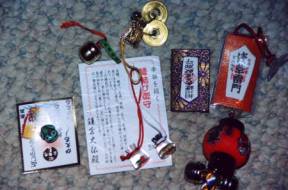 There
are many good luck charms in Japan. For
example, there are charms for good health, great friendship, and super
marriages.
There
are many good luck charms in Japan. For
example, there are charms for good health, great friendship, and super
marriages.
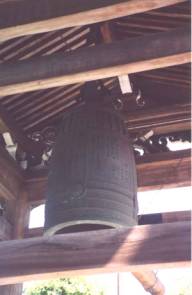
To get the attention of
the gods sometimes people pull the cord and ring the bell.
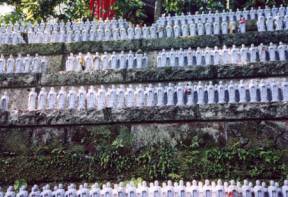 Many
little Buddhas represent the lost children.
These statues symbolize children who died at young ages, at birth or who
died before birth. Buddhists believe
that when people die they become Buddha and protect the family.
Many
little Buddhas represent the lost children.
These statues symbolize children who died at young ages, at birth or who
died before birth. Buddhists believe
that when people die they become Buddha and protect the family.