Toubu
Elementary School
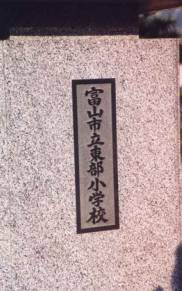
This sign
says Toubu Elementary School.
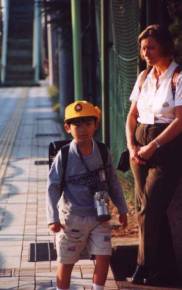
This school of 511 students and 34 staff members opened in 1938.
We watched
students walking to Toubu Elementary School.
It serves students in grades 1 to 6.
The school wants all children to be strong, honest and clean.
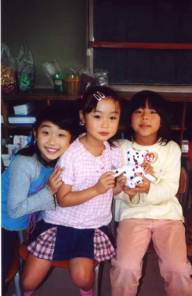
These
Japanese children are just like American children in many ways. Most elementary students do not wear
uniforms. They dress like we do.
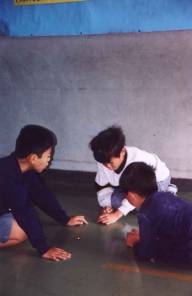
Before
classes children play in hallways and in their classrooms. They play with computers, acorns like
marbles, balls, and tops. The
elementary school was not quiet like the junior and senior highs were. There are breaks between classes of 10 to 20
minutes where students can play or talk in the hallways without teacher
supervision! A buzzer goes off telling
children the next class is about to start.
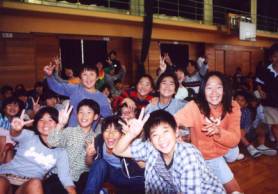 The FMF teachers were so well welcomed by all the students at the
elementary school during an assembly in the gym. The students applauded, sang and danced for the American
teachers.
The FMF teachers were so well welcomed by all the students at the
elementary school during an assembly in the gym. The students applauded, sang and danced for the American
teachers.
Since the
Japanese school year begins in April, children start level l (like our first
grade) in April after their 6th birthday. Students go to school the second week of April through the 3rd
week of March.
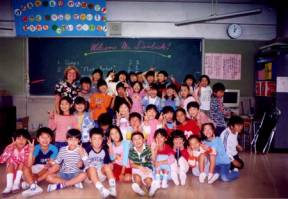
Classes are
large with 30 to 40 children in each class.
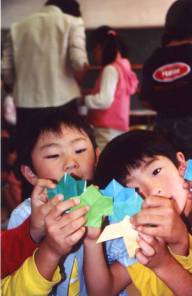
I observed
classes. In the activities class, the
children made origami soldiers.
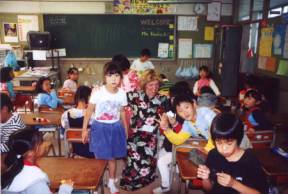
I helped in a
math class where the
students were learning multiplication of the 5 times table.
Administrators
said elementary students study Japanese, math, science, social studies, music,
drawing and crafts, moral education,
home
economics and physical education.
History, reading and writing relate to Japan. Teachers are generally responsible for all subjects. Classes remain in one or 2 rooms for most
activities.
Although
public elementary school is free, parents have to pay some expenses. They pay for school supplies, some books and
school lunches.
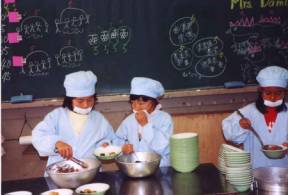 Lunch is called chushoku (choo-shoo-kook). Hot lunches are prepared
for all students. Meals consist of
bread or rice, a main dish and milk.
Students take turns serving the lunch.
The helpers wear masks on their mouth, white smocks and white caps to
keep hair and germs out of their lunches.
No one starts eating until everyone has his lunch. Of course everyone eats with hashi (hah-she)
instead of knives and forks. Hashi are
chopsticks. Students eat together with
their teacher in the classroom enjoying a hot healthy, well-balanced meal. As children eat, the principal tells the
value of the lunch over the loudspeaker.
Lunch is called chushoku (choo-shoo-kook). Hot lunches are prepared
for all students. Meals consist of
bread or rice, a main dish and milk.
Students take turns serving the lunch.
The helpers wear masks on their mouth, white smocks and white caps to
keep hair and germs out of their lunches.
No one starts eating until everyone has his lunch. Of course everyone eats with hashi (hah-she)
instead of knives and forks. Hashi are
chopsticks. Students eat together with
their teacher in the classroom enjoying a hot healthy, well-balanced meal. As children eat, the principal tells the
value of the lunch over the loudspeaker.
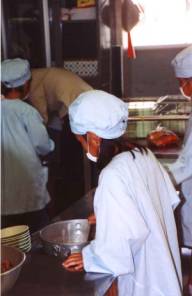
After lunch
everyone carries a tray to the front of the room and places each item in the
right container. Children then brush
their teeth in hallway sinks.
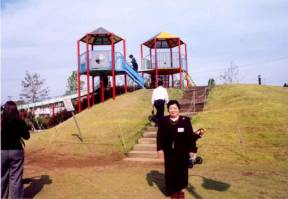
As part of
the class called integrated study the children began designing a park for the
community in 1998. Now the students are
responsible in maintaining it. This
integrated environmental study project helps students develop their capability
to solve problems themselves and helps students become independent.