Minutes of Meeting
160th Edinburgh Branch
Meeting
Craighouse Campus, Napier University, Edinburgh –
Thursday 10 March 2005 - 130pm
SEDERUNT: J Fenton R McLean R Lovering C Lawson T Sayer B Anderson
K Lloyd A Diment H Gardner T Mellon A Pittendreigh R Thomson M Gorman
I Sinclair J Bathgate N Doherty B Morris A Curran S Daly M Johnstone
S McMorland A Russell E M Ramsay S Beaton D Cawkwell M Croston V Stewart
I Wilson M Bancroft H R Innes L Young J Hepburn A Green A Murray
APOLOGIES: Tom Neilson, Bob Bertram, Karen McDonnell, Simon Hunter, Janet Littlr, Karen McDonnell, Julian Davies, Graeme Lyall, Andy Sharman
1.0 CHAIR: Richard Lovering took the Cahir and outlined the safety arrangements
2.0 MINUTES OF PREVIOUS MEETINGS (February 2005)
2.1 Receipt: The minutes had been received as expcted.
2.2 Accuracy: Add Kevin Lloyd to apologies for absence. With this correction agreed correct: proposed by Barry Anderson; seconded by Liz Young.
3.0 MATTERS ARISING NOT ON AGENDA : None.
4.0 CORRESPONDENCE
4.1 Fife Chamber of Safety: Entry for Safety Competition 2005 & Minutes February Meeting.
4.2 Fire Protection Association: LBFB Headquarters Lauriston Place 21st March 1.30pm. The new Fire Scotland Bill. Email [email protected]
4.3 New HSE website puts 'business case' for health and safety at work.
4.4 A controversial plan that could have stopped national enforcement agencies enforcing safety laws for some foreign companies based on their turf is to be revised by the European Commission.
4.4 IOSH National Council: February meeting: The results of the consultation exercise were reported. Council members would be elected from a single candidate list on a multi-transferable vote basis with no reserved places for non-Corporate members nor for SGs or Branches. Implementation of the new governance system (Council/Board of Trustees) would be delayed.
4.5 Environmental Health and Safety Manager who has an API or chemical background (based in the South East).
4.6 European Week for Safety & Health at Work 2005: IOSH nationally would be organizing another Children’s Poster Competition (“Stop That Noise”) and, as in previous years, were looking for companies that could partner IOSH.
4.7 The Secretary reported a phone call concerning a “Safety Notice” concerning sling fabrication that had appeared on the IOSH national website but which had originated in Scotland. It was claimed that the information was misleading. Members reported that this had appeared also on the HSE website but the information had been purely for internal use and the notices should not have appeared and had been withdrawn.
4.8 Centrica required a Group Environment Manager based in Berkshire.
5.0 BRANCH EDUCATION DEVELOPMENT ADVISOR - Liz Young. Liz confirmed she would make a presentation on CPD at the April meeting.
6.0 SPECIALIST GROUPS
6.1 PUBLIC SERVICES – Marion Johnstone: Marion reported on the SG’s 23 operational objectives adopted for 2005 and the substantial achievement of the 2004 objectives. It was hoped to have the 2006 National Safety Symposium in Scotland.
6.2 CONSTRUCTION – Allan Dick: nothing to report.
6.3 FIRE RISK MANAGEMENT - Dave Sinclair: nothing to report.
6.4 HEALTHCARE - Martin Scott-Smith: Max reported that he had received an electronic version of the “Blue Book” - The management of health, safety and welfare issues for NHS staff, 2005 and could forward it (500 kB) if anyone wanted to see it.
6.5 ENVIRONMENT – Julian Davis: nothing to report.
6.6 OFFSHORE - Tam Boyd: nothing to report.
6.7 CONSULTANCY - Derek Cawkwell: Members interested in receiving information quickly on consultancy matters were asked to pass on their email addresses to Derek.
6.8 SAFETY SCIENCES - Steve Boucher: nothing to report.
6.9 TELECOMMUNICATIONS – Graeme Lyall: nothing to report.
6.10 EDUCATION – Chris Lawson: nothing to report.
6.11 RAILWAYS, RETAIL, RURAL: no representatives
7.0 FORTH and TAY DISTRICT
Site visit in June is to RAF Leuchars. Booking essential since they need to hire a bus.
8.0 MEMBERS ITEMS
8.1 AGM – May. Nominations in writing have to be in 28 days beforehand. Nomination forms downloadable from Website and available at meeting. All 4 officers can be contested and 2 vacancies for ordinary Exec members.
8.2 There was still time for members to put forward topics for the 2005/6 programme.
9.0 GUEST SPEAKER: Lone Working in Forestry: Emily Ramsay: Forestry Commission.
Emily Ramsay was initially introduced to the group by Marion Johnson as the National Health & Safety Officer for the Forestry Commission – heading up a very small team covering a very large area and then indicated that she would leave Emily to further expand on her coverage herself.
Emily then indicated that the small team was in fact a group of four in total including herself and they covered all of the Forestry activities of the commission in Scotland, England and Wales. It later transpired that the Forestry Commission employ some 3,000 employees of which possibly only about 120 of them were physically involved in the hazardous activities in the forest, as most of these activities were undertaken by contractors.
Forest Industry
The speaker then described just what was entailed in the forestry industry, as it was perhaps a little broader than a lot of people expected.
· Forest Management – This included planting trees and then replanting those eaten by insects, insect control in the broader sense together with weed control.
· Wildlife management – Including shooting deer to control the rate of growth and the related damage caused and similarly killing rabbits to control ground damage from burrows etc.
· Building & maintaining roads within the forestry areas to enable the removal of harvested tress etc.
· Harvesting trees – This required felling the trees either by harvesting machine or by hand operated chainsaws, although this element had now dropped to less than 3% of the harvesting activity. Then extracting the trees to the forest roadside and in some cases haulage to the end user.
· Machine repair activities – which could be either on site or in a full workshop environment.
· A major extension of their activities for the past 15 years has been the growing countryside recreation – Where they are providing suitable facilities for members of the public to undertake walking, cycling, mountain bike riding, extreme cycling, motorcycling, horse riding, etc
The main Health & Safety Problems
The physical safety aspects included –
• Employees being hung up trees with a chainsaw in their hands
• Employees and members of the public being hit by falling trees
• Contact with electricity from overhead cables
• Machines rolling over and with the requirement to push the harvesting machines further and further up the hills to reduce hand chainsaw usage this was an increasing hazard.
• Slips / trips – this being perhaps their major issue – particularly in areas whichwere currently undergoing clearance as the debris and congestion under foot made safe walking across the areas almost impossible.
• Lone working and even though the Company standard was that no-one using a chainsaw will do so alone, Emily was convinced it still occurred.
• Work related violence and this unfortunately was on the increase. Members of the public setting about their employees in remote areas, or robbery for those collecting cash from ticket machines etc.
The health related issues including –
• Musculoskeletal disorders of all forms – postural issues whilst having to operate hazardous machines etc
• Hand and Arm Vibration Syndrome particularly from the chainsaws but also from other pieces of kit which are used in the forestry
• Noise is obviously a major issue for any employees close to any of the machinery or chainsaws
• Whole Body Vibration is becoming more and more pertinent with the use of some of the newer pieces of harvesting machinery, where the operator is being fully shaken for extended periods of time in the cabin.
• Pesticides and all of the health related issues which this can entail from breathing in the fumes, to ingestion or even skin absorption.
• Work Related Upper Limb Disorders as experienced in a number of computer based activities these days.
Some of the problems from location
The forestry areas are generally in remote or even very remote areas in terms of civilization and the benefits which it can bring. The terrain is often very rough and exceptionally steep and the access will be made more difficult with the felling of trees, so how do you plan to get a stretcher to remove a casualty off the hill side?
This of course then becomes even more of a problem when adverse weather conditions are added to the position together with the lack of adequate communication due to patchy mobile phone coverage. Once the rescue team has left the public roads the trouble starts – how do they locate the actual position of the team/person in trouble? Will the ambulance be able to gain access on the forestry roads which are not built to the same standard as public roads and if they get to the injured party – will they then be able to turn around to egress the area.
If the casualty is in such bad condition a helicopter undertaking an air lift is often the only rescue method available – but then where can you land it?
Site Planning
Often the only way to have answers to all these questions is to ensure the correct planning has been undertaken prior to commencing the activity. This will include amongst other factors -
• Establishing what mobile phone coverage is available in the area and if none is available on site defining just where is the nearest communication point will be.
• Definition of the site location, including a grid reference so that the position can be highlighted exactly.
• What access point(s) are available to get to the site and if the access is so remote, what will be taken as a designated meeting place where the rescuers can be collected from
• What type of access is available – good forest roads, rough terrain, foot access only.
• Is there a suitable helicopter landing area in close proximity.
• Define all of the Emergency contact numbers.
Lone workers
The employees who are considered may be working alone include -
• Chainsaw operators –
• The Company rule is that they never work alone, but for safety sake they have to stay at least two tree lengths apart from the next operator and if the trees are very tall this can mean they are virtually out of site let alone hearing range.
• It is considered that this activity is in itself a High risk.
• Site Safety Rules specify - no lone working, share fuelling points & meal breaks, leave site together and in this way they will be seen every 1 to 1½ hours.
• Forestry Machine Operators – Mechanised Harvesting
• Must work outside each others risk zones which for the Harvesting machines are - two tree lengths plus the range of the machine apart for safety sake.
• Harvester and Tractor trailer / forward loader units are not always on site together and may be working alone.
• It is considered that this activity is Medium risk.
• The Forestry Commission have a 2 hour call system – if no contact has been made within 2 hours then the emergency systems swing into action.
• Contractors are now a major element of any forest clearance activity and the Site Safety Rules specify that they must still operate by at least 2 positive contacts being made each day fro all of their operatives.
• Wildlife Rangers
• These individual will be off shooting deer and apart from the fact that they will have loaded firearms with them, they also work some very odd hours, and cover some very big areas.
• It is considered that this activity is relatively low risk.
• The protection system they will follow will be either a Buddy system or CRISYS where an external agency will be used via c call centre operation to monitor their well being.
• Visitor Centre Staff
• These employees can face robbery and threats of violence.
• This group are often forgotten with respect to lone working as they are likely to be in the company of members of the public etc, but the risk to them is just as real
• The Forestry Commission has defined specific robbery instructions and this may include a link to police where this is considered necessary or advisable.
• Recreation Rangers
• These are the group of individuals required to undertake a facility inspection of all of the remote and outlaying facilities. Whilst they may only be visiting each site on a monthly basis they are obviously always at risk due to the number of location which they have to visit.
• Most of the access will be gained by use of mountain bikes and all of the terrain risks which that will present, but the employees in this group are considered to be the finest in terms of capability and ability such that they are considered safe from their own activities.
• It is considered that this activity is a relatively low risk.
• They are likely to follow either a Buddy system or utilise CRISYS
Summary
The Forestry Commission in all of its activities follow the standards set by the Industry in general and the HSE Arboriculture & Forestry Advisory Group (AFAG) in particular. These require –
• Avoid working alone where possible.
• Make arrangements for someone to check on employees at regular intervals.
• The greater the risk the more frequent the checks will need to be undertaken.
• As a minimum requirement always inform your contact when work starts and finishes.
• Carry a personal first aid kit with you.
• Put in place a system for contacting the emergency services.
• Ensure the system is clearly understood by all people working on the site.
• Identify areas of poor mobile phone reception.
• Ensure you know your location - grid reference & access point from main road.
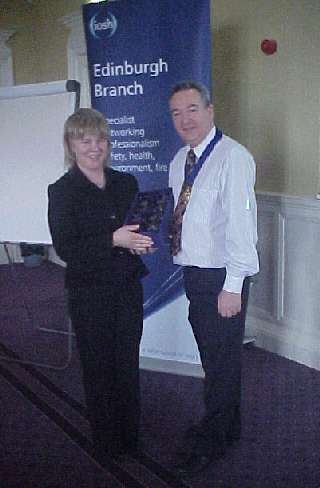
[Emily receiving a token of appreciation from Branch Chair, Richard Lovering]
10.0 DATES OF NEXT MEETINGS
10.1 Edinburgh Branch: 14 April 2005: Management Systems: Mr Ian Robertson: Manufacturing Manager: FMC Energy Systems: Fife
10.2 Forth & Tay District - Thursday 7 April 2005 : ‘Fleetsure’: Paul Richardson: Lothian & Borders Police Initiative to address MORR on a local level
11.0 CLOSURE: Members were invited to mingle and wished a pleasant Easter break.
|
Max Bancroft, MRSC, TechSP Branch Secretary |
Richard Lovering, FIOSH, RSP Branch Chair |
