Minute of Meeting
159th Edinburgh Branch Meeting
Craighouse Campus, Napier University, Edinburgh – Thursday 10 February 2005 - 130pm
SEDERUNT: M Bancroft R Lovering D Richardson A McLeod S McMorland A Sharman B Prout I Munro R Innes L Young S Page J White A Polhill K Darling R Brownlee S Brown S Waddell M Grimmer J Walker R Mclean M Galloway A James G MacGregor H Gardner S Heeson A Jamieson C Lawson J McMahon P M Veitch D Calkwell M Gorman V Stewart K Shaw P Murray A G Dick B Anderson T Ambler
APOLOGIES: Julian Davies, Simon Hunter, Tom Neilson, Bob Bertram, Marion Johnstone, Graeme Lyall, Tom Mellon
1.0 CHAIR: Richard Lovering took the Chair andoutlined the safety arrangements
2.0 MINUTES OF PREVIOUS MEETINGS (January 2005)
2.1 Receipt: These had been received by those expecting them.
2.2 Accuracy: Add to 6.2 Construction SG: Allan reported on the 18 operational objectives that the SG had set themselves for 2005/2006. Of particular interest were:
- To investigate staging a mainland UK Conference in 2005, possibly jointly organized with HSE
- To continue working towards another InterConstruction Conference to be held in 2006
- To continue working in collaboration with the Environmental SG
- To continue working for improvements in competence schemes within the construction sector
- To continue working towards a resource library for the promotion of best practice
The dates for the 2005 meetings were: 10 March, 1 June, 6 Sept, 8 Dec.
2.3 With the above amendment, they were accepted - proposed by Harry Gardner; seconded by Simon Heeson.
3.0 MATTERS ARISING NOT ON AGENDA : None.
4.0 CORRESPONDENCE
4.1 Fife Chamber of Safety – January Minutes.
4.2 BOHS seminar: latest revision of the COSHH Regulations: Edinburgh 10 March
4.3 Scottish Chamber of Safety (SCOS) “Staying Alive 2005” 6th April @ Dunblane
4.4 HSE New Risk Management website: www.hse.gov.uk/risk/index.htm
4.5 eCOSHH: HSE/Glasgow Council Seminar – 22 Feb. email [email protected] –places limited, prior booking essential
5.0 BRANCH EDUCATION DEVELOPMENT ADVISOR - Liz Young.
Liz reiterated that all members should be undertaking CPD and July 2005 was a key date. It would be free for those using the online system. She noted the new scale of membership fees: Affiliate/Associate £67; TechSP/Graduate £82; Member £100; Fellow £110; Retired £20. Members should keep HQ up to date with any change of particulars via [email protected] phone direct 0116 257 3227.
6.0 SPECIALIST GROUPS
6.1 PUBLIC SERVICES – Marion Johnstone: Nothing to report
6.2 CONSTRUCTION – Allan Dick:
Allan reported on the HSE Healthy Handling initiative running from 28 Feb until 7 March. Purpose was to raise awareness of issues such as site tidiness, access, manual handling, HAVS, dermatitis. From 18 May till 25 May they would be concentrating on work at height issues with designers, planning supervisors and contractors. In June and July their focus would be back injuries with clients, LAs and large contractors. Details of what the HSE would expect to find and what they would be looking out for on their website.
6.3 FIRE RISK MANAGEMENT - Dave Sinclair: Nothing to report
6.4 HEALTHCARE - Martin Scott-Smith: Nothing to report
6.5 ENVIRONMENT – Julian Davis: No report
6.6 OFFSHORE - Tam Boyd: Nothing to report
6.7 RAILWAYS - Need a representative
6.8 CONSULTANCY - Derek Cawkwell: Derek commented that he had received notification of a seminar on 20 Jan but with not enough time to let people know. He hoped to set up a communication system within the Branch to enable speedy distribution f such information.
6.9 SAFETY SCIENCES - Steve Boucher: Nothing to report
6.10 TELECOMMUNICATIONS – Graeme Lyall: Nothing to report
6.11 EDUCATION – Chris Lawson: Nothing to report
7.0 FORTH and TAY DISTRICT
Results of AGM:
Chair person - Karen McDonnell
Vice Chair person - Barry Davies
Secretary - Dick Mann
Treasurer - Sandy Chisholm
members - Kirsten Paterson, Joan Goddard, Robin Greer, Dave Devey.
Richard, as Chair of the Branch had presented gifts to Kirsten Paterson and Dave Devey (first Chair and Secretary respectively) who had stood down from these posts – although continuing to serve on Exec. Regular attendance was now in the high 20s. Obviously serving a need and providing a service to members in the northern area of the Branch.
8.0 MEMBERS ITEMS
8.1 Consultation by Branch Exec;
Site Visit – had received a couple of suggestions and were going to try Glenkinchie Distillery
2005-2006 Programme – had received a couple of suggestions. Members should note there was still time over next few months to put in ideas.
2 evening meetings a year: responses – no responses for and one against.
8.2 Early notification of AGM – note it is in May now. Nominations in writing have to be in 28 days beforehand. Nomination forms downloadable from Website. All 4 officers can be contested and 2 vacancies for ordinary Exec members.
8.4 Edinburgh Council is looking for an Occupational, Health and Hygiene Consultant to make recommendations on improving the local environment at a work station. Should have a good knowledge of mechanical installation design (heating/ventilation).
8.5 A Dick: any company gone through ISO 18001? He would like to establish contact.
8.6 ENTO: variety of consultations on H&S – see their website www.ento.co.uk
8.7 Consultant for safety audit – students union – see Liz Young
8.8 Napier University – Assistant Health & Safety Adviser = see web site. Closing date - 18th February
8.9 New IOSH research and development fund is open for bids
8.10 10 minute presentation: John Walker: Role of the Occupational Health Advisor
Branch Member introduced himself to the assembled members and indicated that his intention with the rather short presentation was hopefully to demonstrate the interaction between Health & Safety and Occupational Health as it may affect so many of us at work
A Definition of Occupational Health
•
 The
discipline of Occupational Health is concerned with the 2 way relationship of
Work and Health.
The
discipline of Occupational Health is concerned with the 2 way relationship of
Work and Health. 
• It is as much related to the effects of the working environment on the Health of the worker, as it is to the influence of the workers state of Health on his / her ability to perform the tasks for which she/ he was employed.
• The main thrust of the discipline is to prevent ill-health rather than cure it.
Essential elements of Occupational Health Services
• Health Promotion and Prevention strategies – which is rooted in risk assessment
• Worker / Workplace Assessment and Surveillance as required by the Management of Health & Safety Regulations
• Investigation, Monitoring and Analysis of Illness & Injury – H&S looking into the injury whilst the Occupational Health side concentrates on the illness elements
• Injury and Illness Management - Case Management – Counseling - Management and Administration - Legal and Ethical monitoring – Research = all of these elements rely heavily on the need for a level of trust being built between the OH function and the employees
What Does An OHA Do?
Occupational Health Advisers focus on the Promotion, Protection & Restoration of workers Health within the context of a Safe and Healthy work Environment.
• Autonomy and Independent Clinical judgments – educated to a predefined level to enable them to make decisions and know when to refer the issue to a physician
• Working from a Research based foundation, using Theoretical and Conceptual frameworks
• Must act as advocates for workers and encourage them to make informed decisions about their Health
• Work in collaboration with Health & Safety professionals to provide a holistic Health & Safety at work service
• OHA are professionally accountable to workers (their primary responsibility) employers, their own profession and themselves.
Workplace hazards
PHYSICAL HAZARDS – Are Hazardous agents within the work environment that can cause tissue damage or other physical harm .This includes radiation, temperature extreme, noise, lasers, microwaves and vibration
• ACUTE - Acoustic trauma or excess heat, cuts, burns, rash
• CHRONIC -Tinnitus, Leukemia's, Occupational Asthma.
CHEMICAL HAZARDS - Any substance synthetic or naturally occurring in the work Environment that may be potentially toxic or irritating to the body system through Inhalation, Skin Absorption, Ingestion or Accidental Injection which can include:-
Mists, Vapours, Gas, Solvents, Pesticides, Explosives & Pharmaceuticals.
• ACUTE - Respiratory Irritation. Anaphylaxis.
• CHRONIC -Cancers, Bronchogenic & Gastrointestinal, Occupational Asthma & Neurological disorders.
BIOLOGICAL HAZARDS – As encountered in laboratories & bio-technology working including - Viruses, Bacteria, Fungi, Mould, or Parasites may cause disease via direct contact with infected individuals or animals.
• ACUTE - Colds, Flu, Measles, Parasitical Infections.
• CHRONIC - Tuberculosis, Hepatitis B, HIV and AIDS
MECHANICAL AGENTS - may cause stress on the musculoskeletal or other body systems and hazards include inadequate workstation and Tool design, frequent repetition of a limited movement (RSI) or repeated awkward movements with hand held tools
• ACUTE - Neck strain, muscular fatigue and visual fatigue.
• CHRONIC - Carpal Tunnel Syndrome, Back Injury
PSYCHOSOCIAL HAZARDS – (Stress) - Often related to the nature of the job, the job content, the organisational structure and culture, insufficient training and education regarding job requirements, Physical conditions in the work place, Leadership and Management Styles also contribute as do - Interpersonal Conflict, Unsafe Conditions, Overtime, Sexual Harassment, Racial Inequality, Role Conflict, Shift Work and limited Autonomy.
• ACUTE- Increased Heart rate, Increased Blood Pressure, Fatigue, Depression, Substance Abuse and Violence.
• CHRONIC - Alcoholism, CHD, Mental Illness and GI Disorder.
Summary
The HSG 65 Management System followed within H&S circles including -
• Policy
• Organising
• Planning/Implementation
• Measuring Performance
• Review/Evaluation. – are still applicable in the Occupational Health circles.
9.0 GUEST SPEAKER:
Getting The Best From Your Liability Insurance: Brian Prout, MIOSH Dip2.OSH MIIRSM, Norwich Union Risk Services
Executive Committee member – Andy Sharman then introduced the guest speaker for the afternoon – Brian Prout from Norwich Union who was a Glasgow Branch member, but still felt he had connections with the Edinburgh area by supporting Hibs as a football team to follow.
Brian had been linked to various forms of health and safety and the insurance industry for some 20 years but only managed to escape the office in 1992 and then in 1997 took on the role of Liability Risk Adviser with Norwich Union
He then indicated that during his presentation he intended to cover –
- An insight into who Norwich Union Risk Services are - The Insurance Market and what Insurers do – How Insurers can help Customers To Manage Health And Safety – How to get the best from your Insurer
Norwich Union Risk Services
Norwich Union Risk Services are the Risk Management Arm of Norwich Union who are the biggest Insurers in the Country and involves
• 160 Risk Advisers nation wide with 15 in Scotland
- Risk Advisers operate in a number of different specialisms - Fire and Sprinklers – Security - Liability (Health and Safety) - Business Interruption
• 50,000 Surveys Each Year which is a visit to the Policy Holders premise on behalf of the Insurers to asses if they are a good or bad risk for the underwriter
- Information on insurance risk provided to the Underwriter – this produces risk improvement suggestions. These visits are the only form of face to face visits apart from visits by Claims Advisers following an incident
- Risk Management Advice is provided to policy holders as a free service
• 10 Health and Safety Consultants also provide -
- NEBOSH Cert/Diploma, IOSH Managing Safely, Working Safely, One Day Seminars, Competent Person Services, H&S Audits
The Insurance Market
The insurance market starts with the customer/buyer looking for motor, property, and life insurance that go to Insurance Brokers whose aim is to find the best deal for them. The brokers pass the requirement onto the large Insurers such as AXA, Norwich Union, General Accident, Cornhill Allianz, Lloyds etc. These Insurers in them selves will tend to re-insure those risks where they feel they have too great a risk.
The underwriting cycle demonstrates the very competitive market of supply and demand in which the ups and downs of premiums are a constant cycle based on the normal supply and demand chain –
Supply increases Supply reduces Loss Premiums Fall Premiums Rise Profit


The opinion of the speaker was that the market is currently within the top left of the diagram – where profits have risen to a point where they are leading to profit soon.
There have been several years of EL Underwriting losses which has resulted in the current position being that £1.47 is being paid out in claims for every £1 received in premium and this is making for substantial falling investment returns which has been seen over the whole of the 1990ss and now even into the years of the new millennium.
The market is shrinking so much that a number of smaller Insurance Companies have not been prepare to take on Liability Risks and have closed down, some have been into the position of only providing Liability Insurance where the customer will be taking a full package of insurance and the pressure rises even more now as we see the increase in the litigation based society being provided with the No win – No fee style of claims prevailing.
Add to this the effect legal changes and the ever rising awards which are now being made by the courts such that even the NHS are looking to recoup costs of treating accident victims from the employers. Some of the long tail diseases are still coming to fruition – asbestos – noise induced hearing loss and the Insurers are getting into a stage where they will no longer pay out where the employer has not been taking proper account of full risk management systems. They are trying to imagine what will be coming forward in the next 20 or 30 years time.
The re-insurance market has also felt the pinch over the recent past with the major style of disasters we have seen – 9-11 and the like.
Types of Claims
There has been a substantial change in accident claims over the past years during the move away from manufacturing, where there has been a swing away from the machinery type of incidents such that now the majority are for slips/trips/falls and workplace transport incidents. However the majority of claim these days are in fact not accident related in the normal understanding of the term – being instead Occupational Ill Health issues – more than half of which are noise induced hearing loss related.
The change in emphasis is being seen even wider these days, where the recent claim for £200K for stress was successful and it is estimated that 18m days have been lost over the past 5 years where 1 in 4 employees are suffering from bullying and whilst none of these are resulting in damage claims as yet what can be foreseen for the next 20 years – were the current levels of RSI and stress anticipated 20 years ago?
Liability Insurance
Employers Liability Insurance is almost unique in that it – along with third party motor vehicle insurance, is the only compulsory insurance required in the country and because it is a legal requirement for employers to have, it is not possible to exclude specific actions
The sole aim of Employers Liability Insurance is to provide compensation to those employees who are injured and unfortunately it does NOT promote, encourage or motivate the employers to undertake Risk Management
As an example the speaker then indicated a recent case –
- a general / light engineering company took on an “experienced” worker who was consequently given only a minimum of training, but he was supplied with PPE
- the employee was wearing his overalls tied around his waist as was custom and practice in the Company and had only been working there for 6 weeks
- he was working a cross-cut saw fitted with a top guard but no pivoting guard and as he reached across (being left-handed) his jumper got caught and his arm was dragged in
- The accident happened in July 1997, but was not reported to the Insurers until May 1999 when the claimant, who was 47 years old, was claiming compensation for the permanent disability to his right arm which he was unable to extend and had a dropped wrist
- He had been off work for 18 months and was now suffering from psychiatric difficulties
- The incident had resulted in the Company being prosecuted in December 1997 under a breach of PUWER and had been fined £5,000
- The civil claim amounted to –
- General damages - £35,000 }
- Past losses - £25,000 }
- Future losses - £113,000 }
- Costs - £40,000 } = £213,000 less 10% contributory negligence
From this incident the speaker suggested the actual costs may be in the order of:-
COMPANY INSURERS
EL Premium was £8,500
Increase in premium now £12,500
Compensation paid out - £193,000
Fine £5,000
Total £9,000 £193,000
So it costs the Company £9,000 – but how much would a lower pivoting guard have cost – but as it is the Insurers who pay out – where is the incentive?
The factor which is still missing out of the above calculation is the hidden costs – the investigation time, the court time, the lost production etc. and according to HSE research and reports the differences between insured and uninsured costs can be between 8:1 and 36:1 greater. He suggested that the booklet – “Reduce Risks – Cut Costs” from the HSE – see it at = http://www.hse.gov.uk/pubns/indg355.pdf provides a useful ready reckoner to allow you to work out un-insured costs
How can Insurers Influence Health & Safety?
They can use the traditional methods – undertake a risk survey and insist on risk improvements being put into place, linked to refusing cover if the work is not done and failing that increase the premiums so as to punish the less capable employers.
Alternatively they can follow a “Value Added” services approach, where they provide a number of Risk Management Products, including provision of free advice via help lines and Websites. This system is being put into place by a number of insurers by offering Preferred Suppliers Scheme – which includes discounts on safety & security equipment, Norwich Union provide “Hardfacts” sheets which they believe are extremely useful for the SME’s who often cannot afford to utilise consultancies to provide advice and guidance
Brian also provided a list of what he felt were useful Web sites
- www.nu-riskservices.co.uk
- www.youngworker.co.uk
- www.safestartup.org
- www.thenetrisk.co.uk
- www.norwichunion.com/RiskManager
In offering Employers Liability Insurance the Insurers will take certain factors into account in working out the suitable premiums as they see it.
These factors include
– Company history & future plans, can they see a stable environment with perhaps a low claims history where the employees all feel involved in a family type concern.
– What trade processes and type of plant & machinery is in use – it is the inherently hazardous form or not? How well is it maintained?
– does the company have a defined Risk Management System based widely on the suggestions in – HS(G)65, involving Competent Persons, adequate training of employees, full compliance with legislation, well defined policies and procedures for all of the aspects (not just manual handling and DSE use etc but the broader health aspects of stress, smoking, bullying, etc)
– And above all else do they have a system of keeping Written Records and an effective communication system. It is no use what so ever having detailed risk assessments fully documented if they are not then passed on to the employees who need the detail.
Getting the Best from Your Insurer
If you get a visit from your Insurance Risk Adviser assessing how well you are doing (and bear in mind it is not likely as they only do 50,000 visits per year out of a market of 600,000 policy holders), you need to make sure they know and understand how well you are doing. If they don’t come to visit, find a way of telling them how well you are doing anyway, that way your broker can get the best deal likely for you. Ask what extras you can get there may be risk help-lines and other free information available.
Make sure you involve your insurers as soon as there is a possibility that a claim may be made as a result of an incident, they can help in setting priorities and in providing advice on prevention as well as gathering all of the necessary facts as early as possible. You can work with your insurer to minimise claims by ensuring paperwork is in order before the accident happens by maintaining robust accident reporting system which will incorporate early notification which in turn will provide the opportunities for rehabilitation which can reduce any potential claim substantially.
Summary
The Employers Liability market is likely to remain “Difficult” with the increasing litigious society in which we are now living
There needs to be a greater incentive to prevent accidents and hence prevent claims which will then make more attractive insurance premiums.
The System to defend claims needs to be in place BEFORE an accident happens creating the records which are necessary to pain a complete picture which come from good risk management systems
The net effect of all this is - Work with your Insurer and in that way it will help them to help you
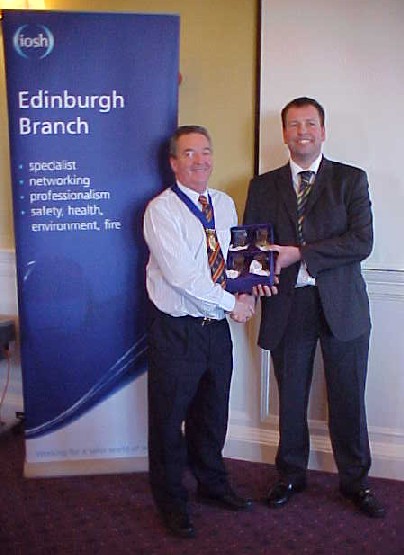
[Brian on the right receiving a token of appreciation from Branch Chair Richard Lovering)
10.0
DATES OF NEXT
MEETINGS 10.1
Edinburgh Branch: 10 March 2005: Lone Working in
Forestry: Emily Ramsay: Forestry Commission. Craighouse Campus –
Castle Room, New Craig 10.2 Forth & Tay District- Thursday 7 April 2005 : ‘Fleetsure’: Paul Richardson: Lothian
& Borders Police Initiative to address MORR on a local level 11.0
CLOSURE: Max
Bancroft, MRSC, TechSP Branch
Secretary Richard
Lovering, FIOSH,
RSP Branch
Chair
