Minute of Meeting
158th
Craighouse Campus,
SEDERUNT: A Russell A James S Ashton C Wilmott J Walker R Thomson L Young R Innes D Collins N Doherty D Millar R Turner B Davies T Neilson D Burns A Polhill I Munro G Anderson E Ramsay R McLean T Ambler C Allan M Grimmer D Jack B Bertram J Fenton G McGeorge C Black J McMahon M Bancroft V Stewart N Olliver G B Dickson M Hardie K Hardie K Heatley R Lovering K Lloyd A Milne P Gallacher S Chisholm C McGlade S Heesom R Hunter S Daly D Lowe S Beaton I Wilson S McMorland B Howden (unknown � Forbo) A Martin S Boucher I Sinclair J Hamilton G Hewson? J Brannigan J Adamson J Johnston S Hunter J Hepburn B Anderson R Bradford G MacGregor A Green G Sharp G Lyall A Reid W Darling S Page A G Dick J Bathgate A Tinkler G Macnab L Saunders R Robertson H Gardner C Toole P Murray A Baily L Crichton J Fell G Johnston
APOLOGIES: Janet Little, Julian Davis, Dave
Sinclair, Marion Johnstone,
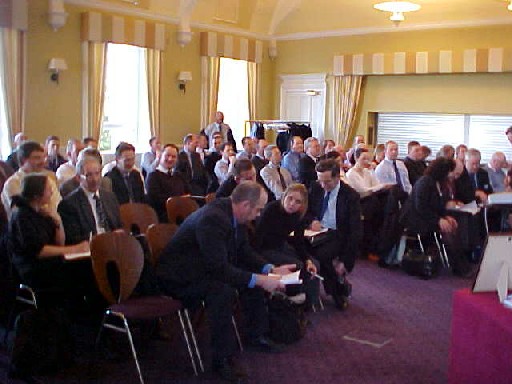
1.0 CHAIR: Richard Lovering took the Chair and welcomed members to the new venue [shown on the left]. Thanks again to Liz Young for organizing the new location. He outlined the fire arrangements.
2.0 MINUTES OF PREVIOUS MEETINGS (December 2004)
2.1 Receipt: The Secretary asked those who expected to get minutes by email but who didn�t receive them to email him � some of the email addresses he had were either incorrect or out of date.
2.2 Accuracy: Proposed by Tom Neilson; Seconded by Vic Stewart
3.0 MATTERS ARISING NOT ON AGENDA : None.
4.0 CORRESPONDENCE
4.1 Fife Chamber of Safety � December Minutes.
4.2 IOSH HQ: 2005 Professional Development Brochure downloadable from http://www.iosh.co.uk/files/professional/PD05.pdf
4.3 Thanks from J Johnston for participation in his survey on bullying. Details available at http://www.healthandsafetytips.co.uk/bullying_survey.htm
4.4 RoSPA: two dates for popular Managing Occupational Road Risk Seminar.
3rd February 2005 - Glasgow Moathouse Hotel
9th February 2005 - Thistle London Heathrow Details via www.rospa.com/morr/seminar
4.5 Society of Occupational Medicine: Scottish Group: Healthy Woking Lives: 11 March
5.0 BRANCH EDUCATION DEVELOPMENT ADVISOR - Liz Young.
6.0 SPECIALIST GROUPS
6.1 PUBLIC SERVICES � Marion Johnstone: nothing to report.
6.2
CONSTRUCTION � Allan Dick:
Allan reported on the 18 operational objectives that the SG had set themselves for 2005/2006. Of particular interest were:
The dates for the 2005 meetings were: 10 March, 1 June, 6 Sept, 8 Dec.
6.3 FIRE RISK MANAGEMENT - Dave Sinclair: nothing to report
6.4 HEALTHCARE - Martin Scott-Smith: nothing to report
6.5 ENVIRONMENT � Julian Davis: members were reminded about Julian�s monthly circular � anyone who wished to receive it email the Secretary.
6.6 OFFSHORE - Tam Boyd: Nothing to report.
6.7 RAILWAYS - Need a representative
6.8
CONSULTANCY -
CONSULTANCY SG:
A review of 2004 Performance
2004 has been a difficult year for the Consultancy SG as committee members� personal workloads have increased therefore leaving little time for committee duties to be fulfilled. Despite this, progress has been made on the following major objectives:-
� Committee representatives met with Rob Strange, IOSH Chief Executive to discuss the committee�s concerns
� The IOSH/ISCA Consultant Register working party produced a draft procedure
� The competence assessment paper was presented and approved by SGMC
� The competence pilot scheme was initiated with accident investigation module due to be forwarded to scheme volunteers shortly
� The planning for a full day Seminar in February 2005 was progressed
� A Consultancy Good Practice Guide has reached an advanced stage of its development
Consultancy SG Plan for 2005
The Group�s strategic aims for 2005 are as follows:
� The committee to be comprised of 12 active members
� To complete the competence pilot study and a report of the findings submitted
� To complete the Consultancy Good Practice guide
� To improve the benefits of Consultancy SG membership
Consultancy Specialist Group Seminar, 8 February at IOSH, The Grange, Leicester
First full day Seminar. The Programme will be available shortly.
The day will include networking opportunities so bring your business cards - we are consultants and the day is about networking opportunities for health and safety consultants.
Competency Pilot Scheme
The workbook for the accident investigation module is now complete and once the pilot study has been completed a report will be available for Consultancy SG members.
Local Networking Events
As part of the Consultancy SG 2005 plan it was agreed to hold regional networking meetings. The dates and locations for these meetings are as follows:
March Dublin, Ireland
26 May Bath
26 October Glasgow
TBA SE England
6.9 SAFETY SCIENCES - Steve Boucher: nothing to report
6.10 TELECOMMUNICATIONS � Graeme Lyall:
Graeme had attended the IOSH TSG Networking Event in Dublin on 8 Dec 04 where some 65 Irish Members attended. It was well received and interesting to see how another country is applying its H&S Legislation from the EEC/UK Model. The key Presentations are set out below.
Gary Jardine, Health, Safety and Environment Advisor, Colt Communications, 'Telecoms Passport Scheme'
Declan Monahan, Safety Officer, Irish Rail, 'Managing Contractors'
Nigel Wilkinson, Health, Safety and Env Advisor, T-Mobile, 'Mobile Phones and Driving'
Tom Oxberry, Health and Safety Advisor, Fingal County Council, 'Safety at Excavations'
John Bartlett, Consultant, JB Consulting, 'Working at Height'
David Wallington, Group Safety Advisor, BT, 'Managing Road Risk'
6.11 EDUCATION � Chris Lawson:
SCOTTISH EXECUTIVE
The Scottish Executive have published their new guide for those involved in organising educational excursions �Health & Safety on Educational Excursions�. The information is presented in a folder, with the folder containing 4 documents, the main guide along with 3 supplements.
The contents of the folder are:
- Health & Safety on Educational Excursions
- Supplement 1: Standards for local Authorities in overseeing Educational Excursions
- Supplement 2: Standards for Adventure
- Supplement 3: A Handbook for group leaders
The document is available on line at: http://www.scotland.gov.uk/library5/education/hsee-00.asp
Hard copies are available from:
Blackwell�s Bookshop, 53 South Bridge, Edinburgh, EH11 1YS
Telephone orders and enquiries 0131 � 622 � 8283 or 0131 � 622 � 8258
Fax orders 0131 � 557 � 8149 Email orders [email protected]
RELATED TRAINING
ROSPA
A new course from RoSPA aims to help cut the number of serious injuries and fatal accidents on educational trips and visits. The three-hour course, called �Managing the risk�, has been developed by RoSPA�s head of safety education, Juliet Barratt.
IOSH
Developed by health and safety specialists from the education sector, IOSH�s five-day course �Managing safely in schools� covers educational visits and risk management, and can be tailored to suit individual teachers� needs.
More details on training for schools is available from RoSPA on +44 (0)121 248 2000 and IOSH on +44 (0)116 257 3100.
7.0 FORTH and TAY DISTRICT
Noted that the next meeting is also the AGM.
8.0 MEMBERS ITEMS
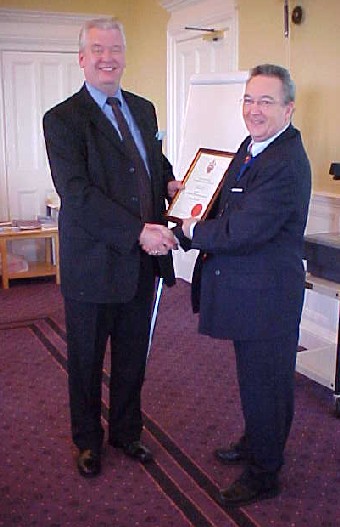
8.1 Presentation: Graeme Lyall � Registered Safety Practitioner [Graham is on the left in the adjacent photo]
8.2 Consultation by Branch Exec on Site Visit, 2005-2006 Programme & 2 evening meetings: responses/suggestion by end January. Further details in the January mailing recently sent out. This included calendar cards for 2005 � members were encouraged to take these and distribute them at their workplace etc.
8.3 Depute Health and Safety Adviser vacancy at Napier University soon. Details will be on web site once received.
8.3 Members� short presentations � members asked if there were any more offers.
8.0 GUEST SPEAKER:
Steve Ashton of Jacobs Babtie
Working Safely at Height
Stave was introduced by Graeme Lyall to the assembled members as a Safety Adviser with considerable background having worked in Chemicals, Local Authority, Lothian Health Board, East of Scotland Water, Croners and now within Jacobs Babtie as a consultant. But Steve then indicated that his actual experience of working at height in terms of wearing harnesses etc was almost zero and he learned a lot about safety at height by falling from one. The actual experience of safety at height was something he hoped the assembled members may learn from rather than repeating his own experience � they do say you learn best from doing things yourself, but he urged the members to learn from his errors when it came to safety on cliffs � and not follow him by falling over the edge of a dam wall at Pitlochry � he had to spend a long time in hospital from that event.
However Steve then followed this introduction by pointing out his experience of monitoring, supervising, auditing of arrangements for work at height was his forte with experience of � The London Eye, Shipyard roof working in Gateshead (where sheet metal was �flying� around in the wind) Railway signal post ladders, House building and the related scaffolding and Christmas decorations for councils around various town centers.
Introduction
The speaker then indicated what he intended to cover during his presentation and emphasized the point that he did not intend to go into the �nitty gritty� of the proposed legislation, but would instead take a broader look at some of the definitions and the reasoning behind some of the elements of the proposed legislation and why it has gone back for yet further consultation.
What is �Working at height� & what is �safe�
�Work at height means work in any place, including a place at or below ground level; obtaining access to or egress from such a place while at work(except by a staircase in a permanent workplace) where if measures required by these regulations were not taken, a person could fall a distance liable to cause personal injury.�
There is NO minimum height requirement � it will include all work activities where there is a need to control the risk of falling, regardless of the duration of the work or height of the work. It will include work entailing access to and egress from a place of work - e.g. scaffold. MEWP, lorry, containner, forestry cradles and ropes, window gantries, tables, staging, trestles, excavation, cellars, mezzanines, pits shafts, painting, gutter cleaning, signing, kick stool, shelving, etc.
But it will NOT include - falls on the level, falls on permanent stairs if there is no structural or maintenance work being undertaken
As an aside Steve then pointed out it did NOT include work on ships by ships crew under the supervision of the master � the reasoning behind this element being the thought that if it did all go wrong the Master of the Ship could officiate at a funeral at sea if necessary.
Size of the problem
Half of all fatalities from falls from height occur in construction activities � still leaves a lot of fatal accidents in �other� industries. The latest figures from the HSE are:
2002/3
49 Fatalities and 3880 Major injuries from falls from height
2001/2
69 Fatalities and 4066 Major Injuries from falls from height
l 11 Fatalities from falls from scaffolding
Within construction activities this was from � 11 Fatalities from falls from scaffolding; 11 Fatalities from falls from roofs; 11 Fatalities from falls from ladders; 8 Fatalities from falls from vehicles
But analysis of the figures by the HSE showed 2/3 of all falls were caused by falls below 2mtrs such as - climbing on tables, using stools as ladders, using blocks of wood as access steps, etc. which is one of the reasons behind the big push in education where teachers fall off tables or chairs while putting up posters etc.
Costing/Benefits
There are estimates of how much the regulations will cost and the benefits available �
Cost of compliance with regulations is estimated between �309million and �448million, whilst the benefits will balance costs if there is a reduction in the number of reportable injuries of between 7% and 10%. - Save five lives / 400 major injuries
Sometimes it is very difficult to see where the compliance costs are calculated from � anyone who is currently complying with the HSWA and with MHSWRegs will be complying with these proposed regulations and therefore there should be no additional costs.
However the ccurrent estimate for construction is that 2.8 million working days are lost per annum as a result of work-related ill health. This is about four times the number attributed to accidents. So, how much of the available time do we as health safety and welfare advisers spend considering Health & Welfare as opposed to physical safety aspects?
What is new?
Existing provisions under - Health and safety at work etc Act; Management of Health and Safety at Work Regs; Workplace Regs; Construction Health Safety and Welfare; PUWER; LOLER, already cover working at height, as they cover other issues �the proposed regs are a response to the Work at Height Directive, and do little more than consolidate the UK position in an attempt to satisfy the EU
The sections of the proposed regulations are �
1. Citation and commencement
2. Interpretation
3. Application
4. Organisation and planning
5. Competence
6. Avoidance of risks from work at height
7. General principles for selection of work equipment for work at height
8. Requirements for particular work equipment
9. Fragile surfaces
10. Falling objects
11. Danger areas
12. Inspection of work equipment
13. Inspection of places of work at height
14. Duties of persons at work
15. Exemption by the Health and Safety Executive
16. Exemption for the armed forces
17. Amendment of the Provision and Use of Work Equipment Regulations 1998
18. Repeal of section 24 of the Factories Act 1961
19. Revocation of instruments
There is nothing really spectacular or new in any of these - although there is apparently one very interesting omission � there�s no new obligation to assess the risks of working at height
There are a set of schedules to the regulations covering �
Existing places of work and means of access
Guardrails etc
Working platforms
Scaffolding
Personal fall arrest protections systems
Work positioning
Rope access and positioning
Ladders
Particulars to be included in a report of inspection
Basically, if you�re doing it now don�t worry due to the similarities with existing requirements. But Steve strongly advised everyone present to go back to their office and study, read learn and inwardly digest the final schedule, detailing the information to be included in reports of inspection.
Regulations 4.3 �
Every employer shall ensure that work at height is carried out only when the weather conditions do not jeopardise the H&S of persons involved in the work.
The requirement to only work at height when weather conditions do not jeopardise health and safety is an absolute requirement. Precautions such as personal protective equipment can be used to ensure weather conditions do not jeopardise the health and safety of workers �up to a point� but there may be circumstances where weather conditions are such that no precautions can be taken to achieve this and the work will have to be suspended / postponed. However the fire, police or other emergency services might still need to act (despite the weather) to save life.
Are linesmen emergency workers?
Regulation 6.
�Ensure that work is not carried out at height where it is reasonably practicable to carry out the work other than at height.
Otherwise take suitable and sufficient measures to prevent falling persons including
Work carried out from an existing place of work
Using existing access or egress provision
Selecting appropriate work equipment
Minimise Distance and consequence of falls not prevented
Take account of risk assessment under reg3 of Mgt regs.�
This is probably the key provision so far as we are concerned in H&S circles and it really does say nothing new � avoid, prevent, minimise, protect per �
Avoid working at height
Prevent falls from height
Minimise distance and consequence of falls
Give Collective measures priority over personal measures
Regulation 13 of the Workplace Health, Safety and Welfare Regulations 1992
This requires effective measures to prevent any person falling a distance likely to cause personal injury � so these proposed regulations require nothing new.
Paragraph 124 of the accompanying Approved Code of Practice identifies a need for fixed ladders inclined at less than 15o to the vertical to be fitted (where possible) with safety hoops or permanently fixed fall arrest systems and yet a recent report from a study undertaken by the HSE has put the use of hoops as a safe device into serious doubt - http://www.hse.gov.uk/research/rrhtm/rr258.htm
Steve provided an illustration of where this requirement has not been met for many years as - next time you�re on a slow train to nowhere courtesy of one of our train operating companies, have a quick look out the window at the signal posts directing the train driver. Look at the ladders used by maintenance staff to gain access � totally vertical, and the width of the steps are very little wider than the boots worn by the engineers and have risers in the order of 2 foot 6 inches high.
Reg 7 � Proposed Work at Height Regulations
�Work equipment must be selected to take account of
work conditions and place of use
Distance to be negotiated
Distance and consequences of potential fall
Duration and frequency of use
Need for easy evacuation and rescue in emergency
Additional risks caused by use, installation or removal
And must give collective measures priority over personal protection�
Choose the kit which will enable the workers to spend less time aloft where possible. Use a safety net where possible to protect all of the workforce rather than just one wearing PPE and remember the potentially fatal effects of being suspended (even in a harness) for more than 3 or 4 minutes where the blood circulation is stopped.
Do make sure that kit that is selected and used is actually necessary � what is the use of edge barriers where the task is cleaning the roof-lights in the middle of the roof some 15 to 20 foot away.
Reg 8 � Requirements for particular equipment
Reg 9 � Prevent falls through fragile surfaces
Reg 10 � Prevent fall of material
Reg 11 Prevent unauthorised access to danger areas
These elements cover virtually identical requirements to those quoted previously in the Factories Act and Construction Regulations, with the exception of the addition of ladder, where now there is an inspection regime for ladders.
Reg 12 Inspect equipment complying with schedules 2-6
Requirements for inspection of kit �
after installation (before use)
periodically
following exceptional circumstances
Inspection of scaffolds greater than 2m in height �
weekly (max) and prepare report
Don�t despatch or use work equipment unless proof of inspection is available - Inspection means such visual or more rigorous inspection by a competent person as is appropriate for safety purposes.
Inspections to be recorded
The requirement to inspect kit prior to despatch, includes returning hired kit leaving your locations
Summary
The proposed Working at Height Regulations adds little or nothing on top of the current requirements placed on employers by existing regulations.
Extra consultation has been pushed forward following the Construction Industry insisting that there should be a �Two meter rule� for construction work � but what use is that. Does it mean that it is safe to fall from 1.9 meters in a construction environment or that it is safe to fall 2.1 meters while removing Christmas decorations in an office?
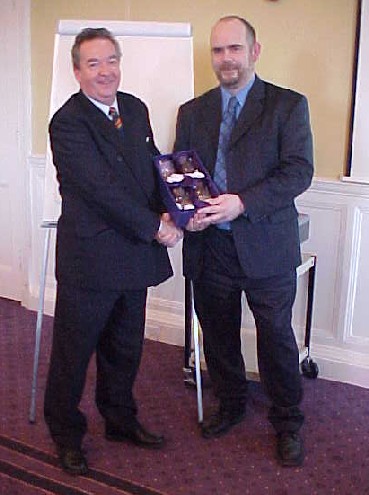
[Steve is on the right in the adjacent photo receiving a token of our appreciation from Branch Chair, Richard Lovering]
10.0 DATES OF NEXT MEETINGS
10.1 Edinburgh Branch: 10 Feb 2005: Getting The Best From Your Liability Insurance: Brian Prout, MIOSH Dip2.OSH MIIRSM, Norwich Union Risk Services. Craighouse Campus � Castle Room
10.2 Forth & Tay District- 3rd February 2005 District AGM - Safety is 24 / 7
10.3 Coming to Court Seminar � Thurs 3 Feb 2005
11.0 CLOSURE:
|
Max Bancroft, MRSC, TechSP Branch Secretary |
Richard Lovering, MIOSH, RSP Branch Chair |
