Minute of Meeting
157th
Sighthill
Campus,
SEDERUNT:
B Morris R Brownlie N Doherty J Burt J Fell T Neilson S Heeson J Hepburn D Cawkwell C Smith T Mellon A James S Hunter J Hamilton A Davies P Mainka G Foggo V Stewart S McMorland J Johnston K Lloyd J Slater A White M Gorman R McLean M Bancroft L Young P Brown A Green R Bradford S Gartshorn G MacGregor C Black C Lawson C Shoesmith
APOLOGIES: Marion Johnstone, Richard Lovering, Graeme Lyall, Steve Boucher, Julian Davis, Dick Morrison, Karen McDonnell, Scott Page, Bob Bertram, Andrew Reid, Andy Sharman, Alan Curran, Dave Sinclair
1.0 CHAIR: Kevin Llyod took the Chair.
2.0 MINUTES OF PREVIOUS MEETINGS (November 2004)
2.1 Receipt: These had been generally received as expected with one exception.
2.2 Accuracy: Proposed by Neil Doherty; Seconded by Peter Brown
3.0 MATTERS ARISING NOT ON AGENDA :
D Sinclair had added some websites relevant to the topic and these were in the minutes.
Apologies to those who turned up to Rm 207 rather than Rm 217 last time.
4.0 CORRESPONDENCE
4.1
4.2 IOSH HQ: Membership: 783 Branch members From a national total of 27,354
Corporate: 370 Tech SP: 114 Associate: 187
Construction 190; Public Services 131; Environmental 98: Off shore 46; Consultancy 40; Healthcare 36; Education 34; Fire RM 22
4.3 IOSH change of membership & Governance passed at AGM. HQ now consulting on new method of electing Council. Details on IOSH website. Exec support Option 2 which will tend to ensure that, if any non-Corporate members do stand, some will be elected.
4.4 Thanks from H Bindless for responses to her request for help with her Corporate Killing survey
4.5 Thanks from D Sinclair for present received after last meeting.
5.0 BRANCH EDUCATION DEVELOPMENT ADVISOR - Liz Young. Liz commented that members should check carefully the CPD requirements for the transitional arrangements that would come into force when the new membership structure was introduced.
6.0 SPECIALIST GROUPS
6.1 PUBLIC SERVICES – Marion Johnstone: Nothing to report.
6.2 CONSTRUCTION – Allan Dick:
Review of breakout groups performance against the construction SG 2004 plan - it was agreed that all objectives had been achieved by the various working groups including ; -
- publish 2 issues of Construction news - completed
- provide info stand at IOSH exhibition 2004 - completed
- deliver the Douglas Short Memorial Lecture 2004 (review the future of the lecture - recommended to continue)
- agree to work with environmental SG & continue to support ISHCCO
- publish
articles regularly - 5 articles accepted or published,
- review operating method of the groups - successful trial of new meetings format
- develop a construction site induction pack - completed on target
- explore, establishing a resource library supporting best practise- report completed on target
- open dialog with Constructing excellence south group - completed on target
- develop power point promoting the Construction SG - advance draft completed
- decide on contribution to IOSH exhibition 2005 - SG to submit a paper - completed on target
- produce a SHP article focused on SG's - completed on target
Site Induction Pack will be available early in the new year - available as a free down-load or for a break-even fee as an IOSH pack
Construction SG Power Point available early next year (will deliver this to branch as a short presentation)
6.3 FIRE RISK MANAGEMENT - Dave Sinclair.
Last
meeting on the Specialist Group was
Membership: Now standing at 1066 (Harold, our newest member enjoyed my talk on impaired vision.)
Budget: Within allocated spend. We continue to charging delegates at Networking Meeting nominal amount to cover buffet lunch, unless sponsored.
Competence Working Party - NEBOSH National Certificate in Fire Risk Management: Is now with NEBOSH. At this point we have to sit back and wait for their wheels to turn. I have passed on any requests
FRMSG Action Plan: On target.
New / Revised British Standards:
BS 5588 Part 5 - Access and facilities for fire-fighting has just been re-issued.
BS 5588 Part 12 - Managing fire safety has just been issued and takes on the "managing" elements in BS 5588 Part8 - Means of escape for disabled people.
Regulatory Reform Order:
Guides should be available June/July 2005 and the new go live date is October 2005 - don't hold your breath!!
6.4 HEALTHCARE - Martin Scott-Smith. Nothing to report.
6.5 ENVIRONMENT – Julian Davis. Nothing to report.
6.6 OFFSHORE - Tam Boyd: Nothing to report. Nothing to report.
6.7 RAILWAYS - Need a representative
6.8 CONSULTANCY - Derek Cawkwell: Nothing to report.
6.9 SAFETY SCIENCES - Steve Boucher: Nothing to report.
6.10 TELECOMMUNICATIONS – Graeme Lyall: Nothing to report.
6.11 EDUCATION – Chris Lawson: Nothing to report.
7.0
Karen reported that the new meeting place had good facilities. The next meeting was the AGM in February.
8.0 MEMBERS ITEMS
8.1 Could members make suggestions to the Exec for Site Visit in June 2005
8.2 Ideas please for topics & speakers for 2005/2006 Programme (remember CPD)
8.3 What do members think of having
two of the meetings in the evening? This is done by East of Scotland
Branch and enables members who can’t get off in the afternoon to attend some
meetings. Suggestions as to possible start time e.g. 6pm .
8.4 Report on Branch Official’s Conference – Kevin Lloyd
Kevin had attended this recently along with Barry Davies from the District. It was a very useful opportunity to be updated on all sorts of issues and a chance to discuss things with members of other Branches and see best practice elsewhere. Particularly interesting had been a presentation on mentoring by a member of Yorkshire Branch.
8.5 Fit testing on respirators: noted that IOM at Riccarton did thus and some suppliers of the testing kit also would run a training course to assist the purchaser to carry these out.
8.6 Members’ short presentations – members were encouraged to come forward for future meetings.
8.7 Tom Neilson of OHSAS
Small to Medium Size Enterprises Safe and Healthy Working Presentation:
The service is funded by the Scottish
Executive, managed by NHS Health Scotland
It costs NOTHING and the following is available:
· A freephone national telephone adviceline (0800-019-2211), providing FREE and confidential advice and guidance to employers and employees
·
Professional advisers throughout Scotland
· A website specifically designed for SME’s www.safeandhealthyworking.com which gives FREE information on a wide range of occupational health and safety topics
You can call the freephone adviceline between 9:00am – 5:00pm Mon- Fri. There
is no limit on the number of times you can call the adviceline
Depending on the nature of your question the adviceline may advise you that a site visit would be beneficial for your business If you do request a visit your regional adviser will contact you to arrange a suitable date and time for the visit to take place
After the visit the regional adviser will forward you a report highlighting the main areas you should address and other areas for improvement
Approximately one month later your regional adviser will contact you to arrange a follow up visit to discuss the report and offer any further advice. It can look at:
· Legal requirements
· Policy documents
· Risk assessments
· Chemical safety
· Fire safety
· Accessibility f0r the disabled
· First aid
· Machinery safety
· Display screen equipment
· Staff security
It can help to keep you on the right side of the LAW. It can help you to reduce the chances of accidents or ill health occurring in the workplace, thereby reducing the likelihood of compensation claims. It can help you to reduce the cost of your employers liability insurance
By providing a safe place of work it can help you to retain your workforce, thereby reducing recruitment and training costs
8.0 GUEST SPEAKER: Charles Shoesmith of PyschaLogica: Behavioral Safety
Key Elements
The PsychaLogica approach to behavioural safety includes a focus on a number of key elements:
· safety leadership behaviour
· the development of a just and positive culture
· manager and supervisor behaviour
· worker involvement in behaviour observation and change
· teamwork, performance feedback and recognition
Together, these form pieces of the behavioural jigsaw.
Any intervention may involve a focus on just one of the above, may involve a combination of them, or indeed may include all of them.
Our Guiding Principles
· Each company is different – the best behavioural approach will be one that is tailored to your company's needs
· Getting people to behave safely is a complex task – we need to beware of over-simplistic solutions that fail to impact on performance and fail to provide a good return on investment
· Having the right attitude does not guarantee the right behaviour – attitudes are generally resistant to change, behaviour change is easier to achieve (and ultimately leads to attitude change)
· Worker behaviour is influenced by manager behaviour – we need to focus on behaviour at all levels of the organisation
· We also need to consider how culture, climate, systems, design and infrastructure serves to influence how people behave
· You can’t force commitment to safety – the need is to encourage safe behaviour and safety attitudes through adopting a mainly positive approach to influence
· Safety conversations are one tool in the behavioural strategy – but they are only part of the strategy and typically they are only partially effective
· Any attempt to change behaviour should be founded on established science - our approach incorporates: Applied Behaviour Analysis, Reinforcement Theory, Goal Theory, Transactional Analysis and Performance Feedback
· Unsafe behaviour can be responsible for organisational as well as individual accidents - we are talking about much more than preeventing cuts and bruises – outcomes range from the likes of these to major catastrophes and multiple fatalities.
The Background
Why is behaviour important?
Safety is serious business. A poor safety record can make a difference between profitability and insolvency, can seriously damage a company’s reputation, increases exposure to litigation and action by the HSE, and increasingly is being regarded as morally indefensible. Most importantly, poor safety ruins people’s lives!
Most companies now appreciate that a good safety record makes good business sense and so aspire to achieving the highest levels of performance. Even one incident or accident is now held to be one too many! However, even those companies that have developed the most advanced and comprehensive safety management systems are finding it hard to achieve levels of safety performance that matches their aspirations.
Why? The answer lies in how people perform - how they behave.
What causes accidents? People cause accidents!
As human beings we are all fallible - we make mistakes and suffer from slips and lapses of attention. All of these at times result in an unplanned event and subsequent loss. Such errors can emanate out of poor design of the job or the workplace, or they can be the result of inadequate training. They can also result from inattentivity and mood.
More significantly, as human beings we have the tendency to take the path of least effort. In safety this means that we are prone to taking unnecessary risks. In other words, we have a tendency to violate systems, procedures and safety rules. None of us are exempt – we all do it, it’s normal behaviour. (How many of us at times exceed the speed limit?). And we do it for what at the time seems good reasons to us! (We believe by ignoring the speed limit we will get there quicker). Like mistakes, unnecessary risk taking leads to incidents and accidents.
What about the role of management?
HSE statistics tell us that the majority of accidents are caused in some way by human behaviour. Whilst error plays a part it seems that violations are the bigger problem.
The focus on human factors has largely been directed at eliminating the causes of error rather than dealing with violations. If companies want to improve their safety performance they must focus on eliminating violations - this is an issue for management and one that most organisations continue to struggle with.
The behaviours that managers and supervisors practice are there to make a difference.
A fundamental aspect of their task is to influence how those who work for them behave. In this respect, managers and supervisors are responsible for the behaviour of their workforce. What does this mean?
It means that we need to focus on the behaviour of managers and supervisors if we are going to improve worker behaviour and therefore improve safety. Whilst a worker may have got injured through taking an unnecessary risk, their choice of the risky behaviour will not have occurred in isolation but within the context of the company setting and culture.
Managers and supervisors, like everyone else, are also prone to take the path of least effort. This can mean that they may not be as vigilant in terms of monitoring what is going on or as focused on ensuring that rules and procedures get followed. Such behaviour contributes to increased levels of risk and increased probability of accidents happening.
Of course, the train of influence does not stop there. How senior managers and company leaders behave is similarly instrumental in determining how those who report to them behave. The relationship between how people behave and safety performance exists at all levels of an organisation and the implication is that if we are going to make a difference then we must also focus on these various levels.
Why do people violate safety rules and procedures?
People take a risk because they think that they will get away with it!
In terms of safety, people risk-assess their choice of behaviour. In their minds they will be weighing up the probability of:
· Will I get caught for breaking the rule?
· Will I get hurt?
Set against these negative factors, people also think in terms of the benefit they will derive from acting unsafely. Typically this is in terms of:
· Saving time
· Avoiding additional effort
· Avoiding discomfort
In many instances, people conclude that it is worth taking the risk because the various negative outcomes are unlikely to happen whereas in contrast the benefits to them are almost certain to occur.
This explains why people engage in the following examples of risky or unsafe behaviours:
· Not wearing personal protective equipment (PPE)
· Driving in excess of the speed limit
· Handling heavy equipment without help or use of an lifting aid
· Smoking and drinking to excess
· Avoiding reading / following procedures
In each case the unsafe behaviour is associated with an outcome that is satisfying or of benefit to the individual. We all know that there are many more such risky behaviours! So what is the problem?
The problem is that these behaviours represent unnecessary risks – and there will be times when the negative outcomes will follow. This explains why people can get injured or incidents happen when least expected. An individual will have behaved in the same way many times before but nothing bad has happened to them. Through this experience we all develop bad habits!
Behaviour and Consequences
What the previous paragraphs illustrate is the fact that our choice of behaviour is largely determined by our expectations of the consequences that will follow if we choose that behaviour.
· If we expect a behaviour to lead to a favourable consequence then we are likely to behave in that way
· If we expect our behaviour will lead to a negative outcome, then we are likely to try and avoid that behaviour
It follows from this that if we want to influence how people behave then we must set about understanding how consequences work and how we can manage them to get the behaviours we want - how to get the best from people!
Have to or want to behaviour
In terms of strategy, a company can choose to force compliance (threaten negative consequences for non-compliance) or it can choose to encourage safe behaviour (make available positive consequences for compliance). Both strategies work to reduce unnecessary risk taking – but in different ways and with varying degrees of success.
The use of a forced compliance strategy is disliked and leads only to what is known as “minimal compliance”. This is have to behaviour and has to be driven by close supervision and the use of sanctions. Further outcomes are poor morale and the likelihood of dysfunctional behaviour springing up elsewhere.
The use of encouragement generates want to behaviour. It also supports the development of a positive culture. The challenge is that, at least in the short term, adopting a positive strategy takes more effort and consideration. However, such a strategy generates levels of performance that far exceed that possible from the minimal compliance attitudes associated with a forced compliance strategy.
A Question of Balance
The above paragraphs polarise the issues. Best practice is represented by the careful and considered use of both positive and negative consequences to drive the required behaviours. The issue is a question of balance.
Whilst there are times when the use of sanctions is called for, the healthiest, safest and most successful companies place far greater emphasis on managing behaviour through the use of positive consequences.
The safe behaviour challenge therefore involves the managed use of positive consequences to drive effort and achievement.
How leaders behave at all levels of an organisation is instrumental in exerting influence over how others behave. Leaders exert influence through:
· Providing clarity about what is important and valued
· Showing others how to behave through exemplary modelling of critical behaviours
· Reinforcing behaviour when they see others acting safely
Developing a Just Culture
This is about creating expectations in terms of how people should behave and clarity about what happens when people don’t comply.
Unlike a “blame free” culture, a just culture recognises that there is a place for a disciplinary system.
The issue here is that there has to be a “bottom line”. There are some behaviours that will never be acceptable in a safety context.
Generally, people will accept a disciplinary system if it highly transparent, seen to be fair and consistently managed. However, such a system needs to be managed sensitively in order to maintain the situation in which the workforce feel both able and confident to report concerns even when these relate to behavioural issues.
Line managers and supervisors have a key role to play in both monitoring and influencing the behaviour of those who work with them. The issue here concerns what constitutes effective practice? Good practice produces high levels of safe behaviour. Poor practice can damage morale, create confusion and leave unsafe behaviour uncorrected.
In the context of safe behaviour, managers and supervisors face two different situations. The first is when they come across examples of good practice. The need here is to reinforce this good practice and so encourage its reoccurrence.
The second situation is when they encounter people behaving unsafely. The need here is for correction through coaching (or in exceptional circumstances when the policy requires it, the use of the disciplinary system).
There are two significant issues here to be addressed:
· The quality of the interaction as managed by the manager/supervisor
· The frequency of such interactions (manager/supervisor visibility)
Behaviour Change
Experience tells us that certain behaviours are resistant to the normal means of influence. Typically, these behaviours are established bad habits which people find hard to change or do not want to change because they provide significant benefit. (Smoking and speeding are two examples most people can relate to either directly or indirectly).
These behaviours are resistant to even the most accomplished and persistent coaching conversations. This explains why a peer-on-peer observation and coaching approach to behavioural safety has limited effect.
If these behaviours are safety critical, then they must be tackled otherwise your company is exposing itself to significant and unnecessary risk. Whilst one answer to the problem lies in the use of negative consequences and the disciplinary system, overuse of this will damage your positive safety culture and also, conversely, your safety performance.
An alternative lies in the use of behaviour modification principles. Behaviour modification is a systematic and data based approach to changing behaviour. It works best when the workforce takes a lead role in its operation. The process involves tackling just a few behaviours at a time, putting together a plan designed to encourage compliance, measuring the effect of the plan through peer on peer observation, providing regular feedback about progress, and providing reinforcement when compliance targets are achieved.
Performance Management
Measuring safety performance is an increasing challenge. Many companies are now searching for more reliable means of assessing how good they really are. The reliance on output measures such as accidents and incidents becomes less informative as performance improves. The need is to measure those activities that keep the company safe - safety inputs.
The problem here is how to identify those activities that most reliably predict good safety performance. Typically, this will involve a focus on a range of different inputs including audits and inspections, toolbox talks, safety meetings, closing-out of safety actions etc. The measures will also need to focus on both activity levels and the quality of the events.
In addition to a focus on these safety input activities, organisations should also look to measure levels of risk. Such a measure can provide useful insight into whether progress is being made once output measures have been brought to consistently low levels. Risk measures might include information obtained from near miss reports and other means through which safe and unsafe behaviour is monitored. The occurrence of high potential incidents would also fall into this category.
Having identified input and risk measures, a further challenge involves making sense of what are likely to be a variety of metrics so as to produce a clear and comparitive indicator of progress. What is required here is a single score that can be compared month by month.
Measuring safety performance is a source of performance feedback to your company's Leadership Team and safety director/manager. However, the use of such measures has much wider significance. Providing teams with such performance feedback can be a factor in getting them interested in improving their performance.
The need here is to devise systems such that local teams have easy and regular access to performance feedback which relates specifically to their own performance. Many companies have at least considered some form of reward and recognition programme for safety performance. This is a tricky area. Rewarding good safety results may mean that you have rewarded good fortune rather than good practice.
Managed and targeted correctly, the use of some form of recognition programme can have a significant impact on effort and motivation. The challenge is in the design and the operation of the measurement and recognition process. Get it right and you have the means to continuously improve both your safety effort and achievement.
www.psychalogica.com
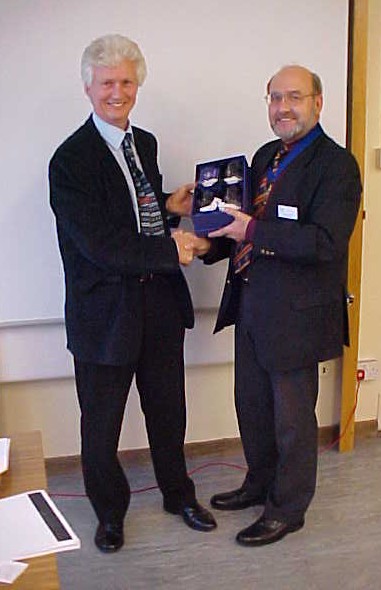
Mr Shoesmith received a small token of thanks from the Branch for his talk.
10.0 DATES OF NEXT MEETINGS
10.1 Edinburgh Branch: 13 Jan 2005: Working at Heights: Steve Ashton, Health and Safety Adviser with SafeSolutions@Jacobs NB: New Venue: Craighouse Campus – Castle Room
10.2 Forth & Tay District- 3rd February 2005 District AGM - Safety is 24 / 7
10.3 Coming to Court Seminar – Thurs 3 Feb 2005
11.0 CLOSURE:
11.1 Kevin wished those present a Safe and Happy Christmas and New Year
|
Max Bancroft, MRSC, TechSP Branch Secretary |
|
