Minute of Meeting
155th Edinburgh Branch Meeting
Donaldson’s College, Edinburgh – Thursday 14 October 2004 - 130pm
SEDERUNT: M Bancroft D Cawkwell V Stewart J Hamilton R Long C Wilmott N Elliot C Forrest S Beaton S Hewson T Sayer I Currie P Gallacher J Fenton C Lawson B Bertram R Bradford P Graham J Davis S McMorland A Reid E Cassidy J Reid J Anderson G B Dickson T Neilson P Brown D Duff R Walker J Johnston G P Lamond N Doherty L Crichton R Brechin M Johnstone L Young K Lloyd D Simpson G MacGregor A White J McMahon A Martin B Anderson C Black R Lovering
APOLOGIES: Russell Brownlie, Jim Hepburn, Steve Boucher, Dick Morrison, Graeme Lyall, Allan Dick, Dave Stewart
1.0 CHAIR: Richard Lovering took the Chair Safety, Welcome
2.0 MINUTES OF PREVIOUS MEETINGS (June 2004)
2.1 Receipt: These had been distributed and received.
2.2 Accuracy:
Item 7: Add: Barry Davis made a report on the first District meeting of the new session
Item 9: In the section on Court Structure, remove the last sentence in the paragraph on the District Court. Add a new sentence to the paragraph on the Sheriff Court: “A Sheriff can also sit summarily i.e. sitting alone where he/she will decide on the facts and the law issues.”
With these changes, the minutes were proposed by Liz Young and seconded by Peter Brown.
3.0 MATTERS ARISING NOT ON AGENDA : None
4.0 CORRESPONDENCE
4.1 Fife Chamber of Safety – Programme, Executive Members.
4.2 Ergonomics Foundation Course For Designers, Safety Practitioners And Engineers:1st to 4th November, 2004, Aberdeen : Professor Rod Graves
4.3 ENTO consultation project - National Occupational Standards for H&S
4.4 Strathclyde FB: Conference – 26/27 Oct: fire in residential and heritage property
4.5 Borders Construction Industry Forum – S&H Awareness day 20 Oct
5.0 BRANCH EDUCATION DEVELOPMENT ADVISOR - Liz Young.
Presentation on Transition to new Membership Structure and importance of CPD.
Liz – as the Branch Education and development officer had received further information of the impending changes to the Membership Structure and the requirement for all members to undertaken CPD in order to gain and retain Chartered status and this ten minute slot was aimed at providing that detail – albeit it rushed for the depth of information.
The proposed membership structure
This was shown as =
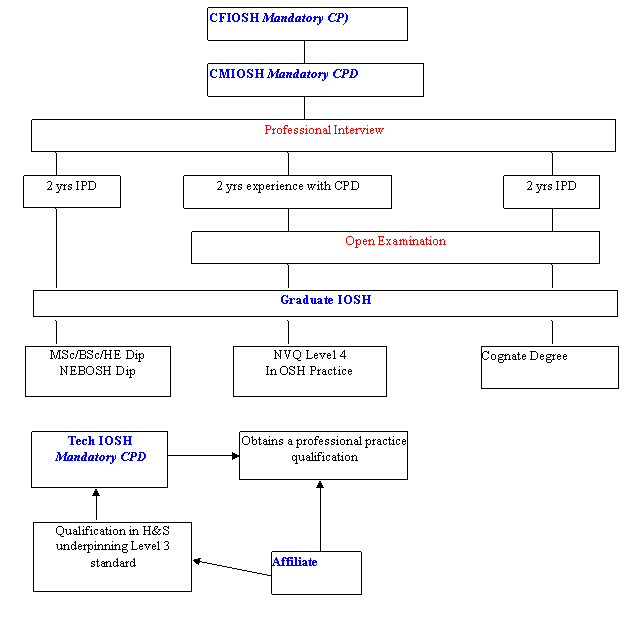
The System is to be based on national occupational standards in occupational health and safety practice at level 4, where all the elements of competence – knowledge, skills and experience – are assessed., but different routes to the initial qualification are recognised
The new system addresses the areas of competence that have not been assessed by the initial qualification.
The actual route to Membership is dependant on the initial qualification but it will be of prime importance that each prospective member registers their attainment of qualification with IOSH
· For accredited qualification holders a skill based portfolio (based on the national standards) needs to be developed.
· For VQ qualification holders - an open examination is required plus 2 years demonstration of the development of further skills via CPD
· For Cognate degree holders - both the IPD portfolio and open examination.
Professional Interview
The final stage for all routes is a professional peer review interview,
· This will require a 15 minute presentation on the work carried out since the qualification was obtained.
· Which can either be on the portfolio or the open examination or both (for cognate degree holders).
The outcome of the Interview being –
· Successful –Admission to Chartered status with a mandatory requirement for CPD
· Referred on some areas of the criteria (with successful completion of specific criteria being “banked”)
· Referred on all areas, specific period of time given before re-interviewing.
· Referred on all areas, mentoring support required. Mentor approval required before re-interviewing.
The reasons for all this
To reinforce the status of the occupational health and safety professional, by ensuring that those aspiring to ‘chartered’ status are assessed in all the elements of competence.
The Initial Stage of Appointment
From the 1st July 2005 (subject to approval at the November AGM) the following arrangements will operate –
· All - MIOSH RSP and FIOSH RSP immediately transfer to CMIOSH & CFIOSH
· All – MIOSH and FIOSH who have completed at least one 2year CPD cycle and are continuing to maintain their CPD will immediately transfer to CMIOSH & CFIOSH
· All MIOSH, and FIOSH enrolled on CPD but have not completed a 2 year cycle , will need to do so on or before 31st December 2006 , when the current CPD system will conclude. During this time MIOSH or FIOSH can be used
· All MIOSH, and FIOSH not enrolled on CPD before 1st July 2005 will need to enrol for and complete at least one new on-line style three-year CPD cycle before progressing to CMIOSH or CFIOSH.
NB: During this time and for the first CPD cycle MIOSH or FIOSH may be used
· All Technician Safety Practitioners (TechSP) immediately transfer to the new Tech IOSH category but must register and take part in CPD.
· Those in Associate or Affiliate category holding old NEBOSH certificate or construction certificate can transfer to Tech IOSH if they can demonstrate 10 years experience H&S & at least 1 Year of 2 year CPD cycle.
NB: This transition would only be available for those with IOSH membership on or before 1 July 2005
· FIOSH who no longer complete CPD may continue to use the term FIOSH in recognition of the professional standing of Fellowship.
· All other categories membership not doing IPD/CPD will become or remain Affiliates
Summary
Ensure you are registered on the CPD scheme and maintain it.
Further details available on www.iosh.co.uk
6.0 SPECIALIST GROUPS
6.1 PUBLIC SERVICES – Marion Johnstone: the Group intended to encourage more networking including at National Conference which was in Wales next year. Heriot Watt University were running a 6 month course on Workplace Health with the support of the Scottish Executive.
Feedback on the National Safety Symposium had been good. The group were now starting to produce guidance for instance on procurement.
6.2 CONSTRUCTION – Allan Dick: Nothing to report.
6.3 FIRE RISK MANAGEMENT - Dave Sinclair. Nothing to report.
6.4 HEALTHCARE - Martin Scott-Smith. Nothing to report.
6.5 ENVIRONMENT – Julian Davis. Nothing to report.
6.6 OFFSHORE - Tam Boyd: Nothing to report.
6.7 RAILWAYS - Need a representative
6.8 CONSULTANCY - Derek Cawkwell: Nothing to report.
6.9 SAFETY SCIENCES - Steve Boucher: Nothing to report.
6.10 TELECOMMUNICATIONS – Graeme Lyall: Nothing to report.
6.11 EDUCATION – Chris Lawson: Bill Callaghan, Chair of the HSC had responded to scare stories that the HSE intended to ban conkers in the playground! There was new guidance on arranging school trips. A new safety website had been launched by Strathclyde Police, the NHS and Strathclyde Fire Brigade.
7.0 FORTH and TAY DISTRICT
Nothing to report.
8.0 MEMBERS ITEMS
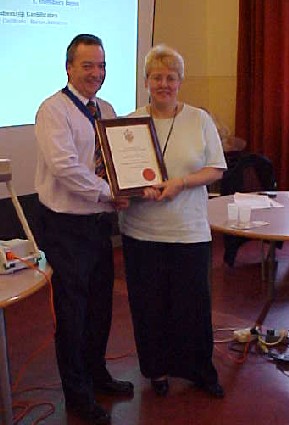 8.1 Presentation
of RSP Certificate: Marion Johnstone
8.1 Presentation
of RSP Certificate: Marion Johnstone
8.2 John Johnston, Branch Member – carrying out a bullying survey – please assist by visiting http://www.healthandsafetytips.co.uk/bullying_survey.htm
8.3 Congratulations to Dick Morrison on winning City & Guilds of London Institute Medal of Excellence for his NVQ Portfolio in Occupational H&S. It had been presented by the Duke of Edinburgh
9.0 GUEST SPEAKER:
New Fire Order (especially as applies to Scotland).Dell Simpson (formerly of Lothian and Borders Fire Brigade)
Dell Simpson
formerly of Lothian & Borders Fire Service
– Topic/ Heading
Dell required very little in the way of introduction to the group having presented to the Branch members on at least two occasions previously. His background was one of being within the local Lothian & Borders Fire Service for many years and he held a high rank by the time he retired from full time employment and has since then still been associated with the development of the new Fire Bill – Scotland.
Introduction
On previous occasion that Dell was presenting to the Branch he had indicated the potential for changes to come in Fire Legislation and even provided a taster of what was likely to be included. On this occasion he was now going to be able to be more specific as during next year – probably by May there would be a total change in the concept of Fire Legislation for Scotland which would be the result of the Scotland Fire Bill – which would probably be reflected almost as a mirror image by the England & Wales Regulatory Reform Order on the same topic.
The major difference being that in Scotland this will be a piece of Primary Legislation in its own right, whilst in the rest of the UK they will be using a “different vehicle” to get there – by use of a Regulatory Reform Bill. However having said that, they should be fully dove-tailed together, but the UK version is currently undergoing some delays due to the lack of guidance notes not being ready in time.
Prior to any further comment on Fire Safety Legislation Dell wished to start by detailing some of the changes which have been put in place and are still progressing from the “Modernization” of the Fire Service.
Modernization
The issues of modernization to the service have come about mainly by the disputes in the service operation which we have seen of late – disputes were really between the Government (or the employers) and the fire brigade unions, which caused a lot of upset at the time and were stated to be mainly about wages, but in fact nothing is gained for nothing these days, so a number of modification have been put in place as a result of the increases in remuneration.
The changes were long overdue and were recognized for many years, but too many thought the issue too big a problem to deal with until it came to a head. Issues like for instance lifting the ban on overtime which had been in place for 30 years. – It was originally put in place to prevent unscrupulous employers keeping the service understaffed, but those issues have long gone and the restriction prevented sensible use of qualified fire fighters.
Working hours
The public conception of the activities of the Fire Fighters during a night-shift pattern is often totally misconceived due to the television. Whilst a number of year ago the night shift may have been considered to be easy work with activity till about 6 pm then playing snooker or reading/sleeping as portrayed on television programs is no longer correct. Stand-down time now is unlikely to start until perhaps 10.30 or even 11.00pm.
Part-time Fire Fighters
As may be appreciated, if rural areas the Fire Service is provided by part-time staff, who are doing other jobs on a full time basis and get paged when there is a need, however in modern times there is a shortage of volunteers as there are reducing numbers of people who are always likely to be based in close proximity to the station. In lifting the ban on overtime has now opened the opportunity for full-time fire fighters to volunteer for duty outside of their normal shift working periods – a condition which was not permitted previously.
Implementation of Integrated Fire Risk Management Plan.
The original standards as defined by Councils and Government which stated an appliance should reach a call out condition in 5 minutes and where necessary the second appliance should also reach site in 5 minutes,, where necessary a third appliance was required to reach site by 8 minutes has been recognized as much too expensive to resource and there is now a requirement on the local area controllers to set standards of fire cover based on high/medium/low risk areas.
The Plan outlines what each Fire Brigade is going to do and it has utilized a computer model to define the level of risks such that it is likely that Fire Stations are going to be moved from low risk areas into high risk areas but this will give rise to considerable debate as the Local Fire Authority Board is made up of local councilors who are likely to defend the locations of existing stations as being correct.
Automatic Fire Alarms
Automatic systems generate a lot of false alarm calls and it is likely that in future there will be a requirement for a call to be made on a 999 system to confirm there is a fire prior to full scale call-out. This doe not mean no Fire Appliance will attend, but it may mean a reduced level of cover initially if there is no confirmatory call.
For instance calls to Universities or colleges currently require 4 appliances to attend – this may be dropped to one until the conditions are confirmed. This is not going to be a problem in large conurbations where several appliances can be called upon, but for the more rural areas this could result in considerable delays.
Improvements
There needs to be improvements in Management systems looking at evacuation procedures, built in fire protection and improvements in fire detection systems, all of which could result in a reassessment of the risk associated with individual premises.
There have also been numerous internal improvements in Fire Service practices where they have been fully updated.
Legislation
Currently there are some 79 pieces of legislation with reference to fir precautions etc and this is gong to change, - In Scotland this will be by the Scottish Fire Bill as Fire was devolved to Scottish Parliament and in England and Wales it will be a Fire Bill relating to that area only and in both cases it is going to be based on Risk Assessment in much the same way as the Workplace Regulations.
The Scottish Bill is undergoing consultation until December 2004 and it is hoped that it will be in place by May 2005 replacing the Fire Services Act of 1947.
Fire Certificates
The issue of Fire Certificates is to disappear, loosing an income for the Fire Service as they do so by removal of the Fire Precautions Act and the related Workplace Regulations and replacement wholesale. The new bill will however retain the “Prohibition Notice and the old Section 10 closure or restriction of use of parts of buildings.
The old terms of Alteration Notice and Prohibition Notice were too similar so are likely to be replaced by “Enforcement Notice” in a similar way to most H&S issues and appeals against them will be heard in a form of tribunal in the same way.
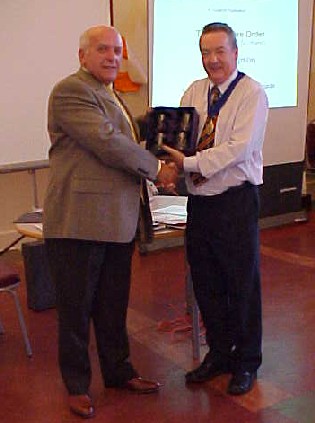 Summary
The new Scottish Fire Bill will bring about a ratification of Fire Legislation in Scotland.
We have the best record in the world for fire incidents and this is considered to be due to taking suitable preventative measures.
In the future there is an intention to concentrate upon the bad incidence ratings of private residences.
Once the Fire Precautions Act has gone, it is thought there will be an increase in risk levels in other areas of – Factories, Offices, Shops, Hotels – and these may then turn the concentration back onto this form of premise.
10.0 DATES OF NEXT MEETINGS
10.1 District: Thursday 4 November 2004: HSE Priority Areas, speaker from HSE, name to be confirmed
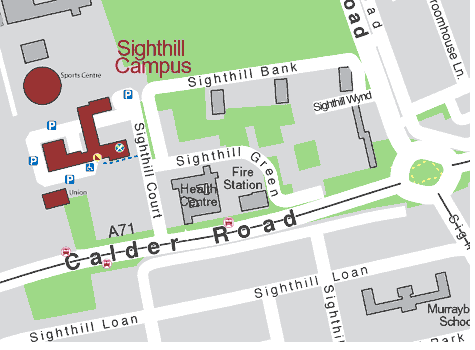
11.0 CLOSURE:
Members were invited to mingle over tea and coffee.
|
Max Bancroft, MRSC, TechSP Branch Secretary |
Richard Lovering, FIOSH, RSP Branch Chair |
