To return to the previous page, please close this window
Minute of Meeting
154th Edinburgh Branch Meeting
Donaldson’s College, Edinburgh – Thursday 9 September 2004 - 130pm
SEDERUNT:
C Toole L Young S McMorland L Murray J Johnson C Shiels R Walker
M Whitham I Skinner S Daly S McGarrigle R Robertson J Brannigan S Brown
A Sharman R Bradford S Groat G Hughson I M Murray S Hunter R McLean
R Brownlee H Doherty B Davies R McLaren R Innes R Lovering J Davis
B Anderson K Wright C Forrest B Byrne G Millar G P Lamond A Gregory
G McGlade I Wilson D Jones B Stainton D Morrison A Milne P Murray
H Gardner S Beaton K Lloyd P Gallacher D Sinclair A McPherson M Johnstone P Brown J Hepburn C Lawson J McMahon A White T Ambler
G MacGregor T Mellon A G Dick J Adamson
APOLOGIES: Max Bancroft, Vic Stewart, Graeme Lyall, Karen Darling, Stewart Page
1.0 CHAIR: Richard Lovering took the chair, welcomed the members to the start of the new session, outlined the safety arrangements. He reported with sadness the death of Executive Committee member Jim McCraith on 13 August who was well known to those present having been Social Secretary for the past few years.
2.0 MINUTES OF PREVIOUS MEETINGS (June 2004)
2.1 Receipt: These had been received as expected.
2.2 Accuracy: Proposed by Marion Johnstone; Seconded by Iain Murray .
3.0 MATTERS ARISING NOT ON AGENDA :
The October meeting would be our last meeting at Donaldson’s College since they were now starting to re-arrange themselves prior to moving to their new premises. We would meet in the Lecture Theatre, Sighthill Campus, Napier University for November and December and then at Craighouse Campus, Napier University from January 2005 onwards.
4.0 CORRESPONDENCE
4.1 HQ – Membership: National – 26058; Edinburgh Branch – 740. Corporate – 344; Associate 186; TechSP – 104
Construction – 179; Public Services – 124; Environmental – 94; Offshore – 42; Healthcare 35; Consultancy – 37; Education – 32; Fire Risk Management – 21.
Substantial drop from previous month – National 27925; Edinburgh Branch – 797. 59 suspended due to non-payment.
4.2 Edinburgh Branch Fire Protection Association programme: available on our website via the Programme page.
4.3 ROSPA Scotland Congress – 15/16 September – details via Branch website.
4.4 ROSPA –promoting young driver’s safety – free competition – details on website
4.5 Fife Chamber of Safety – next meeting 14 September plus minutes of last meeting – all available from their website.
4.6 Centre for Corporate Accountability: Scottish Conference 14th October.
4.7 HQ IT Strategy: Membership: moving towards members taking ‘secure’ ownership of their individual membership records and CPD records on-line. Members who think HQ have any incorrect data especially email addresses should inform Membership Dept ([email protected]).
5.0 BRANCH EDUCATION DEVELOPMENT ADVISOR - Liz Young. Intends to make presentation on CPD at next meeting.
6.0 SPECIALIST GROUPS
6.1 PUBLIC SERVICES – Marion Johnstone: National Safety Symposium at Portsmouth was a great success with many interesting speakers. Looking for venues in Scotland which would be suitable in 2 years time. Anyone who has details of a venue which could cope with 3 and a half days accommodation for approx 120-140 with conferencing facilities let Marion Johnstone know. Next PSG meeting 7 October 2004
6.2 CONSTRUCTION – Allan Dick had been appointed to succeed Roddy McLean. Thanks to the other two members who had offered to serve. Thanks to Roddy for service over the years. Joint Construction/Environment conference 14th October, Aston Villa Footbal Ground. Alan needs assistance to man a stand at Conference, Glasgow 2-4 November. Next SG meeting Leicester 10 Nov.
6.3 FIRE RISK MANAGEMENT - Dave Sinclair. Last meeting on 25th August 2004 at The Grange, Wigston. Membership: 1009 Should increase slightly once late memberships are paid. Budget: Within allocated spend. Charging delegates at Networking Meeting nominal amount to cover buffet lunch, unless sponsored.
Questionnaire Results:
Good response, as far as questionnaire responses go.
- I will be writing to those who provided positive response regarding, sponsorship, writing articles, commenting on consultative documents, or becoming a Branch Liaison Officer.
- Determine future Networking Meeting topics.
- Continue to produce a Newsletter. (90+% in favour.)
Networking Meetings:
25th August 2004 – Excellent turn out with approximately 80 delegates in attendance. Feedback very positive. Workshop looking at “Sharp end issues” relating to evacuation of less able-bodied people. Information collated is being copied to Working Groups involved in the Fire Safety Regulatory Reform Order.
2nd December 2004 – Will take place in London at the Thames Tidal Defence Offices. Presentations and debate will concentrate on “Fire Risk Assessments – Local Factors & Considerations” and “Less able-bodied – Will they get out safely?”.
Draft Programme for next year will confirmed shortly, update next meeting, but I have asked for one to be in Edinburgh. Any sponsors would be greatly appreciated.
Competence Working Party - NEBOSH National Certificate in Fire Risk Management: Fantastic progress has been made. The syllabus is almost complete. Last meeting included two delegates from NEBOSH. Marketing exercise is being carried out, and initial response looks good. Hope to launch April 2005 with first examinations December 2005.
FRMSG Action Plan: On target.
6.4 HEALTHCARE - Martin Scott-Smith. Attended a recent mmeeting where main topic was trying to find the way forward on standardizing accident reports. Meeting noted recent launch of “Health Working Lives” – an initiative by the Scottish Executive. SHP named Ian Walrdram as the Scottish-elected IOSH Council member who the SE asked to help promote the initiative and also names two SE staff for further information.
6.5 ENVIRONMENT – Julian Davis.
Anyone involved in waste management is encouraged to check out a new area on the HSE website. David Allan taking over from Steve Blackburn as chair of SG. SG intend to improve communications this year with web pages being revamped and updated and regular newsletters to SG members. Feedback on these is requested.
Anyone wishing to comment on draft COMAH Regs via IOSH had to do so by 29 September.
6.6 OFFSHORE - Tam Boyd: Nothing to report.
>
6.7 RAILWAYS - Need a representative
6.8 CONSULTANCY - Derek Cawkwell: Nothing to report.
6.9 SAFETY SCIENCES - Steve Boucher: Nothing to report.
6.10 TELECOMMUNICATIONS – Graeme Lyall: Nothing to report.
6.11 EDUCATION – Allan Dick. Need a replacement for Allan who is now Construction SG Rep.
7.0 FORTH and TAY DISTRICT
No report
8.0 MEMBERS ITEMS
8.1 Site Visit: Fri 25 June: had been very successful to Castle Inn, Dirleton, and then East Fortune Airfield.
8.2 Member’s Certificates: Secretary had written to HQ to enquire why these were no longer being sent to him for presentation to members. Informed that sending out to Secy rather than member would be too great an administrative burden on membership dept. Is done for Fellows however.
8.3 Congratulations to Iain Murray, Founder Member of the Branch who was awarded an MBE for services to H&S recently.
8.4 David Jones, self employed member, doing a part time degree in applied ergonomics. Needs “somewhere” to be able to do the practical research part.
8.5 Jewel & Esk Valley College are considering employing additional staff on fixed term contracts, to risk assess work placements for their students.
8.6 Roddy McLean highlighted recent HSE report on fatal accidents and mentioned a one day free seminar at Kelso for contractors/sub-contractors.
8.7 Russel Brownlee asked if there had been any Branch involvement in Healthy Working Lives. There had been none. He also asked people to respond to the NHS document ”Prioritising Occupational Stress”.
9.0 GUEST SPEAKER:
Sue Williams
Head of Training & Development – Crown Office & Procurator Fiscal Service
– Demystifying the Court Process
Marion Johnstone briefly introduced the speaker – Sue Williams, who is the Head of Training and Development for the Crown Office and Procurator Fiscals Service, to the group, by pointing out that not only was she employed as a trainer within the organization, but she is also a qualified Solicitor in her own right and indicated that any further details of her background and qualifications which the assembled group may need to know she would leave to Sue to provide during her presentation.
Introduction
Sue started by stating that she was unsure at the initial invitation just who she would be talking to – perhaps because she put emphasis on the initial part of the name of the Institution, she thought it may be a group of health professionals possibly from the NHS. But having taken a look at out web site and become a little more informed she was then not sure if she should be more or less worried by the possible reception she may get as at times the fiscal’s office isn’t popular with either the health professionals or the health and safety professionals.
Not being aware of how many of the audience may have previously been involved in the court process, either personally or professionally, in either the civil or criminal court, but knowing that the number of persons within the whole of the country who have been so involved is a very small minority of the population although the numbers are rising due to the ever increasingly litigious world in which we live, she decided to aim the presentation at providing a little practical advice which may be of use to the members no matter what their experience.
Possible involvement
As a group of professionals, it was quite likely that we may be asked to produce reports on matters which end up in court and if we are unlucky we may be cited as a witness for proceedings in a civil action, or by the defence in a criminal action and then if you are really unlucky, you may have to give evidence in court.
The majority of civil cases settle out of court, even as late as at the door to the court-house itself and a number of criminal cases end up in an acceptable plea being tendered which negates the need for court appearance.
Fear of appearing in court
There is a degree of fear, worry, trepidation for anyone where they expect to end up standing in the witness box, answering questions form that horrible group - the most hated profession in the world = lawyers.
But why are we scared at the thought of giving evidence? Some of it is down to ignorance of the process, some of it is due to the lack of experience at having to stand up and speak in public, but the reaction is mostly due to the natural human reaction of adrenalin beginning to pump around the body (with the old fight or flight condition which that brings on), but for court proceedings Sue sees that as being a good thing. Once the adrenaline is pumping around it makes your brain sharper and you are alert to what is going on around you, which will make you a better witness.
Court Structure
There are different legal proceedings for different courts. In criminal proceedings there are 3 courts of the first instance (this is not including the appeal courts which we would not have to concern ourselves with).
Criminal Courts
District Court – This is the lowest court and it is not likely that we would be called to appear in that court as a professional. It consists of a Sheriff sitting summarily (i.e. a Sheriff sitting alone) where he/she will decide on the facts and the law issues.
Sheriff & Jury Court – Here the Sheriff presides and decides on the law, but the facts of the case are decided on by a jury of 15 persons and will come to the decision of either – guilty, not guilty, or not proven. This is the most likely format of case where we may be called upon to give professional comment.
High Court – Here a Judge sits to consider the law whilst the jury again is charged with deciding the facts of the case and will be sued for the more serious cases such as the one relating to the Transco case in Lanarkshire.
The standard of proof in a criminal court is beyond a reasonable doubt.
Civil Courts
Sheriff Court – There is no limit to the awards which can be made in a Sheriff’s Court, so it is difficult to see why anyone would opt for a higher court, except for the possible thought that they do not want the session heard within their own backyard.
Court of Session – This is a lot more expensive for the parties involved and there is only one in the Country which sits in Edinburgh.
The standard of proof in a civil court is on the balance of probability and is hence a lower standard than in criminal cases.
Cases will often run in tandem through both court systems, but the criminal case will normally be heard first and even if a conviction does not result an award of damages may be awarded in the civil court. One reason for the delay between the cases going to criminal and civil court is that the burden of proof for a civil case is much easier if it is following a successful prosecution and there is of course the opportunity for the civil case to be laid anywhere up to three years after the event, but the criminal case is normal heard quickly after the event to ensure memories do not fade and become clouded. But this raises one very important factor – if you think an even may lead to court proceedings at some point in the future, there are certain things you can do to make the process easier.
Records and reports
Keep good notes of site visits, machinery inspections, whatever.
Make then at the time or as soon as possible after the event as they will then be fresh in your memory and therefore be at their most accurate.
Record your conclusions and WHY you reached them – something which seems obvious at the time will not necessarily be recalled so easily some time in the future.
The report may well contain opinions and this is the area where the greatest care must be taken. “Throw-away” lines which are based on opinion rather than fact are the most common reason for the evidence of a professional in a report being dismissed – the professional lawyers will pick up on it and show it to be based not on fact which can make the rest of the report unreliable.
Precognition
If you have prepared a report for an incident which is going to the fiscal for consideration of criminal proceedings and the case is going for solemn procedure (that is before a jury), then you are likely to be called to attend the fiscal’s office for precognition. That means you will be asked questions about your report and the opinions you have expressed. You may be asked to explain technical parts of the evidence so that if the case comes to court the fiscal can ask questions of you to help the jury understand.
The defence may also ask for a precognition meeting you and it is important that you co-operate. If you do and the defence is persuaded of the strength of the evidence against the client it may lead to a plea and you will not have to appear in court. If there is no plea and you have received you citation – you must attend and there are sanction available to the court if you do not attend.
In court
Before you go to court – re-read and re-read you report – get to know the content inside out. Your credibility as a witness will be inked to your persuasiveness by being able to give a clear account of your qualifications and experience. Sue emphasized here the importance of keeping you CPD records up to date – keep track of each case you have been involved with and what the result was – whether it went to court etc, then if you get asked by a lawyer what experience do you have of similar cases you can give an accurate reply – even if only one ever went to court (especially if it was the only one of that type in Scotland etc).
Don’t be afraid to give your age – it can show a person of great worldly experience or as someone just starting out and who should be cut a little slack. Don’t be afraid to tell the court that you have never given evidence before as this may explain what may be seen as shiftiness in answering difficult questions.
Don’t be smug or arrogant, it gets people’s backs up and is often seen as a defence mechanism, but equally don’t be timid
Speak clearly and in simple language. Jargon confuses people and a jury often switches off.
Listen to the question being asked and answer it – not the question you would like to have been asked. There are probably good reasons why the lawyer has asked then in that way or in that order, they may even be trying to avoid something which they know is inadmissible, they may be slowing down to cover a particularly important bit of evidence so that its impact is not lost on the jury.
If you are asked a question that you cannot answer, say so and do not let the questioner drag you into the trap of answering something you are not equipped to cope with. If you are asked multiple questions, answer each part separately by saying the answer to your first part is – the answer to your second part is – and if you don’t follow a question of cannot remember all of it, then ask for it to be repeated.
Cross-examination
This is perhaps the most frightening prospect, but don’t worry. Focus on the questioner – they don’t want you to say much – they want to do the talking.
Don’t worry about disagreeing that is what it is all about, but don’t get drawn into an argument with the questioner
Summary
If you are called as a crown witness, as a professional witness, the person calling you is not there to protect you – that is up to you.
You will be vigorously cross-examined, but you should not be harassed and the sheriff, judge or even the fiscal may intervene, but this is not always the case when a professional witness is giving evidence and a number often feel it goes on too far, but Sue did state that you should not take it as a personal attack – they are only doing the job they are faced with.
If you tell the truth and stick to it, you should survive the ordeal.
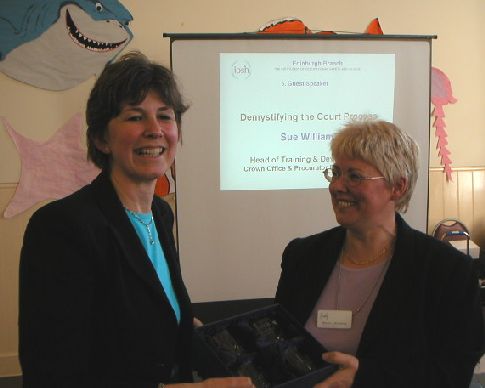 | Ms Wiiliams receiving a token of appreciation from Branch Vice-Chair Marion Johnstone |
10.0 DATES OF NEXT MEETINGS
10.1 Branch: 14 October: New Fire Order (especially as applies to Scotland).Dell Simpson (formerly of Lothian and Borders Fire Brigade)
10.2 District: Thursday 4 November 2004: HSE Priority Areas, speaker from HSE, name to be confirmed
11.0 CLOSURE: Members were invited to mingle.
|
Max Bancroft, MRSC, TechSP Branch Secretary |
Richard Lovering, FIOSH, RSP Branch Chair |
