To return to previous page, close this wondow.

Minutes of Meeting

152nd Edinburgh Branch Meeting

Donaldson’s College, Edinburgh – Thursday 13 May 2004

SEDERUNT: M Bancroft R Lovering R McLean S Ashton I Wilson A Akcan K Hardie D Morrison M Gorman V Stewart L Young G Lyall J Jamieson J McCraith S McMorland K Lloyd J Fisher R Thomson A Green A Martin D Richardson R Hunter S Young J Brannigan P Quill J Johnston I Murray G MavGregor C Wilmott A Dickie A G Dick J Little A Curran G McGeorge S Page A Reid R Graveling S Hunter N Doherty C Petrie C Black

APOLOGIES: Bob Bertram, Dave Sinclair, Derek Calkwell, Harry Gardner, Dave Sinclair, Julian Davis, Marion Johnston, Martin Scott-Smith

1.0 CHAIR: Richard Lovering took the Chair and outlined the safety and parking arrangements.

2.0 MINUTES OF PREVIOUS MEETINGS (March 2004)

2.1 Receipt: These had been received by those expecting them.

2.2 Accuracy: Agreed a correct record: Proposed by G Lyall ; Seconded by J McCraith

3.0 MATTERS ARISING NOT ON AGENDA : None

4.0 CORRESPONDENCE

4.1 Scottish Border’s Safety Forum: Meeting 26 May, Hawick: Fire Update, Agricultural Hazards, Confined Spaces, Farm Health & Safety. Also new URL for their website: www.borders-safety.com

4.2 Scottish Chamber of Safety – March meeting minutes.

4.3 HQ – Membership: National – 27692; Edinburgh Branch – 789. Corporate – 346; Associate 217; TechSP – 107

Construction – 185; Public Services – 138; Environmental – 98; Offshore – 45; Healthcare 37; Consultancy – 31; Education – 31; Fire Risk Management – 23.

4.4 Industrial Safety Equipment Exhibition – 19/20 May – Hilton Grosvenor Hotel, Haymarket.

4.5 H&S Scam: The HSE urged companies and other organisations to ignore information they receive from three firms purporting to regulate health and safety legislation. They have received hundreds of complaints from companies across the country that have been sent requests for payment in return for compliance with health and safety law. The three firms, all based in north-west England, have written to companies all over Great Britain asking for between £125 and £249 to ensure they comply with health and safety law.

5.0 BRANCH EDUCATION DEVELOPMENT ADVISOR - Liz Young. Nothing to report

6.0 SPECIALIST GROUPS

6.1 PUBLIC SERVICES – Marion Johnstone: Nothing to report.

6.2 CONSTRUCTION - Roddy McLean. Roddy confirmed that he would be unable to attend meetings at HQ and would continue as corresponding member while a replacement was sought.

6.3 FIRE RISK MANAGEMENT - Dave Sinclair. Next networking meeting: Wormalds: 10 June in Manchester.  Alternative fire suppression methods, Two presentations, demonstrations and a buffet lunch.  Closing date: 1st June. £10.

Membership has now broken the 1000 mark.

Feedback from last Networking was extreemly positive and as a result Ireland are trying to set up their own Fire Group.

The fire reform order has now been laid before Parliament. Will provide a web link for the document.

6.4 HEALTHCARE - Martin Scott-Smith. Trying to form a Scottish Sector of the Healthcare Group – meeting called for 18th May - NHS Lanarkshire, Centrum Park, Coatbridge. Comment from K Lloyd that there was no constitutional arrangement within IOSH for such a grouping - was this purely for networking purposes.

6.5 ENVIRONMENT – Julian Davis. Monthly bulletin sent out.

6.6 OFFSHORE - Tam Boyd: Nothing to report.

6.7 RAILWAYS - Need a representative

6.8 CONSULTANCY - Derek Cawkwell: Nothing to report.

6.9 SAFETY SCIENCES - Steve Boucher: Nothing to report.

6.10 TELECOMMUNICATIONS – Graeme Lyall. Nothing to report.

6.11 EDUCATION – Allan Dick. Group has grown to 870 members in under 3 years. Arranging first network meetings for the autumn term, two in the Midlands and one in Scotland. Aim to arrange an education seminar. Already planned is a frequently asked questions section of the website to cover the hot topics of the recent questionnaire and the development of an IOSH approved Managing Safety in Education training programme.

7.0 FORTH and TAY DISTRICT

The Branch Executive Committee had agreed that the District could join the local Chamber of Commerce on a one year experimental basis to see if this would assist in raising the profile of IOSH in the area.

8.0 MEMBERS ITEMS

8.1 Ken Shaw: Wish to improve accident / incident investigation methodology, but are unsure as to the 'optimal' form of the end product. Would like to discuss this with any representative of a (manufacturing) organisation currently using a system that would be classified as 'Approach 3' in the HSE contract research report 344/2001 i.e. causal analysis supported by further analysis tools and techniques. Email [email protected]

8.2 Aon Ltd, the Insurance Brokers/Risk Management: Client (plant hire company) want to employ a full time H&S manager/ adviser for their operations throughout Scotland. Contruction/plant hire experience. [email protected]

8.3 Roger Midson challenge Trophy: 21 May: today was closing date for going.

8.4 Secretary’s Sipper Gold Tournament: 28 May – Bells Sports Centre 1230. Meal in Inch Restaurant afterwards.

8.5 Kevin Lloyd –Member’s Presentation

Regional IOSH Selection Panel Interviews

Kevin Lloyd was introduced by the Chair as not having stood back quick enough when asked to make a 10 minute presentation about the training and arrangements which he had been made aware of in the formation of Fellows within Scotland being called upon by IOSH to form a panel for interviewing future Fellows and RSPs.

Aims of panel interviews

Kevin indicated that the prime aims of the interview panel were

The Interviews

The Interviews by a panel are being anticipated for two activities, the original activity being the appointment of Fellows having now been extended to encompass any of the competence appointment issues of RSP and Membership. The reasons for the interviews being to verify the information which is entered onto the application form and also to enlist further information which is not entered onto the applications form. The Chair will be required to introduce all of the panel members and to ask the "ice-breaker" questions to set the candidate at ease, and then to summarise and ask for any final questions of the panel or the candidate at the end of the interview. The panel members will ask questions in turn and will ensure the candidate knows who is asking the question and hence who they should address their answer to.

Why use Fellows

The decisions to utilize Fellow of the Institution to undertake the interviewing was that it was considered they should have sufficient background to know what is important in terms of health & safety at the same time as giving due consideration as to what is best for IOSH.

Interview Structure

Prior to the event the panel members will discuss the submitted details and the relevance of each element so that they can pre-determine questions to discover what the applicant has actually done in order to measure them against the defined standard. The interviewers have been trained to work as a team to gather as much information as possible and to recognize and deal appropriately with both extremes of applicant – those who are shy and reticent at "blowing the own trumpet" and those who beliefs make them prone to saying a lot from what they wish had happened rather than what they had actually done. They have been instructed on being objective and not interrupting the candidate or other panel members, use of "open" questions and avoiding the leading questions, collecting evidence of past experiences rather than judging performance.

Summary

It is hoped in this way to control all of the shortcomings previously indicated and hence avoid complaints based on the topics of being unsystematic, being unclear or opaque, and not to have been fair in the treatment of the candidate – all of which were common elements of complaints that were voiced by the disappointed individuals who had failed to make the grade. More information will hopefully be forthcoming in the future when the pre-defied standards are made available which the panel will need to measure against.


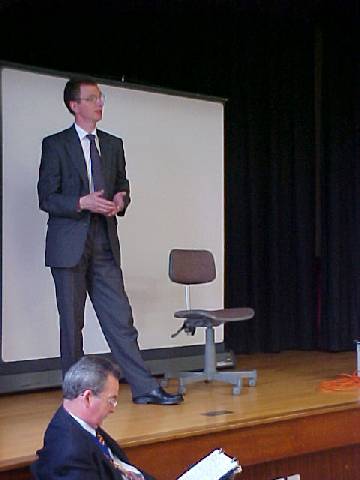
Dr Gaveling with the chair.
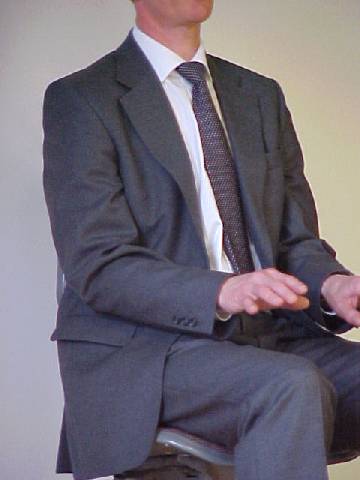

Elbows at 90 deg; arms horizontal
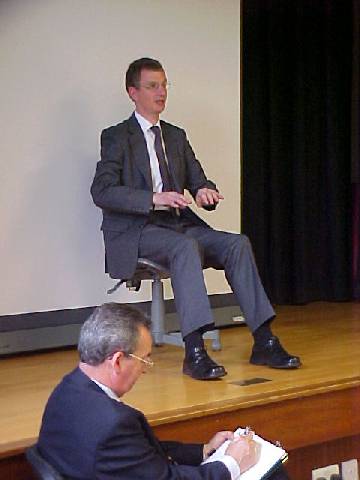

Elbows out; twisted wrists
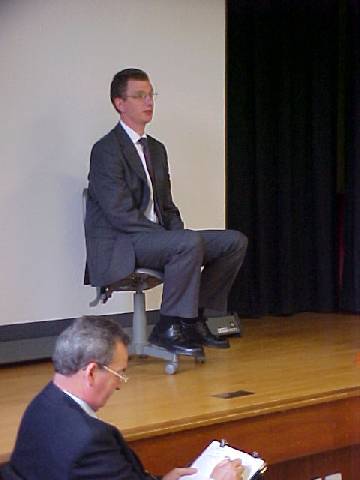

Use a foot rest not the castors
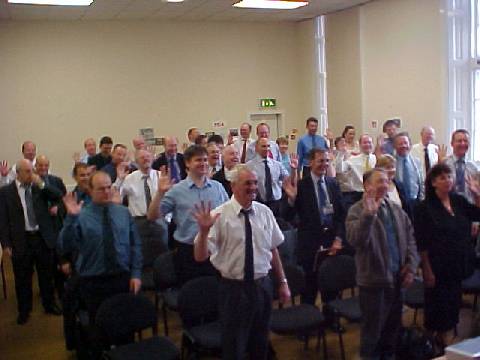

Audience participation
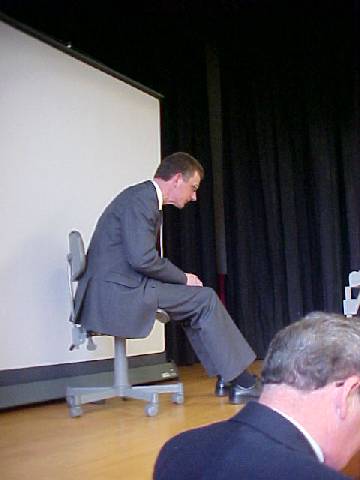

Most of us look down at the keyboard ...
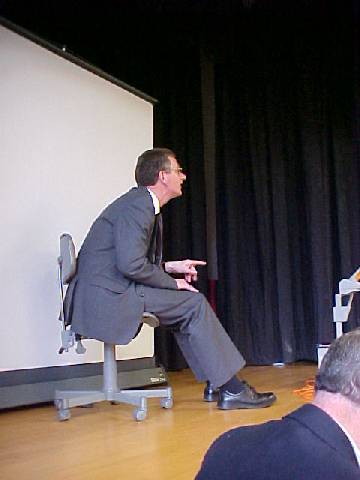

..and this is us then looking up at the screen.

9.0 GUEST SPEAKER: Dr Richard Graveling - of The Institute Of Occupational Medicine

Laying out your VDU Workstation

The Chair introduced Dr Richard Graveling to the assembled members, but firstly pointing out that he had in fact stepped into the breach at exceptionally short notice, as we have lost contact with the planned speaker and the finalization of arrangements were only made the previous Friday.

Richard then pointed out to the group that he had no other visual aids other than "himself" and a chair borrowed from the College Office and whilst he may not present a paper on the original topic, he would so far as possible show the changes in the regulations which have been brought into place from the extension of the environments in which VDUs are now used.

Updated Regulations

The basic extension to the original regulations and guidance as the speaker saw it was the requirement on employers now to "risk assess" ALL workstations and not just those in use by a "user".

The issue of ensuring standards for home workers and Hot Desk Working he saw as very similar in that the often neglected element of the regulations – one of education training – was the means whereby the workstation could be set correctly, but only when the users understood WHY and HOW it was to be set.

Schedule content

Richard indicated that he felt the schedule having been set in the 80’s has been overtaken by technology, but was still a basic list of kit which was necessary although now the levels of requirement are frequently exceeded. Chairs being a prime example and the simple office chair he had at the front was typical in that it was simplicity itself but more than met the requirements of the standard.

Seat backs must be adjustable – Seats should have good lumbar support – seat height must be adjustable. The standards hence does NOT state the seat back should be adjustable independent of the seat base, not does the lumbar support have to be height adjustable – as such a bucket style of chair where the back rises with the seat and tips with the seat would meet the standard but would not be suitable for creation of a good ergonomic posture.

Education & Training

The schedule could be considered as a list of ingredients, but unless you train the employees in how to utilize them correctly it would be like supplying a shopping list to someone without a recipe – no way could you expect the cake output to be exactly as expected. The need is not just to explain what has to be provided, but also on how to use it correctly and why, this is particularly important for the home worker who may not have someone else come to view the shortcomings of the set-up and also for the hot desk worker, who needs to have a measure of what is correct each and every day as the settings may well have changed.

Ideal body conditions

The speaker then got some audience participation in attempting to define the correct postural conditions to be aimed for.

Firstly he requested everyone sit with their hand hanging loosely by their sides. Then to look at the shape their hands were in – that was the ideal at rest condition – it is not with fingers and hand straight out, but slightly cupped. To hold the hand and finger straight takes a muscle loading which you should aim to reduce.

It is obviously not possible to type with your hand by you seat sides so your elbows must be bent at nominally 90 degrees and with a fixed height desk (most are) the seat will then need to be raised to make you forearms level and your hands at the correct position. It is common to find that most us tend to sit too low and then reach forward to the keyboard. Our settings often force us to push our arms out to the sides and then twist the wrists to get onto the keyboard which is a most unnatural position – the expensive solution being to provide a split keyboard, but the easy answer is to sit higher. Some individuals will often hunch their shoulder to create this height with severe pain being generated in the shoulders and back as a consequence. Do beware of the "keyboard domination" pose where the individual tends to hunch over the keyboard

Incidentally the use of wrist rests is not considered to be good practice, especially the gel filled units as they tend to hold the wrists in one position and then force twisting of the hands. It is preferable NOT to rest the wrists on the desk top when typing as this forces the wrists and hands into an upward slope and being flexed beyond the ideal position, but if anything is provided it should be no more than a foam style block up to the same height as the keyboard surface. Remember, pressure on the wrists by resting them on something is increasing the pressure in the carpal Tunnel and could lead to WRUL in that way.

The vertically challenged individuals will now often require a foot rest as it is not a good position to tuck the feet back onto the seat base and beware the use of arm rests as they tend to force people into a hunched should posture.

The human body is not built to match the BS standard exactly in that we are all individuals with individual needs. The length of the thigh is an example. If the seat pan is built to the maximum size allowed by the standard, it will be too deep for the majority of the work-force, pushing them at the rear of their legs and forcing them to "perch" on the seat edge and hence have no back support. If the seat pan is made to the minimum size by the standard, then it will be too shallow for most of us and we will have to force ourselves back into the seat which will be a muscle loading for our back and legs to keep us on the seat.

The speaker promised he was not about to break into song, but he did point out that the hip bone is connected to the thigh bone etc and in fact when we sit down the lower part of the back which is in contact with the pelvis is put in strain, but despite this we do like to sit down and the legal requirement is there for us to have the facility to be seated where we can. It is important under this condition though that the correct curve is maintained in the back at the lower lumbar region – not being forced into shape, but retaining the shape we had before sitting down. The ideal seat back position when we are seated is considered to be just back from the vertical so the our body weight is not just down the spine, but is in fact shared with the seat back rest.

The screen should be set to ensure the eyes are at a neutral position as for the hands. The eyes take a natural rest position at approximately 10 to 15 degrees down from the horizontal so when you sit up with your neck upright and gaze into nothing this will be the rest position for your eyes and this should be set to the top inch or so of the screen. While this position is ideal for the touch typist, for those who need to look to the keyboard on a more frequent basis the screen will possibly need to be set slightly lower to avoid excessive head movements up and down.

Summary

The body is designed for movement not for static conditions, so when you take a break make sure you physically move away from the seat

10.0 DATES OF NEXT MEETINGS

10.1 Branch: 10 June: Environmental Issues for the H&S Practitioner: Bill Holmes, Sypol Scotland.

10.2 District: 3 June: Site Visit: Fire BrigadeTraining Centre, Perth

11.0 CLOSURE: After reminding people that tea and coffee were available and this was a goos opportunity to mingle, the Chair closed the meeting.

Max Bancroft, MRSC, TechSP

Branch Secretary

Richard Lovering, FIOSH, RSP

Branch Chair

Hosted by www.Geocities.ws

1