Minute of Meeting
151st Edinburgh Branch Meeting (AGM)
Donaldson’s College, Edinburgh – Thursday 8 April 2004
Sederunt: M Bancroft, R Lovering, S Page, A James, M Gorman, T Mellon, A A Pittendrigh, D Scott, R McLean, L Young, G Lyall, J Davis, J McCraith, D Bond, S Hunter, R Thomson, J Brannigan, A McNeil, K Lloyd, A Milne, R Brownlie, D Sinclair, D Cawkwell, D Morrison, T Mellon, D Scott, R Bradford, A James, N Robertson, I Murray, D Spratt, R Jones, M Johnstone, S Purdy, C Carter, J Anderson, C Wilmott, C Black, V Jones, L Crichton.
Apologies – Vic Stewart, Karen McDonnell, Bob Bertram, Chris White, Gordon McGeorge, Bob Sweeney, Peter Quill
INTEREST SPEAKER
Colonel Douglas Spratt
Past Lighting Director of the Edinburgh Tattoo
Graeme Lyall introduced Colonel Douglas Spratt to the assembled members, indicating that he was in fact a person friend of a number of years and that his background included amongst many other Service activities holding the post of Lighting Director for the Edinburgh tattoo for over years and that this afternoon he was going to present us with a few illustrated memories of those 40 years
The Tattoo - Background
The speaker firstly made sure that the members appreciated which form of tattoo he was talking about - not the art-work undertaken on skin, but in fact the Military Display held in Edinburgh on an annual basis.
In 1947 during the first Edinburgh Festival a Military Display was put on at the old Murrayfield ground and this was moved in 1948 to take place in the Princes Street gardens. But it was still then defined as being a Military Display and included the Pipes & drums of a number of regiments. It was not until 1950, that the Military Tattoo was moved to the arena area of the car park for Edinburgh Castle and took the name
Lighting made the event.
Douglas showed several 35mm slides to demonstrate that a lot of the atmosphere and effect was in fact down to the lighting, picking out the detail of the performance which was taking place concentrating the eyes of the viewers into one particular slot.
Poor weather however can have a drastic effect on the images as the bright colours of the uniforms and outfits can be hidden by capes and other weather-proof gear needed to protect the performers. The speaker also recalled one instance where the fog had descended to such a level that the Director of the tattoo said to him "Douglas - it may help if you put the spotlights on" to which he replied - "They are already on Sir"
Misconceptions
The speaker recalled a number of conversations which had happened to show that members of the general public did not always appreciate what happened and where. One overseas visitor asked a castle guide what all of the elevated stands were form around the car park, and the guide told him that there had been a murder in the city and it was going to be a public hanging and the stand had been put up to enable the public to watch.
On another occasion a visitor looked over the side of the castle down into the moat and pointed out that it was dry - to which the response came back - "Yes sir - we drain the moat every Thursday so that we can cut the grass"
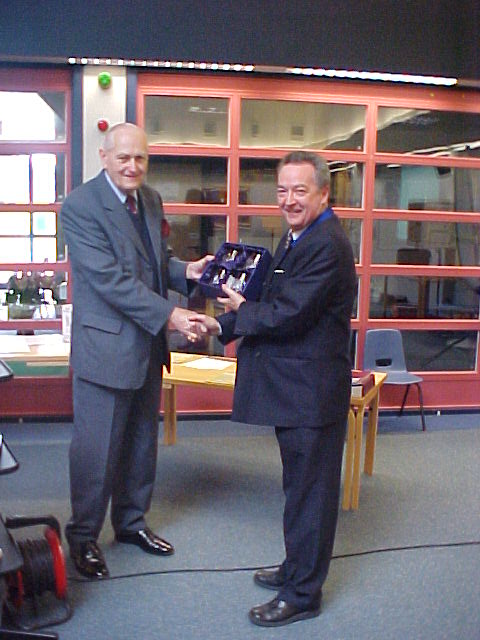 [Colonel Spratt (left) receiving a small gift from Branch Chair Richard Lovering,]
Now-a-days the event is recorded for television so they can pick from several performances and choose the best, but in the early days it was televised live and the weather could under those conditions have made or broken the success of the images of the event. There have also been major developments in the audio presentation conditions and the speaker recalled shortly after have the speakers installed a Sunday practice prior to the event going on rather late in the evening. Just after 11.30 that night one of the local residents opened his bedroom window and shouted across to a guardsman "Can't you stop that b****y noise", to which the guardsman quickly responded "Sorry Sir - can't hear you for all this noise". The gent said he wished to speak to whoever was in charge and he was invited down to speak to the Commanding Officer. He duly arrived in nightwear and a dressing gown and was taken into the Officers Mess for a discussion. He was taken back home at 12.30 being 'escorted' to ensure he did not fall over.
There is also the case some 10 to 15 years ago of the lady who bought a house close to the Castle and then attempted to sue for the noise levels emitted by the event, but she lost the case - it was an issue she really needed to take up with her solicitor. The local obviously do suffer from the noise and as a compensation, all of the locals are given complimentary tickets to the show and are invited to "visit the Officers Mess"
Overseas events
The Tattoo has been taken to a number of overseas locations and some of them have worked very well whilst others have lost some of the atmosphere from Edinburgh whilst others gained something different.
Tasmania
Here the Tattoo was performed in a football stadium which meant the audience were some 4 to 500 yards away from the performers, whereas in Edinburgh castle, as the arena is only 300 yards by 75 yards, the audience are very much a part of the event, but at the sort of distance there were away in Tasmania, it lost some of the atmosphere. There was one event however which stuck in Douglas's memory. It was during the Queen's Silver Jubilee, when they had the pipes and drums of Edinburgh Territorial Army and they were informed that the Queen would be coming to see the second half of the show. When they arrived from dining with the Governor it became apparent that the Duke of Edinburgh had enjoyed himself. By the time they were being introduced to every one a mist had fallen so by the time the Duke got to him and they spoke he then asked "which way now" and on being told he should follow her majesty he said "I would if I could see her"
New Zealand
They ran the Tattoo in New Zealand for 5 days and in order to get the event completely authentic they had built a complete replica of Edinburgh Castle
Australia - Melbourne
They took over the Melbourne cricket ground for the shows in Australia but being a cricket fanatic Douglas and the Producer at that time felt they had to take six stumps, a bat and a ball down with them to the pitch - set up the stumps and then took it in turns to bowl and bat to each other - that way they can no quite honestly say - they had played cricket in Melbourne Cricket Ground.
It was during a show in Melbourne when the RAF Display Team had indicated they would be pleased to play a part, but as normal it came round to who would pay for the travel costs of individuals going abroad. But they were then told that if the Air Force team were less then 50, there was space on a plane going out to Melbourne via Singapore and Brisbane and then back again if they wished to take the spaces. It was obvious that the plane would be taking a dignitary on some trip but they did not know who it was until later - it was Prince Charles. One of the team members was asked if they had the chance to do the tattoo again next year and he sad - "Oh yes - providing he could get a lift with him up front"
South Africa - Durban
In the 1970's there was still very strong apartheid operating in South Africa, so Douglas went to see his Commanding Officer to see if he should go. His Commanding Officer said yes it would be good to go over and run the event there, but as Douglas was leaving and he walked him to the door, the CO shook his hand and said "I hope it all goes well, but do bear in mind this conversation never happened."
The first venue was a rugby stadium and as it turned out the Business Manager for the event was a strong Salvation Army individual and he was insistent that if they all came in through separate doors we would not perform, despite the fact that they were stating they had Laws in the country which stated Blacks, Coloured and Whites had to enter by different gateways. They were obviously prepared to do anything for the event to be a success as they conceded but it took the Business Manager to go down amongst the crowd on the first night to point out they could enter by any doorway - there was concern that they would get into trouble if they came in through the wrong door.
Later the event moved to a football stadium which made the event even less intimate with the audience so far away from the performers, but they did everything to promote and make the event a success, they even had a Tattoo Princess who traveled around in an open topped car to promote the event - a practice which Douglas feels sorry he could not get repeated in Edinburgh - the problem apparently was not getting the attractive young lady - it was getting her to travel in an open topped car.
One of the snags with the football stadium was the entrance to the arena was from the centre rather than at the end as at Edinburgh Castle so a number of the routines had to be reorganized, but with the 10 Military Pipe Bands, all of which are affiliated to Scotland and the Presidential Guard it was a wonderful event.
One event that always went down well was the gun race and the mock battles. There were laws at the time to stop the use of fireworks as it was felt they might incite some violence, but you couldn't run a battle scene without some bangs so they were allowed for the Tattoo. They even managed to get helicopters to come into the arena to make it more realistic - something which cannot be done at Edinburgh as it is a built up area and too restricted in size. They didn’t warn those in the front rows of the audience they would probably leave at the end of the event covered in dirt thrown up by the helicopters.
One other problem encountered in South Africa was when they had the Civilian Zulus to dance - they do not work to a script of patterns - they do what flows for them on that occasion, which mean on some occasions they took a lot longer than was normal. It all then went totally haywire the night the Zulu King cam to the performance - it is tradition that the King leaves firsst before they stop dancing, so there was some hurried re-arrangements being made that night.
Variety
There has been very few horse events put on due to problems with the horses holding their footing in the Edinburgh courtyard as it is covered in cobbles. During one rehearsal the horse with the big bass drum on its back slipped and could not get up - they had to bring in a mobile crane to lift the horse - it was fortunate that it was during a rehearsal not during a performance.
On one occasion they had the James Bond car and with it came an actor who was not so good at controlling the car - he spun it on the first performance and slid it into the stands. It was only the car that was damaged, but the director told the actor he wanted no more exuberant performances as they had difficulty getting the car repaired in time for the performance the following night.
Car chassis have been used to build mock-up boats for sea- battle performances, but the Navy is usually associated with climbing ladders ropes etc. One year saw a very large ladder frame being used at one end of the arena, but it took 10 minutes to erect it and the normal timing of each performance was 1 to 2 minutes set-up, 8 minutes performance, and then 2 minutes to clear down. A Petty Officer was given the task of honing the preparation time and by the time of the tattoo proper they had it down to - one and half minute set-up 7 minutes performance and 2 minute clear down and the Naval Commanding officer came to Donald at the end of the event and said "Thank you - for teaching us to improve to what we should have been doing anyway"
1.0 CHAIR & WELCOME
Richard Lovering took the Chair and outlined the Safety arrangements.
2.0 MINUTES OF PREVIOUS AGM – MEETING 142 (April 2003)
Agreed a true record – proposed Jim McCraith, seconded Julian Davis
3.0 MATTERS ARISING NOT ON AGENDA
Noted that last year’s financial statement, after auditing, had been approved at the June 2003 meeting.
4.0 CHAIR’S REPORT
Richard gave a brief summary of the past year
Ø Provision of attendance certificates
Ø Held 8 Normal Branch Meetings,
Ø Stress Management Developments; Case Law update; Health & Safety Law update; Regulatory Synergies between Fire Safety & Building Regulations; Managing Asbestos; Dealing with Disasters; IOSH New Membership Structure; The Cost of Accidents
Ø Average of 42 Attending each meeting
Ø Only managed one members 10 minute slot during the year. He urged members use this opportunity to seek assistance with a difficult problem or inform others about a solution found.
Ø Very successful Seminar in November on Transport Safety with over 100 delegates and excellent speakers
Ø Social type events
Ø Site visit to Fountain Brewery
Ø Roger Midson Challenge Trophy = Failed to happen
Ø Golfing outing (Secretary’s Sipper) = Failed to happen
He was glad to note that the Roger Midson Trophy and the Secretary’s Sipper were due to be held soon – we had recovered from last year’s hiati. The success of the Branch arose from the hard work done by the Executive Committee whom he thanked on behalf of the members.
5.0 FINANCIAL REPORT
Kevin Lloyd presented an interim report – the closeness to the end of the financial year meant that full audited accounts could not be presented. However, he was able to report that the Branch was in good financial health and well able to fund the range of activities undertaken both at Branch and District level. The new financial system now seemed to be working and there had been no difficulties of reconciliation.
The Executive were considering holding the AGM in May in future so that audited accounts would be available.
The meeting agreed that the audited accounts should be presented to an ordinary Branch meeting for approval.
6.0 ELECTIONS
There being only one nomination received in writing for the following posts by the due dates, the following were elected:
Chair – Richard Lovering
Vice-chair – Marion Johnstone
Secretary – Max Bancroft
Treasurer – Kevin Lloyd
3 Executive Committee members – Andy Sharman, Graeme Lyall, Roddy McLean.
The following posts were filled by nominations from the floor:
Branch Education Development Adviser – Liz Young
Specialist Groups:
PUBLIC SERVICES - Marion Johnstone.
CONSTRUCTION - Roddy McLean
FIRE RISK MANAGEMENT - Dave Sinclair.
HEALTHCARE - Martin Scott-Smith.
ENVIRONMENT – Julian Davis
OFFSHORE - Tam Boyd
RAILWAYS - Need a representative
CONSULTANCY - Derek Cawkwell
SAFETY SCIENCES - Steve Boucher
TELECOMMUNICATIONS – Graeme Lyall
EDUCATION – Allan Dick
District Liaison – Karen McDonnell
Two auditors – Ian Murray, Bob Bertram
7.0 HONOURED GUEST
Richard Jones, Head of Technical Affairs, IOSH HQ
The work of the Technical Affairs Department
Introduction
The Honoured Guest - Richard Jones - Head of Technical Affairs from IOSH headquarters was offered the floor, and indicated that he wished to present to the assembled members details of what his department did, and how it was organized.
Departmental Structure
Beneath Richard there are two effective areas - Administration and Technical
The Administration function is mainly associated with the operation of the Specialist groups operating within IOSH and a number of the members who hold SG nominations may have had contact with Richard or his staff previously. There is = 1 SG Manager; 2 SG Officers; 1 SG Assistant and SG Administrator
The Technical function answering questions from members on a whole wide and diverse range of topics. The function consists of = TA Manager; TA Adviser; TA Administrator; and a Researcher
Within the Technical remit there is also the Information Services function, which consists of = Information Services coordinator; P/T Information Officer and an External Information Provider which ahs enabled the service to be offered 8am to 6pm
Technical Services
There are in fact 6 services offered by Technical Affairs =
· Consultants Register
· Research
· Specialists Groups
· Publications
· Consultation
· Technical Enquiries
Consultants Register
· Approx. 250 members registered
· Offers a twofold service, to:
o Consultants - providing additional sources of work
o General public - providing contact details for suitably qualified/experienced practitioners in required location
· New database established and register is now part of the technical enquiry service
Research
· Activity in support of IOSH Corporate Strategy
· Identify/access OSH research databases
· Link with research bodies e.g. BOHRF, FBE
· Seek to influence what research is undertaken
· Design, conduct and analyse feedback surveys
· Make data available to members
There is also now a Research & Development Sub-committee which is looking to funding for good ideas with grants of up to £3/4 Million
Specialist Groups
There are now 14 Specialist Groups =
Construction Consultancy Education Environment Fire Risk Mgt.
Healthcare International Offshore Public Services Railways
Retail Rural Industries Safety Sciences Telecommunications
with Retail and Rural Industries being the latest additions.
Also waiting in the wings to form Specialist Groups are =
Aviation, Crisis Mgt / BCM, Food, Manufacturing,
Nuclear, Utilities
Publications
Not in direct competition to the IOSH Publication Services organisation, but the Technical Affairs Department did have a while range of publications which they issued =
Those of a Guidance nature covering =
Safety Culture Environment Young Persons Integrated QHS&E
OH Guidance Risk Management Toolkit Business Risk Mgt.
H&S in Annual Reports OSHMS Contractor Safety
Those within a Technical Info Sheet format covering =
Global village Teleworking Behavioural Safety
And of course they also have an input to Journals/Magazines
PPHS (Journal) SHP - IOSH News SG Newsletters
Consultations
Various consultation documents are received from HSE, DEFRA, DTI, etc at which stage an assessment is undertaken to decide\whether IOSH should respond or not.
On the assumption that IOSH do consider it appropriate to respond, a summary of the document will be undertaken and then identification will be completed of suitable respondents. Circulation will then take place to Committees, Council, Associates, Members, Fellows, and their responses will be considered and collated ready for return to the originator of the request, publication on the web or in SHP as appropriate.
Technical Enquiries
· Members contact ‘Technical Enquiries’ by email, fax, phone or letter and are provided with info by quickest practicable method (almost 100 a week). The numbers used to be higher but is felt to have dropped as we all become more IT literate and may be finding our own answers, such that the queries now seem to be that it more involved.
· Information Officers use technical library, Internet and electronic databases on HS&E and fire legislation; case-law; standards; and guidance
Databases used to provide the answers include –
· Barbour Index
· CITB
· Croners
· Gee Publications
· LAWTEL EU
· Redgraves
· SilverPlatter
· Technical Indexes
· Internet
· Reference Books – ILO Encyclopaedia, Journals, Magazines, HSE Publications, Statutory Instruments, Reports etc.
IOSH tools for SMEs
Risk Management Toolkit – SME Toolkit
· European Agency partnership project (UK, Finland & Germany)
· Designed for SMEs (will suit all)
· Freely available to download from www.iosh.co.uk/technical
· Trainers identified on website
Development of the RM Toolkit =
· Small Business Service:
o Business Link
o Business Information Service / Small Business Gateway
o Business Connect
o Invest Northern Ireland
· Federation of Small Businesses:
· 167,000 member businesses
· Engage Trade Associations
· Large companies cascade to supply-chain
· European network of RM portals
· Technical Indexes - web-enabled version
www.safestartup.org – Interactive website
· Developed by IOSH in partnership with NURS, supported by HSE and Small Business Service.
· Interactive website (with downloadable tools) providing basic guidance to help ‘start-ups’ meet their H&S and environmental duties.
· A leaflet giving a brief overview of the 5 main issues start-ups need to consider, plus useful sources of further information, distributed by:
o Companies House
o Prince’s Trust
· Link to be established to RM Toolkit
· Phase I - launched October 2001
o Basic H&S start-up information
o Won HSE’s regional award
o 60,000+ recorded visits
o Positive feedback from users
· Phase II - to be launched 2004
o Will provide occupation-specific information on hazards and controls
o Extends coverage to include Northern Ireland and the Republic of Ireland
Other Technical Projects
· UK part of international study into the role and function of OSH Practitioners (Delft University)
· UK input to Italian international ‘OSH terminology database’ (Bologna University)
· Consultation process for ENSHPO
· Systems in focus translated into Italian and Portuguese (possibly into Spanish and Czech)
· HSE Projects: Chemical Essentials, Slips & Trips, SH2, WSA Challenge Fund
· Risk Awareness Focus Group
Summary
Richard then reminded the members that the service was for them and they should take time to see the full range of services which they can provide on the web by = www.iosh.co.uk/technical
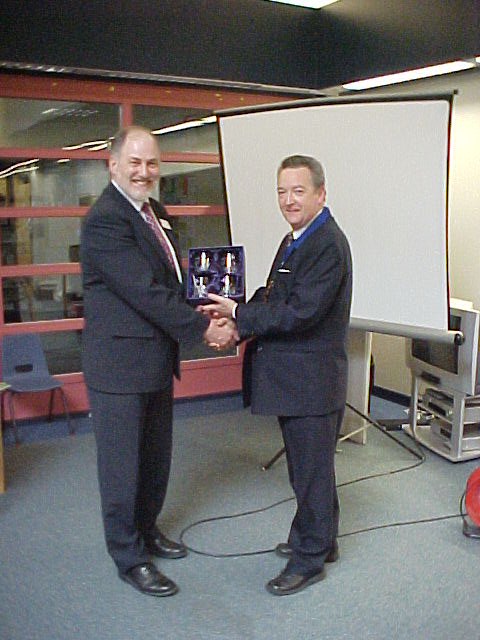 [Richard Jones (left) receiving a small gift from Branch Chair Richard Lovering,]
8.0 Members Items:
Some urgent members items were announced for information. The retirement of Chris White from H&S practice was noted – card available to sign for all those who knew him.
9.0 CLOSURE (& Dates of next meetings)
9.1 Next Branch Meeting: 13 May DSE: Working in New Environments: Hot Desking; Home Working; New DSE ACoP Marilyn McDonald, West of Scotland Clerical Branch of the Communication Workers Union
9.2 Roger Midson Challenge Trophy: 21 May: Target Shooting: Fenton Barns
9.3 Secretary’s Sipper Golf Tournament: 28 May: Perth North Inch.
9.4 Next District Meeting: 3 June: Site Visit: Perth Fire Brigade Training Centre.
|
Max Bancroft, MRSC, MIOSH Branch Secretary |
Richard Lovering, FIOSH, RSP Branch Chair |
