Minutes of Meeting
148th Edinburgh Branch Meeting
Donaldson’s College, Edinburgh – Thursday 8 January 2004
SEDERUNT:
M Bancroft S Hunter J F Anderson I M Munro G Pearson S Boucher K Darling D Morrison M Scott-Smith M Gorman D Duff S Holland G Millar D Richardson M Kincliffe(?) J Brannigan P K Murray R Robertson D Bond A Emerson S Page P Graham S McMorland S Daly J Hepburn P Quill A Diment V Stewart C Wilmott P Mainka A Pittendrigh T Mellon A Thomson W Lyon J McCraith L Young R McLean J Davies G Lyall C Castell R Brownlee J Green J Cordiner R Thomson R Lovering C BlackAPOLOGIES: K Lloyd, M Johnstone, A Sharman, N Robertson, A Reid, G McNab, R Stainton, D D Sinclair, D Calkwell, B Byrne, B Davies, D Brown, R Hunter.
1.0 CHAIR: Richard Lovering was in the Chair, and outlined the Safety and Parking arrangements.
2.0 MINUTES OF PREVIOUS MEETINGS (October 2003)
2.1 Receipt: Had been received OK.
2.2 Accuracy: Proposed by Liz Young; Seconded by Renny Thomson.
3.0 MATTERS ARISING NOT ON AGENDA :
3.1 HQ: European H&S Week: Poster Competition: HQ had published calendar cards for 2004 with some of the national winners featuring on them – these included Daniel Green of Murieston’s poster.
3.2 November Transport Seminar: report, including speaker’s presentations, was now available on the Branch website. A member working in Kazakstan contacted the Secretary to obtain details of the speaker’s notes and circulate them in the oil sector where he worked..
4.0 CORRESPONDENCE
4.1 Scottish Borders Safety Forum: December 2003 Newsletter. .
4.2 IOSH Conference 2004: Harrogate: April 20-21
4.3 IOSH HQ: HSE Power Point Presentation on Slips and Trips in CD form. Available for interested members to use in their workplace. Can be customized to some extent. Anyone who wants a copy email the Secretary (but note it is 3.2 Mb). IOSH/HSE would like feedback from anyone using it.
4.4 IOSH HQ: Membership: 767 Branch members from a national total of 26944
Corporate: 342 Associate: 222 Tech SP: 94
Construction: 181; Public Services: 150; Environmental: 92; Offshore: 47; Healthcare: 38; Fire risk management: 21; Consultancy: 18; Education: 19
4.5 Fife Chamber of Safety: Agenda & Minutes
4.6 Stevenson College: New Lecturer post in Health and Safety: contact HR Department.
4.7 Standard Life: Need temporary Facilities Safety Officer until vacancy is filled permanently plus two permanent posts.
5.0 BRANCH EDUCATION DEVELOPMENT ADVISOR - Liz Young.
Liz reminded members of the importance of CPD which will become compulsory next year.
6.0 SPECIALIST GROUPS
6.1 PUBLIC SERVICES – Marion Johnstone: Nothing to report.
6.2 CONSTRUCTION - Roddy McLean.
Roddy noted that CITB were having a Construction Skills Seminar in the Roxburghe Hotel next Wednesday, that AON were holding an Employers Liability Insurance Seminar at Murrayfield on Thurs 16 January and that Anderson Stathearn were holding a H&S Breakfast at Dynamic Earth on 17 Jan – to be addressed by a Minister.
6.3 FIRE RISK MANAGEMENT - Dave Sinclair: nothing to report.
6.4 HEALTHCARE - Martin Scott-Smith: nothing to report.
6.5 ENVIRONMENT – Julian Davis.
Julian noted that the various ACoPs following on from DSEAR were now out. He also commented on a recent investigation into unshredded paper waste which had shown companies were throwing out a lot of confidential and potentially damaging information.
6.6 OFFSHORE - Tam Boyd: nothing to report.
6.7 RAILWAYS - Need a representative
6.8 CONSULTANCY - Derek Cawkwell: nothing to report.
6.9 SAFETY SCIENCES - Steve Boucher: nothing to report.
6.10 TELECOMMUNICATIONS – Graeme Lyall.
Graeme noted that there would soon be a new IOSH passport scheme for the telecoms industry.
6.11 EDUCATION – Allan Dick (of Edinburgh’s Telford College) has been proposed as Branch Representative for this SG.
7.0 FORTH and TAY DISTRICT
February meeting will also be the AGM.
8.0 MEMBERS ITEMS
8.1 Death of Member: reported with regret that John Glen (Lecturer at Falkirk College) had died.
8.2 Presentations:
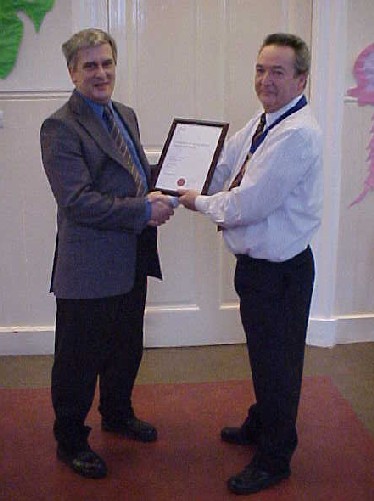
Julan Davies: Corporate Membership
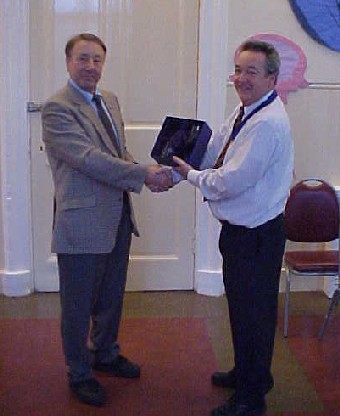
Jim McCraith: pair of engraved tumblers for his services to the Branch on the Executive Committee.
8.3 Allan Thomson – Central Training Services – 10 Minute presentation
CPCS = Construction Plant Competence Scheme
Allan presented detail of the changes which have taken place as and from the end of 2003 with respect to "Tickets" to drive and operate construction equipment, whereby the CITB National Plant Operators Registration Scheme, the CTA Certificate of Training Achievement for Construction Plant Operators, and the CITB LANTRA Awards will all be replaced by the one certificate.
This is not at this point a Legal requirement, but a number of employers are using the CPCS certificate as the only form of proof which they will accept to demonstrate the competence of the individual to operate the equipment on site.
The system has been devised in accordance with the agreed requirements of the Construction Federation, The Federation of Master Builders, The GMB TU, and the equipment manufacturers and the new CPCS plant card is available to cover 65 categories of plant.
Attainment of the CPCS card will follow a number of steps –
- Undertake practical training and pass the competence test for a specific piece of plant.
- Receive a "Trained Plant Operator" card (RED) which will be valid for 3 years and a logbook
- Achieve N/SVQ Level 2 or relevant N/SVQ units in specialised plant machinery operations
- Record 300 hours in the logbook of operating each type of equipment indicated
- Gain confirmation signatures for the employer to verify competence
- Pass the CITB Health & Safety Test
- Receive fully qualified CPCS card (BLUE or GREEN) valid for five years
Blue cards are issued where there is an N/SVQ specific to the machine category
Green cards are issued where the category does not have an associated N/SVQ
Renewal of issue of cards –
- The red – "Trained Plant Operator" card is can NOT be renewed – it is expected operators will progress
- The blue/green cards can be renewed every five years involving –
- Pass the CPCS/Plant Health & Safety Test
- Demonstrate 300 hours of experience per category – signed off by your employer or take an operator assessment.
- Confirmatory competence indicated by your employer
Logbooks – NB: there will be an audit of 10% of logbook each year
9.0 GUEST SPEAKER
Albert Thomson BA MICDDS MEPS - of Rubicon Response Limited – Dealing with Disasters
The speaker was introduced to the group by Jim McCraith following which Albert provided a brief insight into his background to illustrate just how he managed to be so qualified in the topic. Of his 13 years within the Police Force, 9 years were spent in the Police Force Control Centre and this period included the time when the Piper Alpha disaster happened.
He had experienced perhaps too many disasters to list covering quite a breadth of incident but apart from the Piper Alpha two of the major incidents involved nuclear material being transported.
What is a "Disaster"?
Albert asked the group just what they may include within a definition of a Disaster – bearing in mind we had all heard of a number over the Christmas period just past and it became obvious that the definition would often be based on the standpoint from which it was viewed, but he then offered the two following definitions as perhaps being the most representative-
" A disaster is a sudden event, such as an accident or a natural catastrophe that causes great damage or loss of life"
or
"A serious, unexpected and dangerous situation requiring immediate action."
"Disaster" - Facts and Figures
According to NatWest Insurance 75% of firms hit by a major fire end up closing.
According to the BCI 80% of companies suffering a major disaster go out of business within 13 months. – This is perhaps borne out by the two major incidents within Scotland over the past = Lockerbie – PanAm no longer in existence; Piper-Alpha where Occidental have disappeared
Following the Manchester bomb, 650 businesses were displaced, many losing their foothold in the city as a result.
Both of the Scottish incidents resulted in a Paradigm shift but to quote Tolley’s Handbook –
"The events of 11 September 2001 in New York has seen a paradigm shift in the thinking, planning and perception of ‘man-made’ disaster."
This was after all a major event which had heavily involved all of the emergency services including the Police, The Fire Brigade, The Ambulance Service and the Armed Forces, as well as all of the ancillary voluntary and civil services.
It created a "new thinking" – one which could affect all forms of business
UK Resilience
There is a Government headed project aimed at considering the UK resilience to major disasters on both a strategic and a local level which are aimed at looking to see what can be in place to deal with disasters AND to ensure the affected companies stay in business, such that their aims are -
- To reduce susceptibility to major incidents of all kinds by reducing their probability of occurring and their likely effects, responding effectively and efficiently when they occur, and building institutions and structures in such a way to minimise the possible effects of disruptions upon them.
- Resilience aims at addressing all forms of incident with a coherent framework of procedures at all levels. i.e. Providing a basic set of signposts.
- Building a comprehensive capability for anticipating major incidents.
- Preventing them where possible, or taking actions to mitigate their effects putting in place legislation where this may help. The first steps on this line being the introduction of COMAH Regs. Which were the necessary update to the original CIMAH Reg which had little effect.
- Preparedness for emergencies determined by a risk analysis.
- A commitment to business continuity planning.
- Resilience is a live process, and should be continually reviewed and changed to incorporate new changes and differing factors.
- Needs to be incorporated into public policy formulation and delivery.
- Needs to be part of our public culture across all sectors and levels.
DEMS = Disaster Emergency Management Systems
A number of Companies in the past have has some form of Emergency plans in place, but all too often they failed to have Business Recovery elements within them – they were only looking to control the disaster and not recover from it.
DEMS entails four branches
- Occupational Health and Safety along with Control Measures. – This prevents the incidents on a day to day basis
- Security and Emergency Management including mitigation. – This links Security into the picture as so many more incidents are now being man-made and are very costly.
- Business Continuity Management and Disaster Recovery. – Previously had been seen as much further down the line without due consideration
- Insurance, Investigation, and Review. – Some insurance Companies are now insisting on the existence of a full DEMS for continued cover.
The aim of a DEMS and true crisis management is to –
- Bring a crisis under the control of those tasked as Incident or Crisis Managers.
- Permit Incident or Crisis managers, through their actions, to shape the developing course of the crisis and thereby bring about an acceptable solution.
Whilst some of the reasons for having it are –
- Legal/Legislation. - COMAH
- Corporate. – It was fairly obvious that P&O did not have one in place
- Insurance. – As stated some companies are making it compulsory
- Social. – "Bad" news travels fast and is well reported = 2 plane crashes over Christmas
- Environmental. – As under COMAH – the polluter pays
- Humanitarian. – Knowing you have done everything to keep your staff safe.
Definition of a Crisis
Here we firstly need to recognise there is a difference between an Incident and a Crisis and as such a CRISIS is -
- Any event which has wider or long-term implications and has an ongoing effect on the ability of the company to carry out normal business or damages reputation i.e. man-made or natural disasters, serious crime, product contamination etc."
- Effective crisis management is used throughout a successful business day to day and is linked into making decisions under pressure.
- Helps mitigate the impact upon safety of the public and/or our people, the environment, the operating efficiency of company assets, brands and of course reputation.
- As for reputation, don’t do a "Ratner" - ensure you employ the right person
Consider the differences between the Routine and a Major Incident
- Routine - familiar. Major - unusual.
- Recognised tasks and procedures. Unfamiliar procedures.
- Simple co-ordination. Multi-agency.
- In-house comms. Complex comms.
- Familiar terms. Unusual terminology.
- Adequate resources. Diverse resources.
- Local press/media. National media.
- Orderly procedures. Limited control.
- Limited scale/impact. Major scale/impact.
As such the Characteristics of a Crisis are –
- Element of Surprise.
- Panic – which may give rise to freezing
- Initial loss of Control, with no immediate solutions.
- Compression of Time, where the events outpace initial response whilst Escalating Events that become more intense as time goes by.
- Important interests at stake.
- Lack of resources at early stages.
- Insufficient information when most needed. and often too much information, - an even balance is needed.
- Internal conflict & confusion., where intense Scrutiny will often push Key players iinto developing a Siege Mentality.
- Regular decision making process disrupted and there is an urgent need for rapid decision making.
Integrated Emergency Management
A range of acceptable resolutions depending upon the individuals involved, their experience, the cause and effect of the incident and it’s location. In other words, we don’t know what the right answers will be.
There needs to be a risk analysis
- The need for a risk analysis is important to establish the internal / external factors which may affect your business and / or its operation.
- Evaluates risk present in local environment. Including the consideration – what if a major incident happened locally and you were evacuated and kept out of your premise for 12 days – how would you survive – what would you need to do?
- Identifies measures taken to mitigate the risk and identifies measures that need to be taken.
What Plans Should Contain
- Terms of Reference.
- Aims of the Plan.
- Review Record.
- Amendments Record.
- Distribution List.
- Contents.
- Abbreviations/terms used (include those used by the Emergency Services).
- Identify key people by position not name.
- Initial Response.
- Evacuation procedures.
- Notification Process kept as generic as possible (who to tell).
- Specific Actions.
- Structure, roles and Responsibilities.
- Media Response and who does it (they need specialist training for this).
- HR Response.
- Environment.
- Checklists.
- Equipment etc.
- Appendices.
- Deal with the Effects – (needing the plan means normal systems have failed).
- Embody the same Principles as those used by the Emergency Services.
- Be Flexible to Individual Circumstances.
- Initial Response to be similar on each occasion.
- Same basic management structure.
- Subject of focus and training.
Initial Response (from the Emergency Services Handbook)
Do not get involved in rescue work but assess the situation.
Provide the appropriate information (CHALET) – see details below.
Is there a need to shutdown systems/services?
Activate fire alarm in event of fire.
Seek further instructions.
Do not return to incident unless safe to do so.
- C - CASUALTIES
- H - HAZARDS (Actual & potential)
- A - ACCESS
- L - LOCATION
- E - EMERGENCY SERVICES
- T - TYPE OF INCIDENT
Notification Process
- Obtain name of person calling.
- Ascertain nature of incident (CHALET).
- Inform Duty Manager.
- Inform Fire Brigade (even if fire alarm activated).
- Inform Police.
- Inform Ambulance.
- Remain at post unless site evacuated.
- Maintain link with Duty Manager until his/her arrival.
Evacuation (Fire)
- Switch off equipment being used.
- Close all doors and windows behind you.
- Only pick up belonging immediately at hand.
- Leave building immediately.
- Do not use lifts.
- Do not move to other parts of the building.
- Proceed to Assembly Area.
- Reception Staff take "Visitor’s Book".
- Do not re-enter unless instructed to do so.
- Provide shelter in event of inclement weather.
Principles of Command & Control
- Deal with the Effects.
- Embody same Principles (CHALET).
- Be Flexible to Individual Circumstances.
- Initial Response to be Similar on each Occasion.
- Same Basic Management Structure.
- Subject of Focus and Training.
Three tier response structure =
Operational Tactical Strategic
Each of the Emergency Services will operate to – Command – Control – Co-ordinate as there is no one agency in overall control
Operational – An inner cordon will be created, which is often the boundary of the premise
Tactical – Another cordon (Outer cordon) will be created to keep the public out under the control of each of the services – the controller wearing a chequered jacket – red/white – Fire, green/white – Ambulance, blue/white for Police
Within each of the cordons control points will be set up –
- Incident control point (often provided by the Company)
- Casualty clearing and body holding point for ambulances
- Rendezvous point controlled by the emergency services
- Media Liaison point, run by the Police with the Company present
- Emergency Control Centre often set up by the Company
Whilst off site further centres will be created –
- Casualty bureau set up by the Police to account for everyone
- Hospital co-ordination to ensure each emergency centre can cope
- Rest centres – to provide for the needs of those involved
- Temporary Mortuary – large space required if a major incident
- Relative reception centre – the next of kin will not stop at home and wait
- Media Briefing centre – Police will brief on a regular basis
- Local Authority Emergency Centre – under the local authority
"Close Out"
- Brief the Team.
- Outstanding Team Actions?
- Debrief interested outside parties.
- Recovery/Restart?
- Liaise with BST.
- Understand HR issues
- Final Media Statement.
- Keep staff informed.
- Capture/record all information.
- Team Debrief.
- Review Procedure.
- Close out review and report.
After the Event
- Internal debrief / inquiry.
- HSE Report.
- Public Inquiry.
- Inquest / Fatal Accident Inquiry.
- Criminal Prosecution.
- Trial by Media.
- Human Rights Act Implications.
- Disciplinary proceedings.
Summary
The Turnbull Report places some new requirements on the board of Directors –
- Financial and human implications of business interruption, employment implications and reputation loss.
- Requires that the board of a listed company adopts and maintains a system of internal control to safeguard the shareholders’ investments and the company’s assets.
- Decision making processes at strategic, operational and tactical levels of management.
- Not the exclusive domain of senior management and needs to be adopted through all layers of an organisation.
- Ensuring long term corporate survival.
Whilst the Civil Contingencies draft bill seeks to create a statutory duty on the part of local bodies to develop contingency plans for dealing with a wide range of emergencies, and provides powers for the government to make regulations to deal with proclaimed emergencies and whilst the current recent news of action on this front was specifically for England & Wales – Scotland will do their own
Rubicon Response Limited believe –
"No matter how ready you think you are,
you will never know when the moment has arrived,
until that moment has past!"
10.0 DATES OF NEXT MEETINGS
10.1 District: 5 February 2004: AGM and Managing Health and Safety in Forestry: Mr Jim Dewar - Safety Officer: Forestry Commission. Free Buffet from 6.30pm
10.2 Branch: 12 February: New IOSH Membership Structure & Strategic Alliances with other related organizations: Hazel Harvey, Head of Professional affairs: IOSH.
11.0 CLOSURE
The Chair wished members a safe journey home.
