Close this indow to return to previous page
MINUTE
146th Edinburgh Branch Meeting
Donaldson’s College, Edinburgh – Thursday 9 October 2003
SEDERUNT:
M Bancroft K Flockhart J Davis R McLean A James T Smith D Jones J McCraith D Millar K Lloyd A Diment I Wilson D Bond C Wilmott A Thomson D Gillespie D Duff M Scott-Smith R F Hunter B Byrne P Brown S Daly A G Dick B Campbell R Walker R Lovering G Horsman J Hepburn P Graham C Spearling N Doherty S Page A White H Gardner T Sayer J Cordiner A Pittendrigh T Mellon C Black D R Staines L Crichton N Ollwer
APOLOGIES: Bob Bertram, William McCafferty, Joe Brannigan, David Brown, Steve Boucher, David Richardson, Chris White, Dick Morrison, Bob Stainton, Graeme Lyall, Andy Sharman, David Sinclair, Karen McDonnell.
1.0 CHAIR: Richard Lovering was in the Chair and outlined the arrangements for Safety, Parking, and Attendance Certificates
2.0 MINUTES OF PREVIOUS MEETINGS (Sept 2003)
2.1 Receipt: These had been received by those expecting them.
2.2 Accuracy: They were agreed a true record proposed by Jim McCraith and seconded by Julian Davis.
3.0 MATTERS ARISING NOT ON AGENDA :
3.1 HQ: European H&S Week: Poster Competition for Children – approx 45 entries had been received and would be judged later today – results to be posted on website over weekend.
4.0 CORRESPONDENCE
4.1 Scottish Borders Safety Forum: Gear Up Campaign
4.3 HQ: Asthma Workshop (POOSH) 14 Oct 2003, London (leaflets available)
4.5 CCA: Safety & Corporate Criminal Accountability: Conference: 23 Oct 2003: Glasgow (leaflets available)
4.6 Fife Chamber of Safety: Agenda & Minutes
4.8Fourth Behavioural Safety User Conference: Manchester Conference Centre on October 30th 2003.http://www.rydermarsh.co.uk/conferencehome.html
4.9 HQ: Reminder that AGM, Annual Dinner and Awards Ceremony were on 12 November in the Walkers Stadium, Leicester.
4.10 HQ: The September meeting of IOSH Council had considered the proportion of income that was generated by subscriptions (29%) and also the level of subscriptions with comparable professional bodies (£45 pa lower). Council had decided that there would be increases in subscriptions in April 2004 and also April 2005 to aim for 50% income from subscriptions and a level closer to that of other bodies.
4.11 HQ were looking for members with experience of maintaining websites and serving on a Branch Executive to serve on the Web Strategy Working Group – initially half a day a month to get things going.
5.0 BRANCH EDUCATION DEVELOPMENT ADVISOR - Liz Young. Report on the annual BEDA meeting at HQ on the 25th September. Amongst other issues the new membership structure approved by Council had been described along with the requirements for entry. This would be dealt with in more detail at the February meeting with Hazel Harvey.
6.0 SPECIALIST GROUPS
6.1 PUBLIC SERVICES – Marion Johnstone: Marion reported that the National Social Care Safety Forum was developing links with IOSH and PSG were looking for interesting links to put on their website.
6.2 CONSTRUCTION - Roddy McLean. Roddy reported on a Safety Health Awareness Day in conjunction with the HSE at Stirling on 18 November. This was important for companies employing sub-contractors.
6.3 FIRE RISK MANAGEMENT - Dave Sinclair: Nothing to report.
6.4 HEALTHCARE - Martin Scott-Smith. Martin reported on the Review taking place in the NHS towards achieving a healthier Workplace involving self-audit and peer review. Part of the strategy involved the creation of an integrated management policy.
6.5 ENVIRONMENT – Julian Davis. Julian reported he was sending out a monthly news letter to members of the SG in the Branch covering a variety of environmental issues.
6.6 OFFSHORE - Tam Boyd: Nothing to report.
6.7 RAILWAYS - Need a representative
6.8 CONSULTANCY - Derek Cawkwell: Nothing to report.
6.9 SAFETY SCIENCES - Steve Boucher: nothing to report
6.10 TELECOMMUNICATIONS – need a representative
6.11 EDUCATION - need a representative
7.0 FORTH and TAY DISTRICT
No report
|
8.0 MEMBERS ITEMS
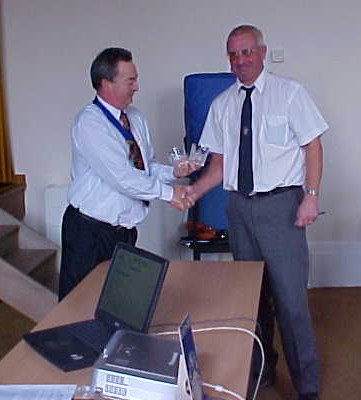
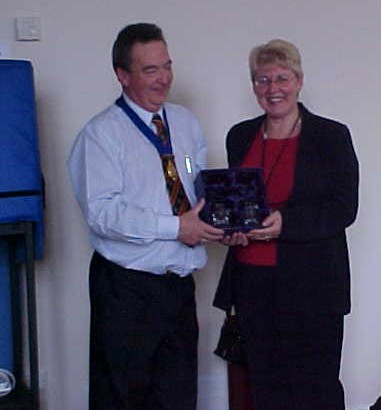
8.1 Presentations: The Chair presented Roddy McLean with a pair of engraved tumblers for his services to the Branch on the Executive Committee. To his surprise the Chair was then presented with a pair of tumblers for his services on the Executive Committee by Marion Johnstone, Vice-Chair.
8.2 The Chair reported details of a recent legal case concerning an accident while driving at work resulting in serious injury to the on-call employee. This covered issues such as having a safe system of work and implementing it, dealing with the risks from work related driving and hours of work, not allowing the 11 hours rest required by the Working Time Regulations, inadequate number of on-call employees, etc.
9.0 GUEST SPEAKER
Graham Horsman of Praxis42
Regulatory Synergies between Fire safety & Scottish Building Regulations
The Chairman then briefly introduced the speaker as Graham Horsman, who was well versed in Fire safety having worked his way through the ranks of front-line fire fighting prior to going on to the Fire College to teach the subject to fire staff. Graham had then moved on to work for the Home Office within the Fire Prevention legislation team and reminded the members present that Graham had in fact made a Fire presentation to Edinburgh Branch in February of that year.
Graham started off by indicating the agenda which he would be using for the session as –
- Fire safety Legislation reform
- Overview of a new Fire Alarm code of practice which would require only certificated installers to be used
- High sensitivity smoke detection systems
Proposals for fire safety legislation reform
Within the regulatory reform act of 2001 annex D identifies 51 areas of legislative control, Fire being but one of them.
The Department of the Deputy Prime Minister issued a consultative document setting out the program of reform for Fire Safety Legislation. The reform includes the repeal of some 77 pieces of fire legislation, the oldest being the Fire Prevention (Metropolis) Act 1774, in which only sections 83 and 86 are still effective. Section 83 enables an Insurance Company to force a claimant to use the pay-out to do the work it was paid out for. Section 86 stipulates you cannot be prosecuted for an accidental fire.
The intention is for ONE simple Fire Safety Regime to apply to all places of work and for the actions to be Risk Based as we are now used to for all other forms of H&S legislation, where the duty will be defined to maintain the fire safety conditions stipulated in the building regulations whilst the Fire Authority responsibilities will be just to Police the Act and not act as Certification agent etc.
The responsible person may be the employer, the occupier or the building owner, but it will include the duty to maintain the condition even in empty buildings. It will also include for the first time – the self employed, but it will not apply to home workers. It will also include voluntary workers – i.e. Village Halls, Scout Halls, etc
Employees will be required to tackle fires and there will be a duty to minimize risks to fire fighters.
The responsible person will be required to appoint one or more competent persons to assist and there is indication that it is accepted these individuals may be external consultant, but if they are` appointed from within his employees, they must be given adequate time to do the job.
The responsible person must nominate persons to carry out specialist duties, such as fire marshals, and then ensure they are adequately trained.
There will be a duty to provide parents of minors with information on fire risks relative to the building.
Each occupier within a shared multi-occupied building has duties to consult with each other.
Employees will have duties to take reasonable care of themselves and others who may be affected by their activities and a duty to notify their employers of any matters affecting the safety of themselves or others
|
Timescales = Consultation – summer 2002 (3 months), Review and amendment – Autumn 2002, Parliamentary process – summer 2003, New legislation effective – Mid to late 2004
New Fire Alarm code of Practice
BS 5839 – effective October 2003
The old standard has been updated in line with new technologies, together with what has now been accepted as standard custom and practice over the years. In so doing it has become aligned to LPS 1014, guidance from the FSAB and certification to BAFE¬SP 203.
There are a number of cross references to –
- BS 5839-6 Fire Detection & Alarms in dwellings
- BS 7273 Extinguishing systems
- BS 5839-8 Voice systems for fire evacuation (considered to be a faster response)
- BS 7807 Integrated systems tied into Building Management Systems
- BS 6266 Electronic Data Processing Areas
- HTM 82 Hospitals which may have several level of alarm prior to going to evacuation
The standard` now also includes –
- Carbon Monoxide detectors
- High Speed Smoke Detection – Aspirating smoke detection
- Video which monitors and identifies smoke and flame
The smoke detection systems now include
L1 – Full protection which covers ALL areas = smoke detectors everywhere
L2 – Defined parts = detection only in selected areas
L3 – Escape routes = smoke detection on routes used for fire exits
L4 – Escape routes comprising only circulation areas = only the main parts of the escape routes
L5 – Designed to suit specific fire safety objective
The standard places a requirement to exchange information:
- The purchaser/user
- The enforcing authority
- The property insurer
- The designer/ installer/ commissioner
Such that any variations
- Must be agreed amongst interested parties
- Must be listed in the system certificate
4 Certificates will be required for the system - possibly 5, covering -
- Design
- Installation
- Commissioning
- Acceptance
- Verification
The level of unwanted alarms (Unacceptable rate of false alarms) has been defined as -
Systems with more than 40 detectors:
- No more than one false alarm per 20 detectors pa
- No more than two false alarms per device pa
Systems with less than 40 detectors:
- No more than two false alarms pa
Alarm output changes =
- The normal 65db sounder can be reduced to 60db for – stairways, small enclosures, specific points of limited extent and there is no minimum for small areas of less than 1 square metre
- Visual alarms to be used where the noise level is above 90db, which must be readily visible, will flash between 30 and 130 times per minute, preferably red, intense enough to attract attention, but not cause glare
- Outputs for person of impaired hearing (vibrating pillows or vibrating pagers)
- Staged alarms – such as the lower floors of a multi-occupied building can be considered but early consultation with enforcing authorities is necessary and then only where sufficient number of trained staff and there is a requirement to time out
Travel distance to manual call points can be extended to 45m but this may be reduced to 25m where occupants are of limited mobility
Electrical circuits powering the system are to be considered a critical path – and ccurrently only MICC fits the new requirement = (simultaneous heat exposure (830°C), mechanical shock (15mins) and water). There are changes to the power supply, in that it must be -
- Via isolating device from load side of main incomer
- Dedicated solely to fire alarm
- Double pole isolation
- Batteries to be date marked (max 4 years)
The system maintenance requirements will be:
- Weekly by user different Manual Call Point every week
- Monthly by user – Generator test 1 hour
- By competent person (normally fire alarm company)
- Determined by risk assessment
- Maximum 6 months
Whilst the user responsibilities include:
- A single named person
- Check fire alarm panel every 24 hours
- Arrange for testing and maintenance
- Ensure system log book up to date
- Instruct relevant occupants/operators
- Ensure false alarms are limited
- Ensure MCP are unobstructed
- Hold spare MCP glasses
- Investigate, action and pre-alarms
HSSD - High Sensitivity Smoke Detection
Graham then went on to demonstrate some of the issues relating to HSSD and to show the potential benefits of such a system
- Normal smoke detectors can be unreliable in high air flows as the air will pass by too quick to register any smoke present, especially where air-conditioning units may be pulling the actual air movement away from the detectors.
- Some layouts not conducive to maintenance – particularly for high ceiling areas where it becomes exceptionally difficult to gain access to the point smoke detectors
- Some protection needs very early warning and in particular expensive electronic equipment which if problems can be detected early enough they can be switched off and the problem adequately controlled without loss.
Graham indicated that despite objections by some of the managers associated with some very expensive electronic set-ups, physical fire lit amongst the tall cabinets containing the electronics equipment did not register as a fire and this was again demonstrated in the recent past where a flash fire in a room failed to raise the alarm from point detectors.
However when a system is installed to monitor the air being drawn into the air conditioning units by being drawn into a tube fitted across the front of the air intakes, the alarm can be seen to perform very well. Graham then further demonstrated this by use of a small test-bed unit which registered fire from its first stages purely from an overheated cable which did not even create smoke
Summary
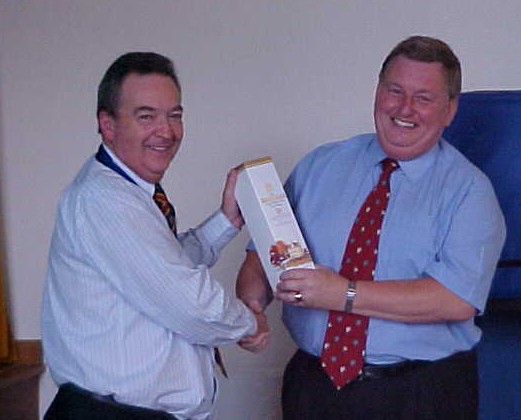
Graham then apologised for the speed at which he had had to go through the detail as the content of his presentation should perhaps have occupied more than one session. There then followed a short question session following which graham was presented with a token of appreciation by the Chair.
10.0 DATES OF NEXT MEETINGS
10.1 Branch: 11 December: Asbestos Action Plan: Elizabeth M Sneddon MIBiol., Cert.Occ.Hyg., LFOH, FFB Asbestos Consultant OHSAS
(No November meeting due to Transport Seminar)
10.2 District: 6th November: Good Vibrations: Mr C Collins: C/Chec
11.0 CLOSURE
Members were encouranged to mingle over a cup of tea and the meeting was closed.
|
Max Bancroft, MRSC, TechSP
Branch Secretary |
Richard Lovering, FIOSH, RSP
Branch Chair |
